
Caddie's Gear Advisor
Curated for today's 78°F · Clear
Low-Spin Wind-Cheating Balls
Penetrating ball flight that holds its line in the gusts
Wind-Blocking Layers
Cut the chill and drag without choking your swing
Low-Launch Drivers
Lower spin off the tee for control in a crosswind
Secure-Fit Caps
Stay-put headwear built for a blustery round
Your Golf Trip, Handled
The Ultimate Golf Trip Planner
Everything you need to play TPC Scottsdale Stadium Course — from booking your flight to checking in course-side.
Best time to golf in ArizonaCourse-Side Stays
Luxury hotels, resorts, and stay-and-play packages just minutes from the first tee.
Flights
Compare fares across 700+ airlines for the best route to your tee time.
SUV Rentals for Golf Bags
Spacious vehicles with room for clubs, bags, and your foursome.
Travel Insurance
Coverage for medical, weather delays, and gear at your destination.
TPC Scottsdale Stadium Course: Course Intelligence
Signature Setup
I teed off at 7:30 on a dry November morning, 54°F with the McDowell Mountains still pink behind the 1st tee, and the air had that thin high-desert stillness that flatters a golf swing. By the time I reached the back nine the temperature had jumped twenty degrees and the wind had woken up — and that swing, in two and a half hours, is the whole story of how the Stadium Course plays.
Tom Weiskopf and Jay Morrish built the Stadium Course in 1986 on flat Sonoran desert at roughly 1,510 feet of elevation, and Weiskopf came back in 2014 to firm up the bunkering and greens. It is a public TPC course that hosts the WM Phoenix Open every early February — the loudest, most attended event on the PGA Tour. From the back tees it measures about 7,261 yards to a par of 71.
Hole-by-Hole Wind & Playing Lines
Hole 11 (#1 handicap, par-4, 469y from the back). The hole that quietly wrecks scorecards while everyone is talking about the 16th. It runs into the prevailing afternoon SW wind, and on a 12–15 mph breeze I hit driver and still had a 4-iron in. Aim right-center off the tee to take the left fairway bunker out of play, and accept the middle of the green — anything at a left pin into that wind drifts long-left into trouble.
Hole 16 (par-3, 163y). The signature shot in golf: a short iron to a green fully enclosed by stadium grandstands during the Open. The Coliseum blocks the wind almost completely once you're inside it, so the number is the number — but play it on a normal day and that same 163 yards sits exposed to a crossing desert breeze. Tiger aced it in 1997, Sam Ryder in 2022, and the noise is real.
Hole 17 (par-4, 332y). A drivable par-4 with water down the left the whole way. Downwind in the morning calm, long hitters take a rip at it; into the afternoon wind I lay back to a full wedge and aim at the right edge, because a pulled driver is wet and a bogey here in front of the 18th is a round-killer.
Green & Fairway Characteristics
Winter overseeding keeps the Bermuda fairways tight and green from October through April; once the rye burns off out of season the Bermuda firms and the ball releases for yards after it lands. Tournament week rolls the bentgrass greens to roughly 11 on the Stimpmeter — firm, fast, and pitched with the kind of subtle desert tilt that shows itself in flat morning light and hides under midday glare. Slope reaches about 138 from the tips. Because the inward holes meet the prevailing wind head-on more often than the front, the round is settled on 11, 15, and 17 — not the famous 16th. The takeaway on these firm surfaces: a held drive into the wind beats a high approach the breeze can swat down.
Seasonal Weather Pattern
Start with the desert fact that drives everything: this is high Sonoran heat country, where June through September pushes highs routinely over 105°F and the afternoon thermals make a midday round an endurance test. Scottsdale's season therefore runs backwards from most of the country — November through April is the peak, with daytime highs in the comfortable 65–75°F band and mornings that begin cool and calm. The Phoenix Open's early-February slot is a genuine coin flip: usually warm and still at dawn, occasionally a cold, gray, rain-soaked day nobody pictures when they think of Arizona. NOAA puts the diurnal swing at 25–30°F between a winter dawn and the afternoon, and that single number matters more than any other when you pick a tee time. I won't pretend to know how the course bakes out in a July afternoon — I've only had it in the cool months — so I lean on those records, not memory, for the summer read.
Local Play Tips
One thing the yardage book won't tell you: at 1,510 feet of elevation the ball carries noticeably farther than it does at sea level, and on a warm, dry afternoon the thinner air adds even more. I club down about half a club on full shots once the temperature climbs past 80°F, and I trust the carry numbers a lot less than the firmness of the landing area. The other local truth is wind timing — the desert is dead calm at dawn and reliably breezy by late morning, so the front nine in the first wave is a completely different course than the same nine at 1 p.m.
Pre-Round Weather Workflow
The 7-day G-Score at the top of this page is the first thing I check, and on the Stadium Course it answers one question: does your tee window beat the late-morning thermal? Lock that in three days out, because the gap between a calm-dawn slot and a 1 p.m. slot is worth 8–12 points here. On the day itself, the windExposure panel tells you direction — and a SW reading is the one that matters, because it stands holes 11, 15, and 17 dead into the breeze that already decides this round. When it's blowing, give yourself the right-center lines off those tees and take an extra club coming home. One last dial: if the high tops 85°F, the thin afternoon air carries the ball farther, so trust one less club than the yardage prints.
Related Reading
Before you tee off at TPC Scottsdale Stadium Course

America's 20 Windiest Golf Courses: A G-Score Wind Analysis
We ranked America's 20 windiest golf courses using G-Score wind penalty data. See how coastal gusts and prairie gales reshape playability scores.
Read Story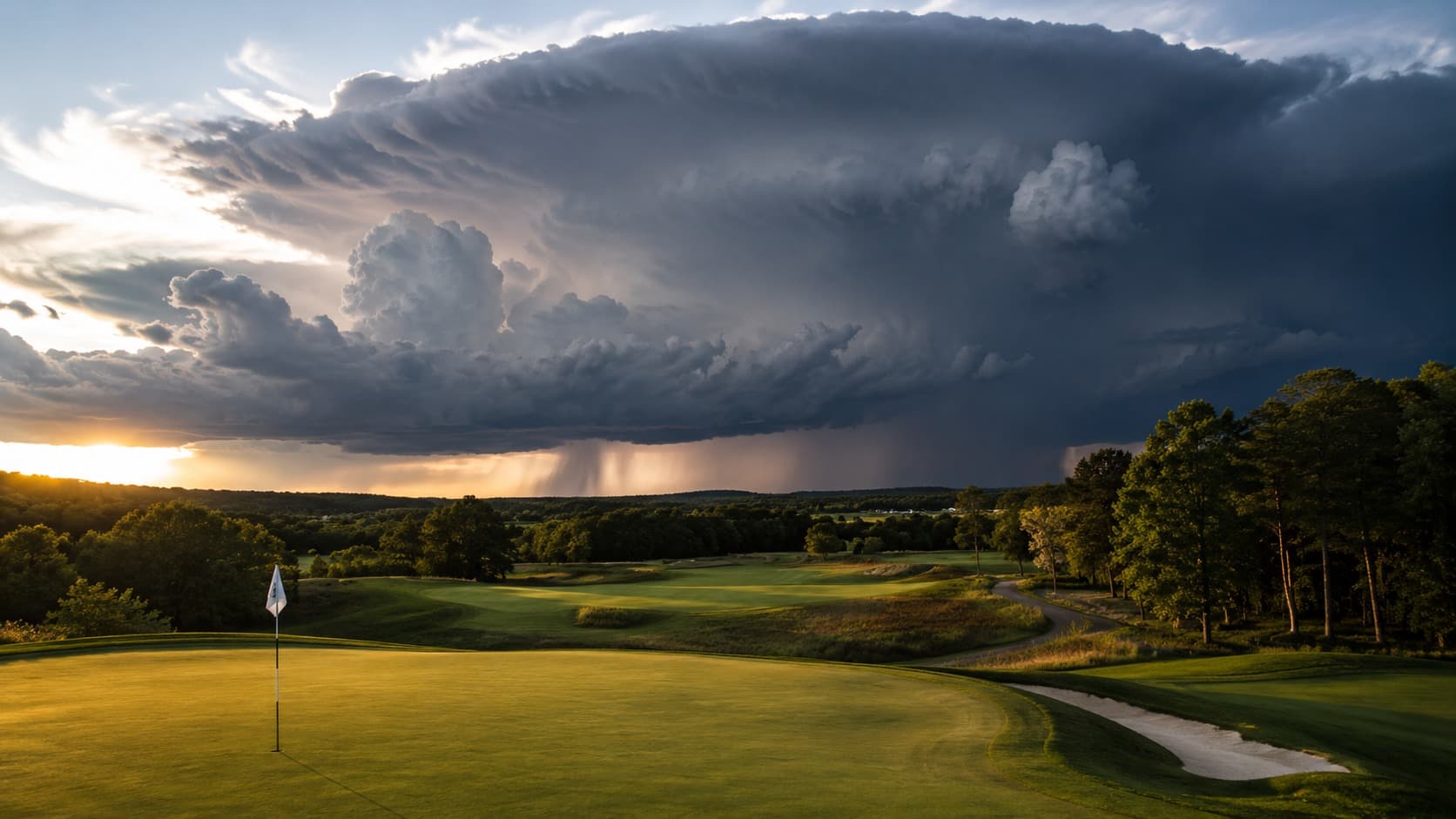
The Three O’Clock Storm: Reading Summer’s Convective Cycle to Protect Your Round
A 40% chance of afternoon thunderstorms does not mean a 40% chance of getting rained on. In the summer convective season it means the morning is nearly clear and the afternoon carries a fast-building, high-energy storm risk driven by a daily heating cycle. Here is the meteorology behind the pattern, the G-Score data on how the storm cycle punishes afternoon tee times across the Southeast, Midwest, and desert Southwest, the lightning-safety decision tree that actually matters, and the workflow that gets you off the course before the first bolt.
Read StoryDanorie
Editorial & Data
Golf Weather Score is built by Danorie. We compute the G-Score — our own playability rating — from live NOAA forecasts and published course scorecards, so any US course can be compared on any day with a single number. Methodology and data sources are documented on every page.
Every Friday Morning
When TPC Scottsdale Stadium Course plays best next weekend.
Friday 6am ET: peak G-Score windows for TPC Scottsdale Stadium Course, wind direction by hour, and one gear call. Three minutes to read, save you the round.
One email a week. Unsubscribe in one click.
The Caddie's Oracle
Draw your luck before the tee off