
Caddie's Gear Advisor
Curated for today's 89°F · Thunderstorm
Storm-Ready Outerwear
Waterproof layers built for 18 holes in the rain
Tour-Grade Umbrellas
68" double-canopy wind-resistant coverage
Wet-Weather Gloves
All-weather grip that performs in the rain
Waterproof Golf Shoes
Keep your feet dry through every fairway
Your Golf Trip, Handled
The Ultimate Golf Trip Planner
Everything you need to play Bardmoor Country Club — from booking your flight to checking in course-side.
Course-Side Stays
Luxury hotels, resorts, and stay-and-play packages just minutes from the first tee.
Flights
Compare fares across 700+ airlines for the best route to your tee time.
SUV Rentals for Golf Bags
Spacious vehicles with room for clubs, bags, and your foursome.
Travel Insurance
Coverage for medical, weather delays, and gear at your destination.
Bardmoor Country Club: Course Intelligence
Signature Setup
Bardmoor sits in Largo, on the Pinellas peninsula between the Gulf and Tampa Bay, and it carries more tournament history than most public-access Florida tracks. The North Course hosted the JCPenney Classic — the mixed-team event — through the 1980s, and you can still feel that pedigree in the length off the back tees (a touch over 7,000 yards) and the water that guards the closing holes. The course opened around 1970 and was reworked by Florida architect Ron Garl in 2007, who softened a few of the older mounding patterns and rebuilt the green complexes. The 18th, a par-4 of roughly 440 yards with water down the left and a green that sits slightly above the fairway, is the hole everyone remembers — it played as a genuine card-wrecker when the pros came through.
Hole-by-Hole Wind & Playing Lines
The three holes that decide your round here are 4, 12, and 18.
- Hole 4 (#1 handicap, par-4 ~445y): Plays straight into the NNE wind that arrives behind winter cold fronts. On those mornings — and Pinellas gets a front roughly every 5–7 days from December to February — a 150-yard approach can stretch to 175. I clubbed up two full clubs (6-iron to 4-iron) on a 54°F January morning here and still came up short of the flag.
- Hole 12 (par-3 ~190y): Exposed to the Gulf sea breeze that builds from the WSW after about 11 a.m. The breeze pushes a held shot well right of the green; aim at the left bunker and let it ride.
- Hole 18: The prevailing SW summer breeze quarters into you off the left water. Most amateurs bail right and short-side themselves — take one more club and start it at the left edge.
Green & Fairway Characteristics
Fairways are Bermuda, overseeded with rye in winter so they stay green and tight December through March. The greens are TifEagle Bermuda — they run firm and fast in the dry spring (stimp in the low-to-mid 11s by my own putts in April), then slow noticeably in the wet summer when the surfaces hold more moisture. The front nine is the more open, slightly longer half; the back tightens with water in play on 12, 16, and 18. There is no severe elevation here — this is flat Gulf-coast land — so the defense is wind and water, not slope.
Seasonal Weather Pattern
Largo's golf calendar is split sharply. November–April is the season: mornings in the 50s–60s°F, low humidity, and the NNE/N winds behind passing fronts. June–September is a different game — daytime highs near 90°F, dew points in the mid-70s, and near-daily convective thunderstorms that fire as the Gulf and Bay sea breezes collide over the peninsula in early afternoon. That convergence is why Pinellas County records some of the highest lightning-strike density in the U.S. (NOAA data backs this). Plan around it, don't fight it.
Local Play Tips
Book the first or second tee time in summer. I learned this the hard way in July — teed off at 7:40 a.m., finished 16 holes in calm air, then watched the sky go black to the west and got chased off the 17th by 1:15 p.m. The storms here are not a maybe in July and August; they are a near-certainty by early afternoon. I haven't played Bardmoor in a wet-season tournament setup, so I can't speak to how they handle pace under threat — but the staff are quick to sound the horn.
Pre-Round Weather Workflow
Use the 7-day G-Score the night before and the morning of. For Bardmoor specifically: in winter, check the wind direction first — an NNE reading means holes 4 and 18 will play one to two clubs longer, so adjust your number before you stand on the tee. In summer, read the windExposure and the afternoon storm timing: if convection is flagged before 2 p.m., move your tee time earlier rather than risk a washed-out back nine. A G-Score in the high single digits before 10 a.m. is your green light here; anything mid-afternoon in July should be treated as a coin flip.
Related Reading
Before you tee off at Bardmoor Country Club
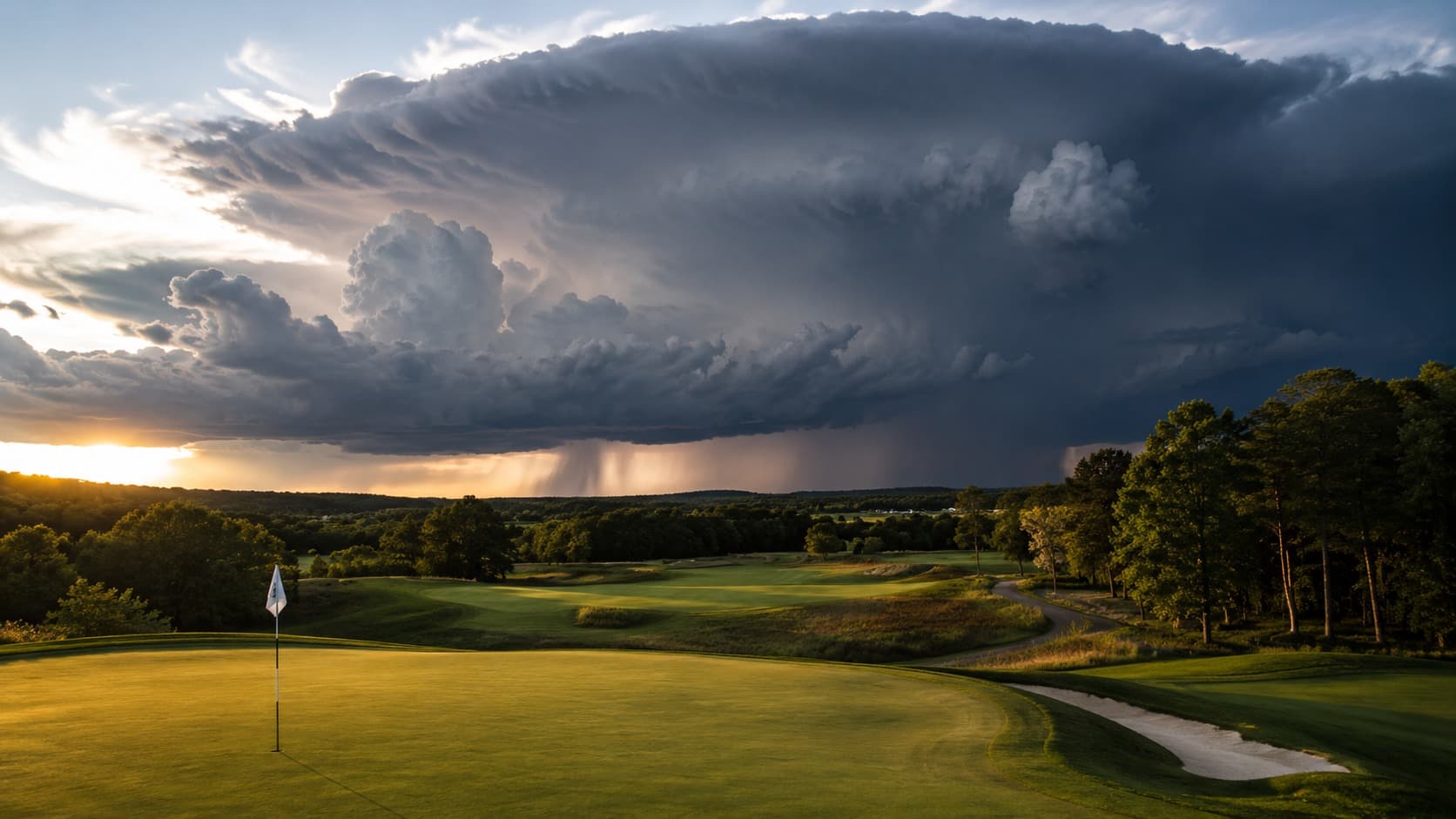
The Three O’Clock Storm: Reading Summer’s Convective Cycle to Protect Your Round
A 40% chance of afternoon thunderstorms does not mean a 40% chance of getting rained on. In the summer convective season it means the morning is nearly clear and the afternoon carries a fast-building, high-energy storm risk driven by a daily heating cycle. Here is the meteorology behind the pattern, the G-Score data on how the storm cycle punishes afternoon tee times across the Southeast, Midwest, and desert Southwest, the lightning-safety decision tree that actually matters, and the workflow that gets you off the course before the first bolt.
Read Story
How to Read a G-Score: The 0–100 Golf Playability Number, Decoded
A G-Score on this site is a single 0–100 number that tells you whether today is worth tee-up. Here is exactly what each band means, what drives the calculation, and how to use it to plan a round you will actually score on.
Read StoryMinSu Kim
Founder & Golf Data Analyst
MinSu is a data analyst and golfer with 10+ years on the course. He built Golf Weather Score to answer one question: is today a good day to play? He combines weather data, course intelligence, and the proprietary G-Score algorithm to help golfers make smarter decisions.
Every Friday Morning
When Bardmoor Country Club plays best next weekend.
Friday 6am ET: peak G-Score windows for Bardmoor Country Club, wind direction by hour, and one gear call. Three minutes to read, save you the round.
One email a week. Unsubscribe in one click.
The Caddie's Oracle
Draw your luck before the tee off