
Caddie's Gear Advisor
Curated for today's 95°F · Thunderstorm
Storm-Ready Outerwear
Waterproof layers built for 18 holes in the rain
Tour-Grade Umbrellas
68" double-canopy wind-resistant coverage
Wet-Weather Gloves
All-weather grip that performs in the rain
Waterproof Golf Shoes
Keep your feet dry through every fairway
Your Golf Trip, Handled
The Ultimate Golf Trip Planner
Everything you need to play Barefoot Bay Golf Course — from booking your flight to checking in course-side.
Course-Side Stays
Luxury hotels, resorts, and stay-and-play packages just minutes from the first tee.
Flights
Compare fares across 700+ airlines for the best route to your tee time.
SUV Rentals for Golf Bags
Spacious vehicles with room for clubs, bags, and your foursome.
Travel Insurance
Coverage for medical, weather delays, and gear at your destination.
Barefoot Bay Golf Course: Course Intelligence
Signature Setup
Barefoot Bay sits inland by a few miles from the Atlantic, tucked against the western edge of the Indian River Lagoon in southern Brevard County, Florida, near Micco and Sebastian. It is the golf amenity of the Barefoot Bay community, a large planned development that General Development Corporation laid out in the 1970s, and the course reads exactly as that lineage suggests: flat, walkable, near sea level, and routed around the community's water-retention lakes rather than carved into dunes or hills.
I want to be honest about the limits of what I can tell you here. This is a residential community course, not a championship venue with a thick tournament record, and I have not stood on its tees the way I have at the marquee Florida tracks. So I will keep the course-specific claims modest and spend the word count where it actually changes your round at a course like this: the wind, the water, and the Treasure Coast weather clock.
Hole-by-Hole Wind & Playing Lines
On a flat Florida community layout with almost no tree screening, the wind is the entire defense. The card's #1-handicap par-4, in the low-400s, is the hole that punishes a casual approach. In the morning calm it is a plain two-shotter. By early afternoon the sea breeze stands up off the lagoon and the Atlantic beyond it, and a stock 150-yard club becomes a 165–170-yard club into it — that is the difference between a green in regulation and a bunker.
The lakes that thread the property are lateral hazards, not heroic carries, so the smart line on the water holes is the dry side, even at the cost of a longer approach. On the short par-3 over the lake — roughly 150 yards — the danger is not the carry but the crosswind, which can push a held shot ten yards offline with no tree cover to slow it.
Green & Fairway Characteristics
Expect bermuda tee-to-green, the standard for inland Brevard County, with grain that runs hard toward the afternoon sun on the greens. On flat terrain like this, putts break less from slope than your eye expects and more from grain — read the shine. The fairways are wide and forgiving landing zones; the penalty for a miss is usually a longer angle, not a lost ball, except where the retention lakes pinch in. Because the whole property sits at near-zero elevation, drainage is the quiet variable: after a heavy summer downpour the low spots stay soft and the ball plugs rather than releases.
Seasonal Weather Pattern
This is a humid subtropical Treasure Coast climate, and it runs on a sharp wet/dry calendar. June through September brings highs around 90°F with brutal humidity and near-daily afternoon thunderstorms — the sea-breeze convergence over the narrow Florida peninsula fires storms most summer afternoons, often between 2 and 5 p.m. The dry, comfortable season is roughly November through April, with January highs near 72°F and far lower storm risk. Rainfall is heavily front-loaded into summer, so the genuine play-quality season here is winter, when the snowbird population swells and morning tee times fill fast.
Local Play Tips
The single most useful thing I can tell you about a course in this pocket of the coast: the Indian River Lagoon sits between you and the open Atlantic, and the sea breeze it helps drive does not arrive on a fixed clock — it depends on how fast the inland air heats. On a humid, still summer morning the breeze can stand up before 11 a.m.; on a cool, dry winter day it may never really fill in. Watch the dew burning off the fairways as your cue, not the printed forecast wind speed.
Pre-Round Weather Workflow
Use the 7-day G-Score on golfweatherscore the night before and the morning of. For Barefoot Bay, weight two factors above all: the afternoon thunderstorm probability in summer (a 50%+ PoP after noon means book the earliest tee time you can get and plan to be on the back nine by the time cells build), and the windExposure rating — on a treeless, flat layout like this, a moderate forecast wind plays stronger than the number suggests because nothing blocks it. Tee off early, check the radar at the turn in storm season, and let the lake-side holes dictate your club selection rather than the yardage plate.
Related Reading
Before you tee off at Barefoot Bay Golf Course
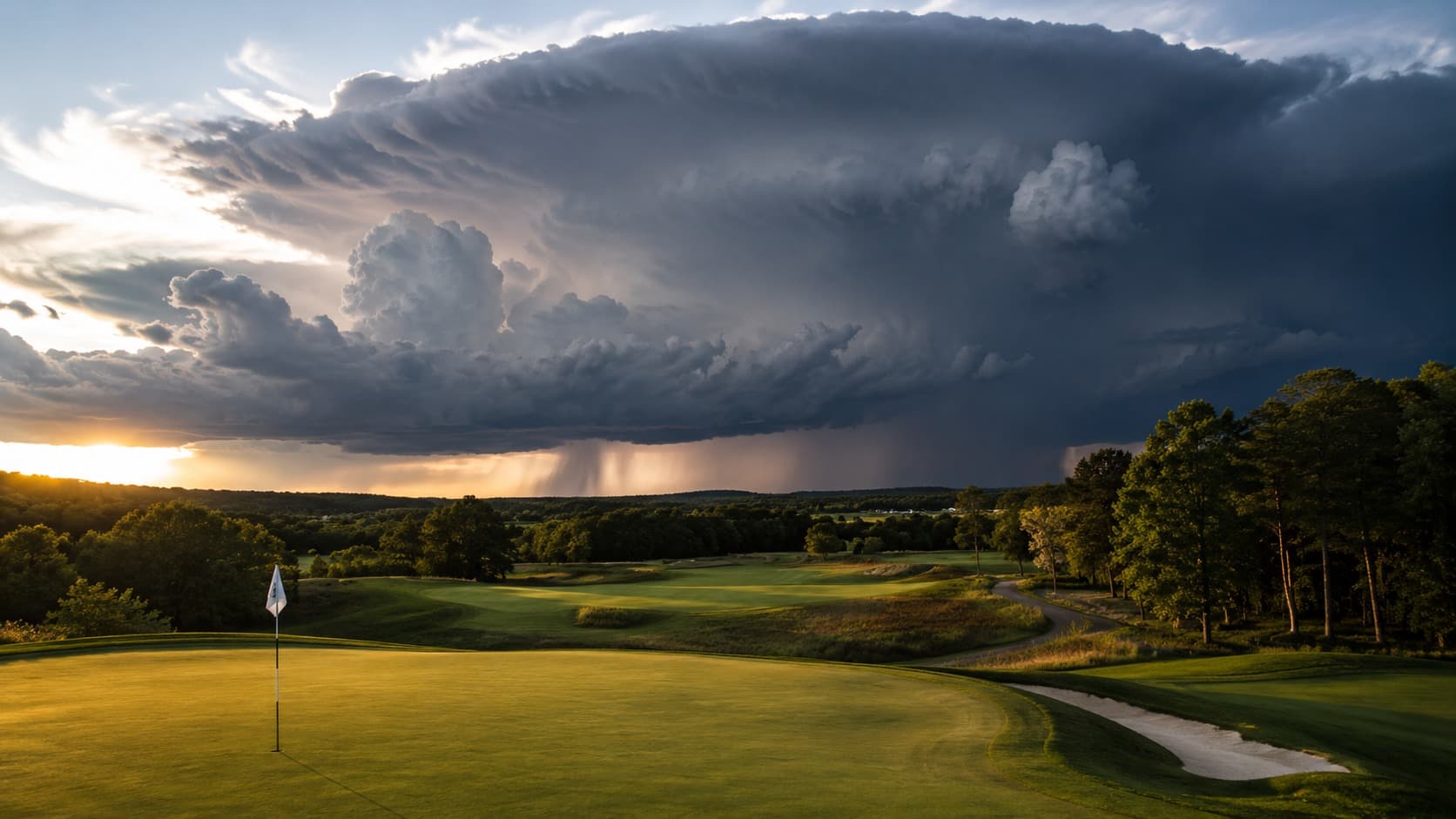
The Three O’Clock Storm: Reading Summer’s Convective Cycle to Protect Your Round
A 40% chance of afternoon thunderstorms does not mean a 40% chance of getting rained on. In the summer convective season it means the morning is nearly clear and the afternoon carries a fast-building, high-energy storm risk driven by a daily heating cycle. Here is the meteorology behind the pattern, the G-Score data on how the storm cycle punishes afternoon tee times across the Southeast, Midwest, and desert Southwest, the lightning-safety decision tree that actually matters, and the workflow that gets you off the course before the first bolt.
Read Story
How to Read a G-Score: The 0–100 Golf Playability Number, Decoded
A G-Score on this site is a single 0–100 number that tells you whether today is worth tee-up. Here is exactly what each band means, what drives the calculation, and how to use it to plan a round you will actually score on.
Read StoryMinSu Kim
Founder & Golf Data Analyst
MinSu is a data analyst and golfer with 10+ years on the course. He built Golf Weather Score to answer one question: is today a good day to play? He combines weather data, course intelligence, and the proprietary G-Score algorithm to help golfers make smarter decisions.
Every Friday Morning
When Barefoot Bay Golf Course plays best next weekend.
Friday 6am ET: peak G-Score windows for Barefoot Bay Golf Course, wind direction by hour, and one gear call. Three minutes to read, save you the round.
One email a week. Unsubscribe in one click.
The Caddie's Oracle
Draw your luck before the tee off