
Caddie's Gear Advisor
Curated for today's 79°F · Thunderstorm
Storm-Ready Outerwear
Waterproof layers built for 18 holes in the rain
Tour-Grade Umbrellas
68" double-canopy wind-resistant coverage
Wet-Weather Gloves
All-weather grip that performs in the rain
Waterproof Golf Shoes
Keep your feet dry through every fairway
Your Golf Trip, Handled
The Ultimate Golf Trip Planner
Everything you need to play Barrington Golf Club — from booking your flight to checking in course-side.
Course-Side Stays
Luxury hotels, resorts, and stay-and-play packages just minutes from the first tee.
Flights
Compare fares across 700+ airlines for the best route to your tee time.
SUV Rentals for Golf Bags
Spacious vehicles with room for clubs, bags, and your foursome.
Travel Insurance
Coverage for medical, weather delays, and gear at your destination.
Barrington Golf Club: Course Intelligence
Signature Setup
Let me be candid before the strategy: this read draws on Barrington's design pedigree, the Aurora-area climate record, and how Nicklaus Signature builds typically play — I have not teed it up, so what follows is pattern reasoning, not a recalled round. Barrington sits in Aurora, Ohio, in Portage County southeast of Cleveland, and it is a Jack Nicklaus Signature Design that opened in 1999 as the anchor of a private residential community. That lineage tells you most of what you need: a Nicklaus course rewards the player who can move the ball left to right, punishes the bail-out, and tends to protect par through green complexes and forced carries rather than brute length. The routing crosses rolling glacial terrain typical of Northeast Ohio and pushes into the mid-7,000s from the tips — a real championship test, not a developer's filler nine.
TL;DR: Private Jack Nicklaus Signature course (1999) in Aurora, Ohio, near Cleveland. Long from the back, bentgrass throughout, sloped Nicklaus greens, water on several holes. No sea breeze — the wind is frontal and lake-influenced. Play placement, read the synoptic and lake-effect setup over the tee-time clock.
Hole-by-Hole Wind & Playing Lines
Barrington doesn't publish a per-hole handicap card I can independently verify, so instead of inventing hole numbers I'll lay out how the wind dictates play on a Nicklaus build of this length:
- The longest par-4s into a SW summer flow: at 12–18 mph from the southwest, a flushed 150-yard club starts behaving like a 168. Nicklaus greens sit firm and tilted, so the answer is an extra club and a flatter flight, not a high ball the surface spits back.
- The water par-3: anywhere Nicklaus tucks water short-left of a canted green, a crossing wind off the open valley becomes the real test. Club for the gusting read, not the average one — short-siding here is how two strokes vanish from a good card.
- The downwind holes after a NW front: once dry post-front air gets behind you, the fairways firm and the holes shorten. Land short and release into these greens rather than flying a hot pitch onto a fast surface that falls away from the pin.
The habit to carry: on the first open hole, judge whether the breeze came in on a front or is just a quiet thermal drift, and let that one call set your clubbing all the way home.
Green & Fairway Characteristics
Expect bentgrass from tee to green — standard for a premium Northeast Ohio build of this era — over gentle glacial contours. The defining element is the green complexes: Nicklaus Signature courses are known for firm, multi-tier surfaces with run-offs that shed a slightly missed approach away from the hole, so the side you miss on matters as much as the line you pick. From the championship tees in the mid-7,000s the course demands length off the tee, but the scoring pressure lives on the second shot and the putt. Firmness here swings hard with the weather — baking under a summer ridge, softening fast after the region's frequent rain — so your stock yardages only hold in the calm, settled windows.
Seasonal Weather Pattern
Aurora lies in a humid continental climate on the rim of Lake Erie's snow-belt corridor — inland, with no moderating ocean, but firmly under the lake's hand. Spring (Apr–May) runs cool and changeable, with SW-to-NW shifts behind passing systems and wide swings; often the firmest scoring test of the year. Summer (Jun–Aug) is warm and humid, highs commonly low-to-mid-80s°F, a prevailing SW breeze, and a real chance of afternoon thunderstorms that stall play. Fall (Sep–Oct) is the prime window — crisp mornings, dry NW air behind fronts, firm greens and the steadiest scoring of the season. Winter closes the course for Ohio cold and lake-effect snow; for that stretch I rely on NOAA Cleveland-area historicals rather than anything firsthand.
Local Play Tips
The coastal reflex that misfires at Barrington: there's no daily sea breeze to outrun at dawn. This is inland golf, and the wind that matters is driven by passing systems and, in the colder months, by lake-effect setups streaming off Erie to the north. What decides your round is whether a front has cleared and how the lake is feeding the air mass — not whether it's morning or afternoon. A settled high can sit calm at any hour; a frontal passage can lock steady wind onto a Nicklaus layout that already has no interest in handing you par. Plan around the synoptic forecast and the lake-effect outlook and you'll read this course far better than a golfer who books the first time out of habit.
Pre-Round Weather Workflow
On an inland, lake-influenced course, golfweatherscore's 7-day G-Score and windExposure earn their keep when you read them around the fronts and the lake. Several days out, the G-Score trend mostly flags the next system; in Northeast Ohio a 9 falling to a 4 marks a front arriving, not a change in the hour. The night before, nail down the wind — a SW flow promises warm, humid, storm-prone play, while a NW flow behind a cleared front delivers firm, fast, dry turf that shrinks the downwind holes and turns the greens treacherous. Then on the tee, if windExposure is calling steady 18-to-20-mph gusts, expect this mid-7,000-yard Nicklaus card to stretch a club or two into the wind — favor the broad side of these sloped greens, leave the tucked pins alone, and let position keep the number intact.
Related Reading
Before you tee off at Barrington Golf Club
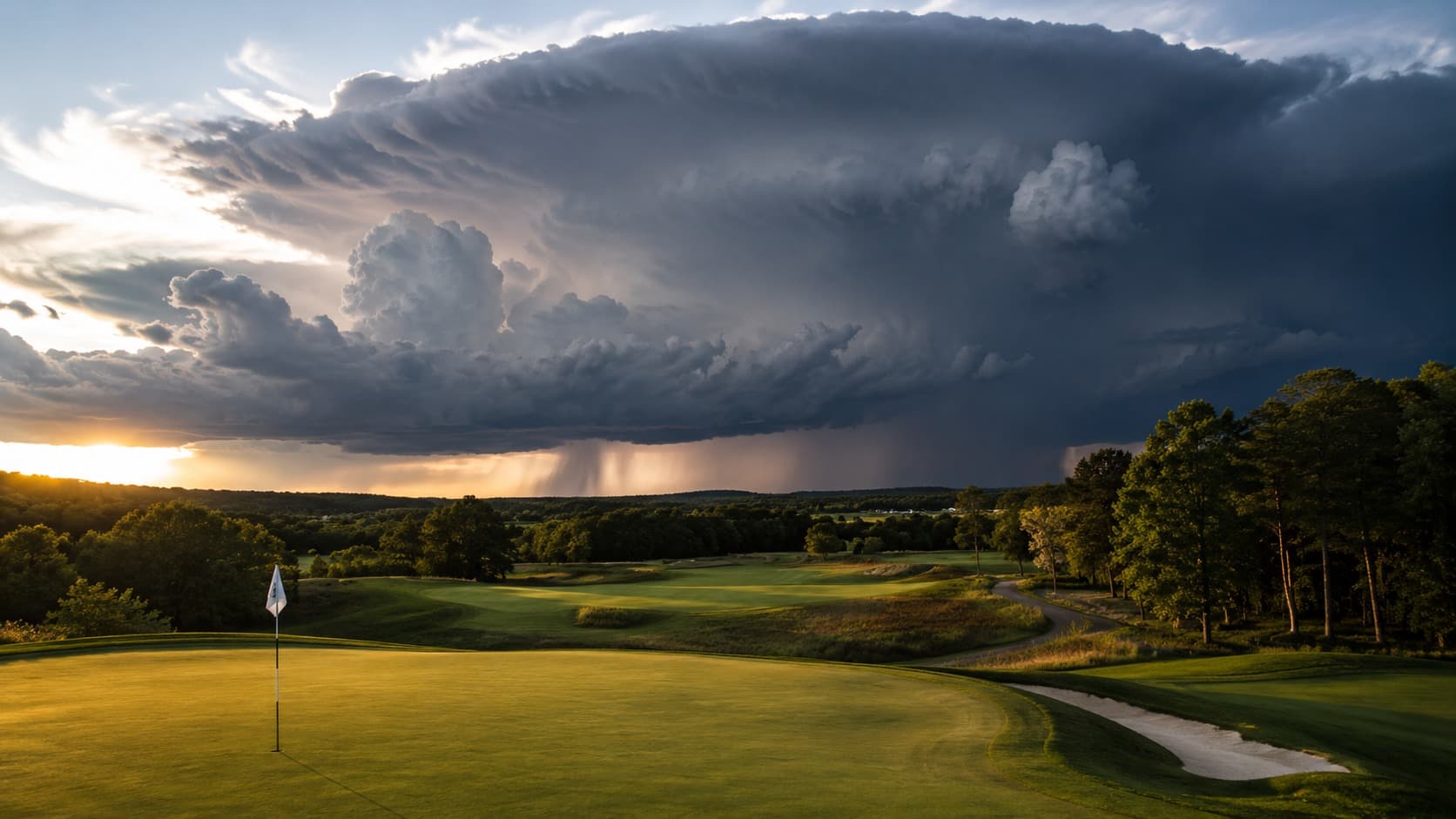
The Three O’Clock Storm: Reading Summer’s Convective Cycle to Protect Your Round
A 40% chance of afternoon thunderstorms does not mean a 40% chance of getting rained on. In the summer convective season it means the morning is nearly clear and the afternoon carries a fast-building, high-energy storm risk driven by a daily heating cycle. Here is the meteorology behind the pattern, the G-Score data on how the storm cycle punishes afternoon tee times across the Southeast, Midwest, and desert Southwest, the lightning-safety decision tree that actually matters, and the workflow that gets you off the course before the first bolt.
Read Story
How to Read a G-Score: The 0–100 Golf Playability Number, Decoded
A G-Score on this site is a single 0–100 number that tells you whether today is worth tee-up. Here is exactly what each band means, what drives the calculation, and how to use it to plan a round you will actually score on.
Read StoryMinSu Kim
Founder & Golf Data Analyst
MinSu is a data analyst and golfer with 10+ years on the course. He built Golf Weather Score to answer one question: is today a good day to play? He combines weather data, course intelligence, and the proprietary G-Score algorithm to help golfers make smarter decisions.
Every Friday Morning
When Barrington Golf Club plays best next weekend.
Friday 6am ET: peak G-Score windows for Barrington Golf Club, wind direction by hour, and one gear call. Three minutes to read, save you the round.
One email a week. Unsubscribe in one click.
The Caddie's Oracle
Draw your luck before the tee off