
Caddie's Gear Advisor
Curated for today's 80°F · Clear
Tour-Level Drivers
Engineered for maximum distance and forgiveness
Laser Rangefinders
Pin-seeking technology for precision approaches
Premium Golf Balls
Tour-caliber spin and distance performance
Performance Sunglasses
Polarized lenses optimized for reading greens
Your Golf Trip, Handled
The Ultimate Golf Trip Planner
Everything you need to play Barton Hills Country Club — from booking your flight to checking in course-side.
Course-Side Stays
Luxury hotels, resorts, and stay-and-play packages just minutes from the first tee.
Flights
Compare fares across 700+ airlines for the best route to your tee time.
SUV Rentals for Golf Bags
Spacious vehicles with room for clubs, bags, and your foursome.
Travel Insurance
Coverage for medical, weather delays, and gear at your destination.
Barton Hills Country Club: Course Intelligence
Signature Setup
Barton Hills Country Club sits on the bluffs above the Huron River just northwest of Ann Arbor, Michigan, and it is a genuine Donald Ross design that opened in 1920. Ross routed it across rolling glacial terrain that drops toward Barton Pond, which means almost no two consecutive holes share the same elevation. This is a private club, and it has long been part of the University of Michigan golf community — the men's and women's programs have used the area's Ross-era courses for generations. The fingerprints are textbook Ross: crowned greens that shrug off anything not landed cleanly, bunkers set short of the surface to fool your depth perception, and short par-4s that punish the wrong angle more than the wrong club.
Hole-by-Hole Wind & Playing Lines
The three hardest holes here are about wind direction, not raw length.
- The #1-handicap par-4 (~445y): Ann Arbor's prevailing summer wind is W to SW, and on this hole it leans into you all afternoon. A driver chasing distance leaves a downwind flier into a crowned green that won't hold. The smarter line is a long iron or 3-wood to the wider left half of the fairway, accepting a full 6- or 7-iron approach you can spin.
- The valley par-3 (~175y, downhill): Standing on the tee it looks like a 7-iron, but the W wind funnels up the river shoulder and knocks the ball down. I'd club up a full one — an honest 6-iron — and aim center, because the green falls away on the right toward trouble.
- A mid-length dogleg par-4: On NW post-frontal mornings the wind quarters left-to-right and pushes tee shots toward the trees. Start it up the left tree line and let the breeze work it back.
Green & Fairway Characteristics
The greens are the defense. They are bentgrass mixed with invasive Poa annua, classic Ross crowns, and they run around 10.5–11 on the Stimpmeter in mid-summer — fast enough that a downhill putt past the hole brings a real three-putt into play. Fairways are firm bentgrass that gives you summer roll but also kicks slightly errant tee shots into the rough. The front nine plays tighter through the river valley; the back opens onto higher ground. Total yardage from the back tees is in the ~6,300–6,500 range, modest by modern standards, which tells you this course defends with contour and angles rather than length.
Seasonal Weather Pattern
Michigan's golf season here is roughly mid-April through late October. May and September are the sweet spots: daytime highs in the 60s–low 70s°F, low humidity, and firm turf. July and August bring highs in the mid-80s°F with real humidity off the river — afternoon thunderstorms are common, and the Poa greens slow noticeably after a soaking. Spring mornings can sit in the low 40s°F with valley fog that lingers past 8 a.m. By October, frost delays start showing up, and the firm, fast greens get treacherous as leaf-fall changes your read.
Local Play Tips
The river-valley microclimate is the local edge nobody tells you about: cold air drains into the Barton Pond basin overnight, so the low holes hold fog and dew an hour longer than the higher back-nine ground. If you tee off too early, you're putting on slow, wet Poa; wait until the sun clears the valley and those same greens pick up nearly half a club of speed. Plan your tee time around the dry-out, not just the temperature.
Pre-Round Weather Workflow
Run the 7-day G-Score for Ann Arbor before you book. A few habits that pay off here: (1) Check the wind direction specifically — a W/SW reading means the long par-4s and the valley par-3 play a full club longer, so widen your scoring expectations. (2) Watch the afternoon convective risk in July–August; the highest G-Scores cluster in the morning before storms build. (3) In spring and fall, factor frost and fog delays into your start time, and assume the greens run faster once they dry. Let the forecast pick your tee time, and this Ross design rewards you instead of embarrassing you.
Related Reading
Before you tee off at Barton Hills Country Club

America's 20 Windiest Golf Courses: A G-Score Wind Analysis
We ranked America's 20 windiest golf courses using G-Score wind penalty data. See how coastal gusts and prairie gales reshape playability scores.
Read Story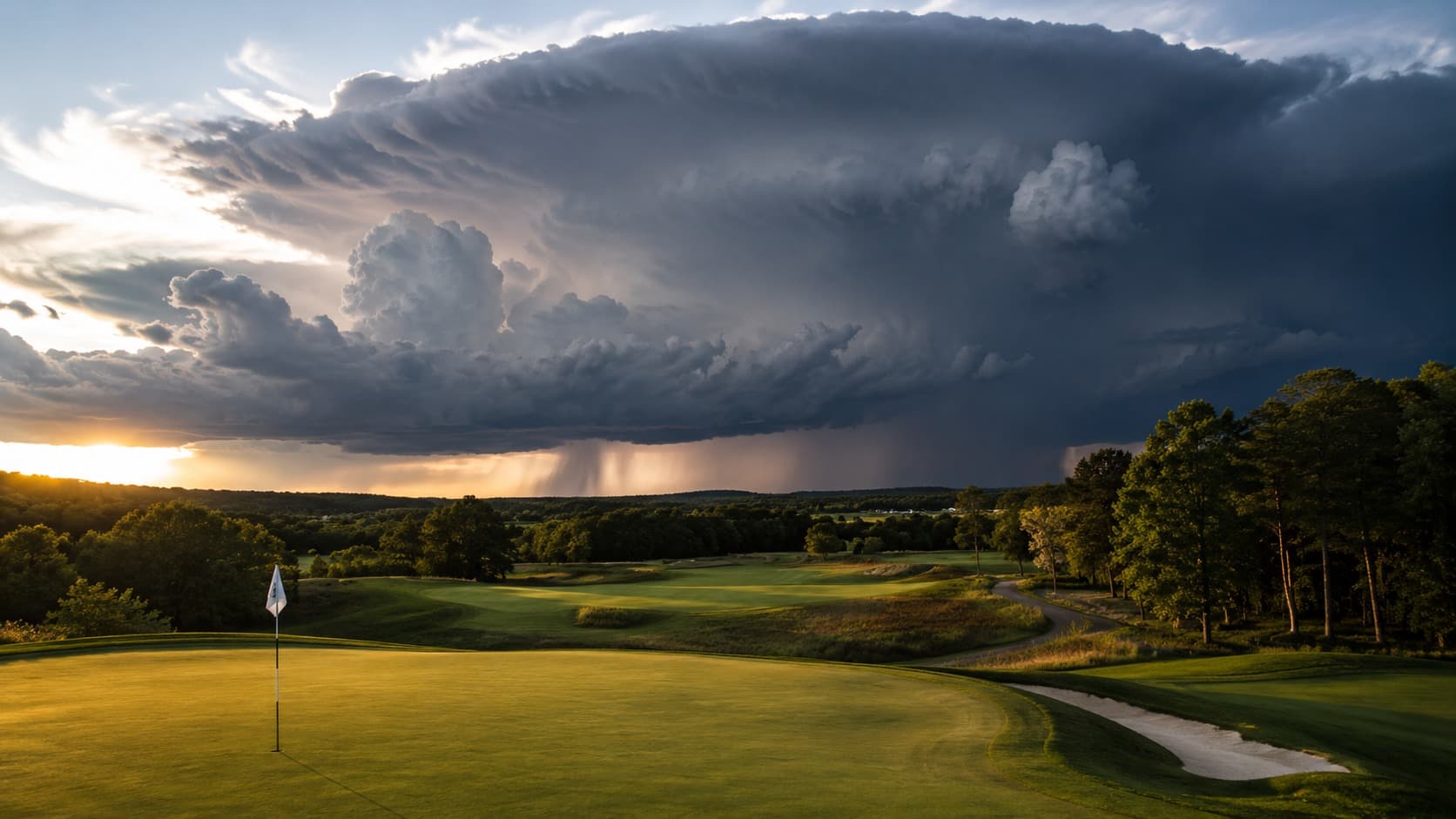
The Three O’Clock Storm: Reading Summer’s Convective Cycle to Protect Your Round
A 40% chance of afternoon thunderstorms does not mean a 40% chance of getting rained on. In the summer convective season it means the morning is nearly clear and the afternoon carries a fast-building, high-energy storm risk driven by a daily heating cycle. Here is the meteorology behind the pattern, the G-Score data on how the storm cycle punishes afternoon tee times across the Southeast, Midwest, and desert Southwest, the lightning-safety decision tree that actually matters, and the workflow that gets you off the course before the first bolt.
Read StoryMinSu Kim
Founder & Golf Data Analyst
MinSu is a data analyst and golfer with 10+ years on the course. He built Golf Weather Score to answer one question: is today a good day to play? He combines weather data, course intelligence, and the proprietary G-Score algorithm to help golfers make smarter decisions.
Every Friday Morning
When Barton Hills Country Club plays best next weekend.
Friday 6am ET: peak G-Score windows for Barton Hills Country Club, wind direction by hour, and one gear call. Three minutes to read, save you the round.
One email a week. Unsubscribe in one click.
The Caddie's Oracle
Draw your luck before the tee off