
Caddie's Gear Advisor
Curated for today's 94°F · Thunderstorm
Storm-Ready Outerwear
Waterproof layers built for 18 holes in the rain
Tour-Grade Umbrellas
68" double-canopy wind-resistant coverage
Wet-Weather Gloves
All-weather grip that performs in the rain
Waterproof Golf Shoes
Keep your feet dry through every fairway
Your Golf Trip, Handled
The Ultimate Golf Trip Planner
Everything you need to play Baseline Golf Course — from booking your flight to checking in course-side.
Course-Side Stays
Luxury hotels, resorts, and stay-and-play packages just minutes from the first tee.
Flights
Compare fares across 700+ airlines for the best route to your tee time.
SUV Rentals for Golf Bags
Spacious vehicles with room for clubs, bags, and your foursome.
Travel Insurance
Coverage for medical, weather delays, and gear at your destination.
Baseline Golf Course: Course Intelligence
Signature Setup
I have not teed it up at Baseline myself — for this one I am working from the published scorecard, Ocala-area weather records, and the way central-Florida executive courses tend to play in the months I know. What the card tells you is unusual: par 61 over roughly 3,484 yards from the back, a course rating of 60.1 and a slope of just 96. Arlin Parker and Stan Norton opened it in 1988, and locals call it Ocala's answer to Augusta — more botanical garden than brute, with specimen trees and flower beds framing the holes. The layout leans on par 3s with a handful of par 4s, and its calling card is the 13th, "Lucky 13," a par 3 played all the way over water to an island green. On a short course like this, the scorecard yardage lies: precision and a calm wedge matter far more than length, and the wind is the variable that decides the round.
Hole-by-Hole Wind & Playing Lines
Ocala sits inland in north-central Florida, so the wind here is softer than on the coast — but on an executive course where most approaches are wedges and short irons, even a 6–10 mph breeze swings club selection.
- 13th "Lucky 13" (par 3, island green): This is the card-wrecker. On a summer afternoon the prevailing E/SE sea-breeze pushes inland and quarters across the water; the carry plays 8–12 yards longer than the number. Take one extra club, commit to the center of the green, and treat short-right as the safe miss — long leaves you dead against the back collar with water in your eyeline.
- The long par 4s (six on the card): Into a winter NW wind behind a cold front, the two-shotters that normally ask for a wedge approach suddenly need a full short iron. Favor the fat side of these small greens rather than chasing a tucked pin.
- Short par 3s downwind: With a helping breeze the danger flips — a firm, overseeded green will not hold a knockdown that comes in hot. Land it short and let it release rather than flying the flag.
Green & Fairway Characteristics
The greens are Bermuda, overseeded 100% for winter so the putting surfaces, tees, and fairways stay lush from December through March. They are small and subtly contoured, ringed by bunkers placed to punish the miss rather than just frame the hole — accuracy is rewarded and a slightly long approach is rarely your friend. Fairways are tree-lined and tight in spots, with ponds and the island 13th bringing water into play. Because the complexes are compact, a ball pin-high but ten feet wide is often a tougher up-and-down than a straightforward 30-footer. With a rating of 60.1 against par 61 and a slope of 96, the numbers say "gentle," but the green sizes quietly tax anyone who sprays approaches.
Seasonal Weather Pattern
Ocala's golf seasons split by humidity, not by frost. Winter — December through February — brings cool, calm mornings often in the 45–55°F range, with the occasional cold front dropping a brisk NW wind and, on the coldest dawns, a frost delay that pushes the first groups back an hour. March and April are the sweet spot: mild mornings, highs near the upper 70s to low 80s, and manageable wind. From June through September the pattern turns tropical — muggy, still mornings followed by near-daily convective thunderstorms that build off the heat by roughly 2–4 p.m. and can shut play down quickly. I write the summer storm timing from regional NOAA records rather than my own card, since I have not played here in that season.
Local Play Tips
The detail that does not show up on the scorecard: Baseline runs as a walk-on, first-come course with no traditional tee-time sheet. That changes your strategy before you ever swing. On winter weekends the lot fills early, so getting there at or near opening does two things — it beats the crowd that backs up the par-3-heavy front, and on a cold morning it lets the frost burn off the small greens before you reach them. If you have any choice in your start, aim to reach the 13th while the morning air is still calm, before the afternoon breeze finds its way inland.
Pre-Round Weather Workflow
Pull the 7-day G-Score for Baseline the night before and again at dawn, and watch two things. First, in winter, the overnight low — anything near or below freezing means a likely frost delay, so plan to arrive a touch later rather than stand around. Second, in summer, the afternoon storm probability: with a walk-on course and no reserved slot, an early start is your only reliable defense against a 2–4 p.m. washout, so be on the first tee at opening and check radar before you make the turn. On a windy day, lean on the windExposure flag for the island 13th — add a club into any breeze over the water, aim center-green, and let the short course reward patience instead of forcing the pin.
Related Reading
Before you tee off at Baseline Golf Course
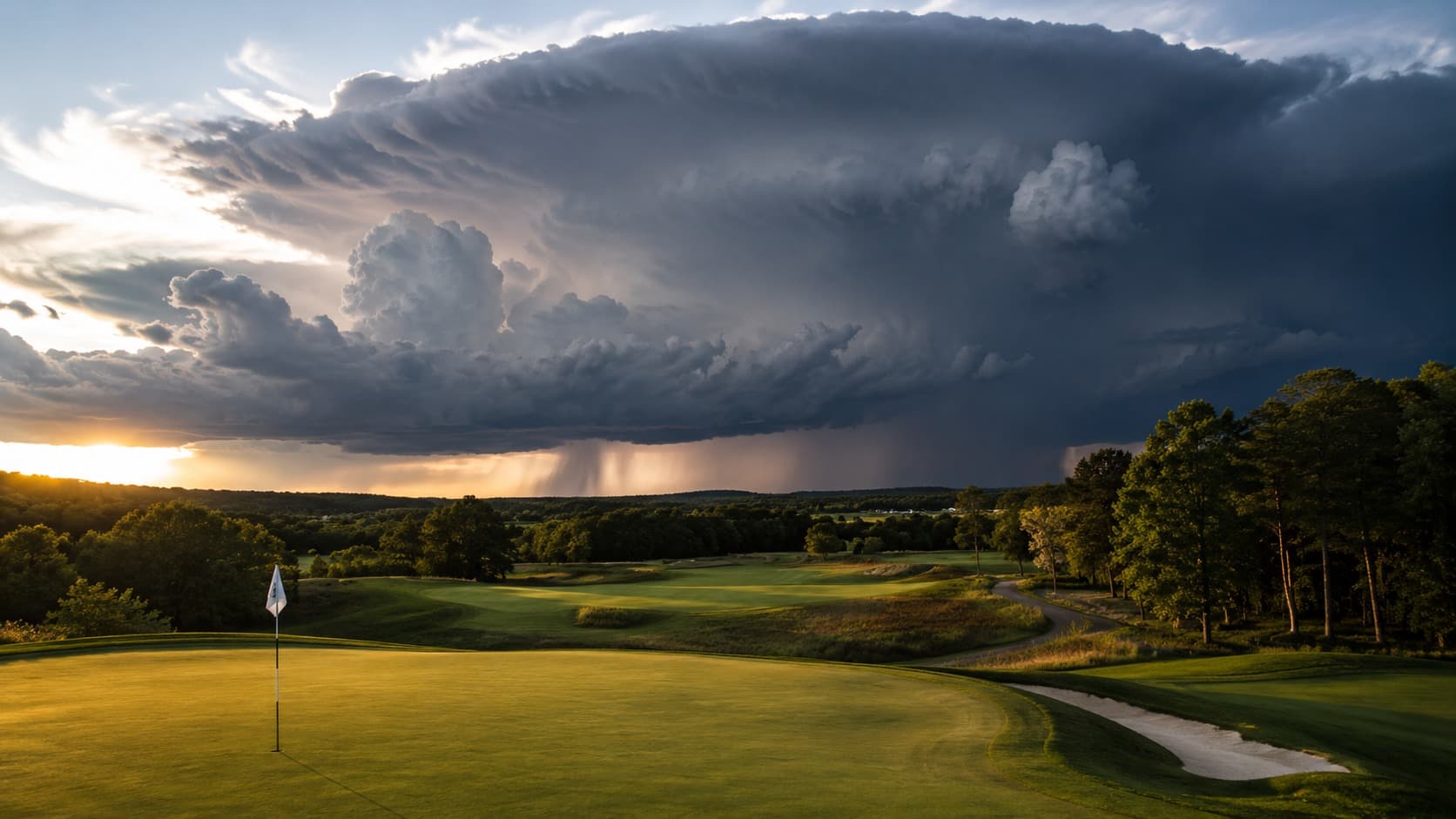
The Three O’Clock Storm: Reading Summer’s Convective Cycle to Protect Your Round
A 40% chance of afternoon thunderstorms does not mean a 40% chance of getting rained on. In the summer convective season it means the morning is nearly clear and the afternoon carries a fast-building, high-energy storm risk driven by a daily heating cycle. Here is the meteorology behind the pattern, the G-Score data on how the storm cycle punishes afternoon tee times across the Southeast, Midwest, and desert Southwest, the lightning-safety decision tree that actually matters, and the workflow that gets you off the course before the first bolt.
Read Story
How to Read a G-Score: The 0–100 Golf Playability Number, Decoded
A G-Score on this site is a single 0–100 number that tells you whether today is worth tee-up. Here is exactly what each band means, what drives the calculation, and how to use it to plan a round you will actually score on.
Read StoryMinSu Kim
Founder & Golf Data Analyst
MinSu is a data analyst and golfer with 10+ years on the course. He built Golf Weather Score to answer one question: is today a good day to play? He combines weather data, course intelligence, and the proprietary G-Score algorithm to help golfers make smarter decisions.
Every Friday Morning
When Baseline Golf Course plays best next weekend.
Friday 6am ET: peak G-Score windows for Baseline Golf Course, wind direction by hour, and one gear call. Three minutes to read, save you the round.
One email a week. Unsubscribe in one click.
The Caddie's Oracle
Draw your luck before the tee off