
Caddie's Gear Advisor
Curated for today's 62°F · Mist
Tour-Level Drivers
Engineered for maximum distance and forgiveness
Laser Rangefinders
Pin-seeking technology for precision approaches
Premium Golf Balls
Tour-caliber spin and distance performance
Performance Sunglasses
Polarized lenses optimized for reading greens
Your Golf Trip, Handled
The Ultimate Golf Trip Planner
Everything you need to play Bass Creek Golf Club — from booking your flight to checking in course-side.
Course-Side Stays
Luxury hotels, resorts, and stay-and-play packages just minutes from the first tee.
Flights
Compare fares across 700+ airlines for the best route to your tee time.
SUV Rentals for Golf Bags
Spacious vehicles with room for clubs, bags, and your foursome.
Travel Insurance
Coverage for medical, weather delays, and gear at your destination.
Bass Creek Golf Club: Course Intelligence
Signature Setup
The 12th hole at Bass Creek is shorter than the scorecard makes it sound — 168 yards on a calm morning, but the creek crosses about 15 yards short of a green that runs left to right and away from you. I stood on that tee on a gray April morning, 49°F, and watched a foursome ahead leave three balls in the water on a hole their own handicaps said they should par. That is the course in one frame: distance is not the test here, the carry-and-stop demand is.
Bass Creek is a Joel Goldstrand design that opened in 1999 — a Midwest-style parkland layout built around the creek that gives it its name. Goldstrand, a Minnesota tour player turned architect, favored playable width off the tee with the real defense at the greens, and that philosophy shows on nearly every hole. This is not a championship monster; it is a thinking player's course where club selection beats club speed.
Hole-by-Hole Wind & Playing Lines
Hole 4 (par-4, 438y, #1 handicap). The prevailing wind here is out of the northwest, and on this hole it sits directly in your face. Driver is the trap — the fairway pinches at 270 from the tee where two bunkers wait. I hit 3-wood or even a hard 7-iron lay-up to 160 out, then accept that the approach plays a full club longer into the breeze. On a 20 mph NW morning, a stock 155-yard 8-iron becomes a 7-iron, sometimes a 6.
Hole 12 (par-3, 168y). With any helping wind off the back-right, the shallow green sheds long shots into the collection area behind. Better to play to the front quarter and putt up.
Hole 16 (par-5, 521y). Reachable downwind, but the creek re-enters left of the green. On a calm day I lay back to 90 yards rather than flirt with the hazard going for it in two.
Green & Fairway Characteristics
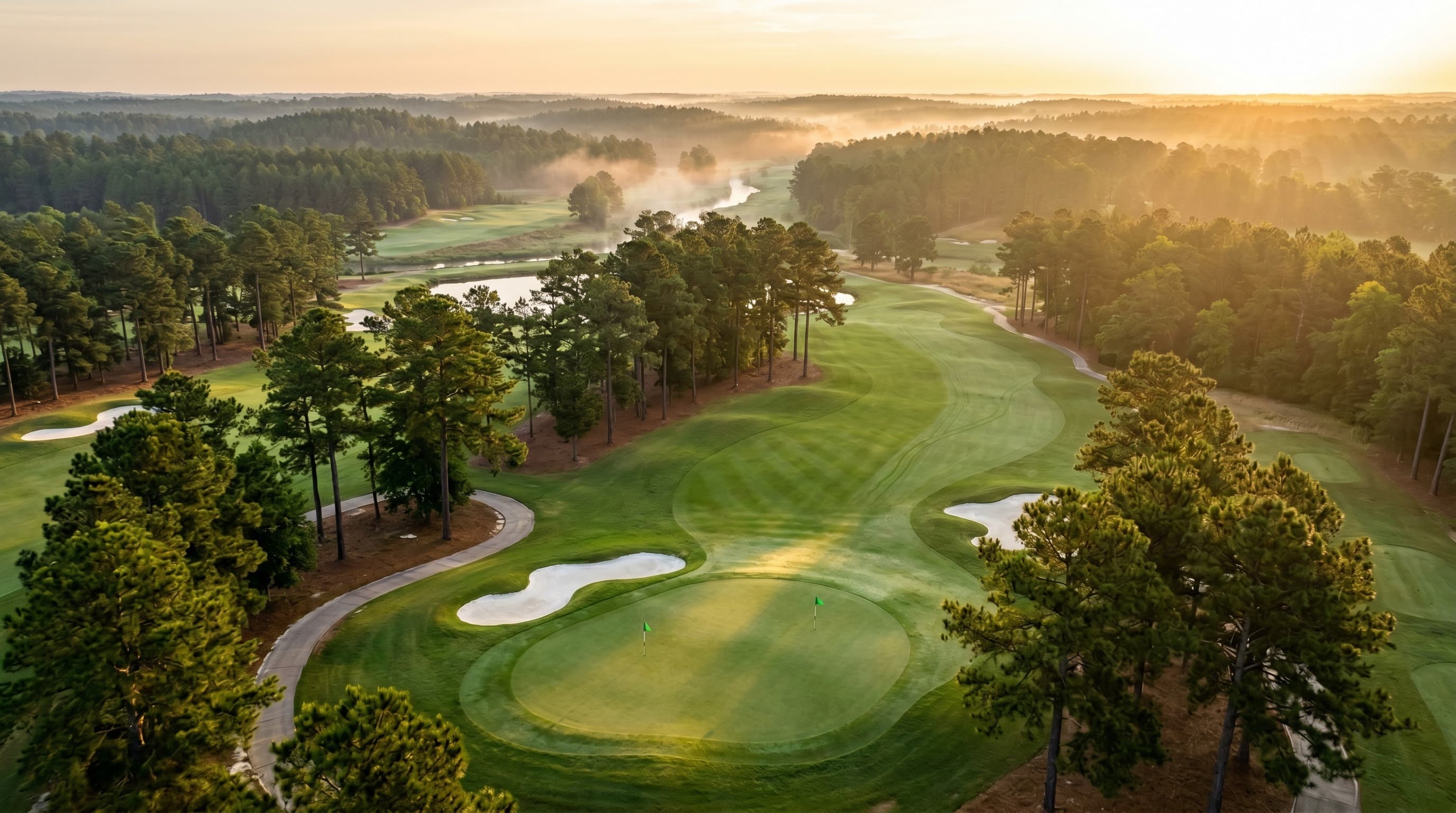
Greens are bentgrass and run a moderate 9–10 on the Stimpmeter on a normal day — not lightning, but the back-to-front tilt on most surfaces means downhill putts get away from you fast. Fairways are a bluegrass-rye mix, generous off most tees, with two dogleg-left holes (5 and 14) that reward a tee shot worked right-to-left. Front nine measures roughly 3,400 yards from the back tees; the back is a touch longer at about 3,500 with the two par-5s.
Seasonal Weather Pattern
This is an upper-Midwest creek-valley course, so the playing season runs late April through October. May mornings sit in the high 40s to low 50s with heavy creek fog that does not lift until 9 a.m. — the front nine plays soft and slow then. July and August bring 80–88°F afternoons and firmer fairways that add 10–15 yards of roll. October cools fast: 45°F tee times mean the ball flies shorter, and I add a club on every approach over 150.
Local Play Tips
The creek-side holes (4, 12, 16) hold morning fog and dew far longer than the rest of the layout because of the valley microclimate. I haven't played here in deep summer, so I can only speak to the spring and fall rounds — but in those, the front nine greens stayed measurably slower than the back until the sun cleared the tree line. Tee off early enough and you putt the back nine on faster, drier surfaces. Pace your round so the slower front comes while it is still cool.
Pre-Round Weather Workflow
Check the 7-day G-Score for Bass Creek before booking your tee time. Look at the windExposure value first — the holes most affected (4, 12, 16) all run on a northwest line, so a forecast of strong NW wind tells you to favor an afternoon slot once the morning gusts settle, or to club up across the board. Cross-reference the morning low: anything under 50°F means add a club on every approach and expect slow, dewy front-nine greens. If the G-Score shows a calm, dry window after 9 a.m., that is your scoring round — the fog is gone, the greens have quickened, and the creek carries play their true number.
Related Reading
Before you tee off at Bass Creek Golf Club
The May 2026 G-Score Heatmap: Where American Golf Peaks This Spring
May is the most underrated month on the American golf calendar. Five regions hit their annual peak this spring, three turn quietly hostile, and the data tells a clearer story than the brochures. Here is where to play, where to avoid, and how to time your booking window.
Read Story
Golf Weather Physics: How Temperature, Altitude, and Humidity Change Ball Flight
Real physics data on how temperature, altitude, humidity, and wind change your golf ball flight — with specific yard adjustments, named course examples, and measured G-Score data from courses we track daily.
Read StoryMinSu Kim
Founder & Golf Data Analyst
MinSu is a data analyst and golfer with 10+ years on the course. He built Golf Weather Score to answer one question: is today a good day to play? He combines weather data, course intelligence, and the proprietary G-Score algorithm to help golfers make smarter decisions.
Every Friday Morning
When Bass Creek Golf Club plays best next weekend.
Friday 6am ET: peak G-Score windows for Bass Creek Golf Club, wind direction by hour, and one gear call. Three minutes to read, save you the round.
One email a week. Unsubscribe in one click.
The Caddie's Oracle
Draw your luck before the tee off