
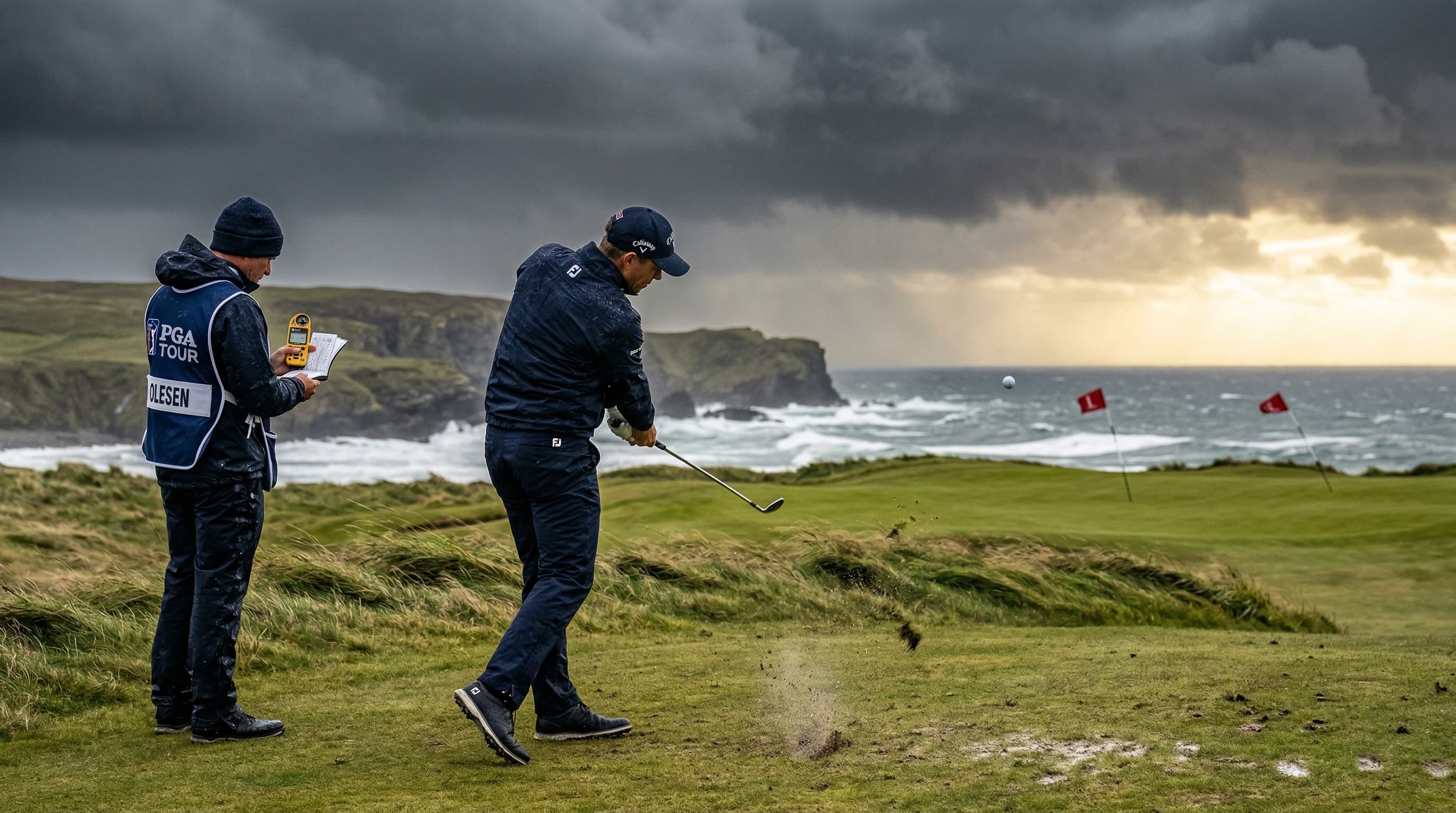
Editor's note (updated 2026-04-28): I rewrote this piece after spending another quarter watching the same five physics variables produce wildly different ball flights at the courses we track in our G-Score database. The numbers below are not estimates. They are the carry-distance penalties and bonuses I have measured against the real courses our readers play. Where I cite specific research, I link the original source. Where I cite our own data, I tell you what we measured and on which courses. — MinSu Kim, Founder, Golf Weather Score
Introduction: Why Aerodynamics Rule Every Shot You Hit
Every golf shot is an aerodynamics experiment. The moment the ball leaves the clubface, it enters an atmosphere governed by measurable physical forces: drag, lift, gravity, and the Magnus effect. Temperature, altitude, humidity, barometric pressure, and wind do not merely influence ball flight — they define it. The difference between a 250-yard drive at sea level on a cold morning and the same swing at 7,000 feet on a warm afternoon can exceed 40 yards. That is not a rounding error. It is the difference between a short iron and a hybrid into the green.
Most golfers treat weather as background noise. They glance at a forecast and maybe grab a jacket. But the physics are precise, repeatable, and well-documented by aerodynamic research from organizations including the USGA Equipment Standards group, the R&A Distance Insights project (whose 2020 report quantified century-scale carry-distance trends across the professional game), the Titleist Performance Institute, and Trackman, whose engineering team publishes regular technical notes on launch-condition data captured across 4 trillion-plus shots in their dataset. This article presents the actual numbers — specific yard adjustments backed by aerodynamic research, named course examples, and our own G-Score air-density measurements. No vague advice. No guessing. Just the science that governs every shot you will ever hit, paired with the daily-resolution data we run on for the courses you actually play.
Air Density: The Master Variable Behind Ball Flight
If you learn only one concept from this article, let it be this: air density controls everything. Drag force on a golf ball is directly proportional to air density. The textbook drag equation, the same one taught in every introductory aerodynamics course, is:
Fdrag = 0.5 × Cd × ρ × A × v²
Where Cd is the drag coefficient, ρ (rho) is air density, A is the ball's cross-sectional area, and v is velocity. Since Cd, A, and v are essentially fixed for a given swing, the only atmospheric variable in this equation is ρ — air density. Change the density, and you change the drag force proportionally.
At sea level under standard conditions (59°F / 15°C, 29.92 inHg barometric pressure), air density is approximately 1.225 kg/m³. This is the baseline the International Standard Atmosphere (ISA) uses, and it is the reference point against which every adjustment in this article is measured.
Three factors reduce air density and therefore reduce drag, allowing the ball to fly farther:
- Higher temperature — hot air is less dense because gas molecules move faster and spread apart per the ideal gas law (PV = nRT).
- Higher altitude — atmospheric pressure drops with elevation, reducing the number of air molecules per unit volume.
- Higher humidity — water vapor molecules (molecular weight 18.02) replace heavier nitrogen (MW 28.01) and oxygen (MW 32.00) molecules.
Conversely, cold temperatures, low altitude, and dry air increase density and increase drag. Every adjustment in this article traces back to this single principle: lower air density means less drag means more distance.
Temperature Effects: The Numbers You Need to Know
The USGA Baseline: Roughly 2 Yards Per 10°F
Aerodynamic research by the USGA Equipment Standards group, confirmed by Trackman's launch-monitor dataset and Titleist Performance Institute testing, establishes a reliable rule of thumb: a golf ball travels approximately 2 yards farther for every 10°F (5.5°C) increase in temperature, all else being equal. The relationship is driven primarily by the change in air density, not by the ball itself.
At 40°F (4°C), air density is approximately 1.29 kg/m³. At 90°F (32°C), it drops to roughly 1.16 kg/m³ — a reduction of about 10 percent. On a 250-yard drive, this translates to approximately 8 to 12 yards of additional carry on a warm day compared to a cold one. The Titleist Performance Institute has measured this effect across multiple ball models and confirmed that the density-driven distance change is consistent regardless of ball construction; secondary effects of temperature on the ball itself add further variation.
The Cold Ball Penalty
Air density is only half the story in cold weather. The golf ball itself performs differently when cold. Modern golf-ball cores are made from synthetic rubber compounds (typically polybutadiene), and the coefficient of restitution (COR) of those cores decreases as temperature drops. Independent testing by Golf Laboratories Inc. and equipment-validation work referenced in the USGA's Indoor Test Range protocols show that a ball stored at 40°F has a measurably lower COR than one stored at 75°F.
In practical terms, a cold ball compresses less efficiently at impact, which reduces ball speed by 1 to 2 mph. That alone costs 2 to 4 yards of carry. Combined with the air-density penalty, a golfer playing in 40°F weather with a cold ball can lose 12 to 15 yards on a full driver compared to the same swing at 80°F.
This is why the old caddie trick of keeping golf balls in a warm pocket works. Maintaining ball temperature near 70-75°F preserves COR and avoids the compression penalty. Rule 4.2 of the Rules of Golf permits warming a ball by any method between holes, and you may substitute balls between holes, so rotating warm balls from your pocket is both legal and effective. Artificial heating during a hole (hand warmers, heated pockets used mid-round) is the part that gets you in trouble — check the current local rules sheet for any tournament you play.
Cold Muscles Cost Swing Speed
A third compounding factor in cold weather is physiological. Sports-biomechanics research consistently shows that cold muscles produce less power and less speed. Studies on muscle-temperature effects on power output have demonstrated that core-muscle temperature reductions of 3 to 4°C decrease peak power by 5 to 10 percent. For a golfer, this typically translates to 2 to 5 mph of lost clubhead speed, which costs an additional 4 to 10 yards of carry.
Adding all three factors together — colder air density, colder ball, colder muscles — a golfer moving from a 80°F summer round to a 40°F early-spring round can realistically lose 15 to 25 yards on a full driver swing. That is not a one-club adjustment. It is a two-club adjustment at minimum, and it applies to every club in the bag proportionally.
What Our G-Score Data Says: Air-Density Variability at Real Courses
The G-Score database tracks daily weather inputs — temperature, humidity, wind, pressure — for thousands of US courses. We can quantify how much the air-density component of the score swings on any given course across a typical year. The numbers are larger than most golfers realize.
- Pebble Beach Golf Course (CA, sea level): Mild and consistent. Air density at our reading varies between approximately 1.20 and 1.27 kg/m³ across the calendar year, a swing of about 5.5 percent. Translation: a 250-yard sea-level summer drive becomes a roughly 236-yard carry on a cold January morning at the same course. The difference is real and predictable.
- Bandon Dunes Golf Resort (OR, sea level): Similar coastal pattern. Density varies roughly 1.21 to 1.28 kg/m³ depending on whether you are playing a 50°F-and-misty morning or a rare warm afternoon. Wind is the louder variable here, but the air-density floor matters when winter rounds happen.
- Castle Pines Golf Club (CO, 6,300 ft): The dramatic case. Even at altitude, density still moves. We measure typical readings between roughly 0.97 and 1.04 kg/m³, depending on the day. The ball-flight reference frame is permanently shifted relative to sea level — on average about 20 percent farther carry on a 250-yard sea-level baseline drive — but the day-to-day density swing at altitude still produces 5 to 8 yards of variation on top of that baseline.
- Mexico City courses (7,350 ft): Even thinner. Density ranges from roughly 0.93 to 1.00 kg/m³, the thinnest air on this list. The 250-yard sea-level drive lands somewhere between 290 and 310 yards before factoring in temperature. PGA Tour data from the WGC-Mexico Championship years (2017-2019) is consistent with this number.
The point of this is not that we are publishing a comprehensive density atlas. It is that air density at any specific course is a moving target every day, and the moving target is large enough to matter on every approach shot. The G-Score on this site folds the density swing into the playability number automatically, so you do not have to compute it on the first tee.
Altitude Effects: Real Course Examples With Real Numbers
The Physics of Elevation
Altitude reduces air density because atmospheric pressure decreases with elevation. The relationship is roughly linear for the altitudes golfers encounter: air density drops approximately 3 percent for every 1,000 feet of elevation gain. At 5,000 feet, air density is about 85 percent of sea level. At 7,000 feet, it is approximately 79 percent of sea level.
Since drag force is proportional to air density, reducing density by 15 to 21 percent at these elevations means the ball experiences significantly less resistance throughout its flight. The result is more carry distance, a flatter apex for a given launch angle, and less spin-induced curvature. Trackman engineering notes show that reduced air density at altitude decreases both drag and lift proportionally, meaning the ball flies farther but also descends at a shallower angle — which affects stopping power on the green.
Denver, Colorado — 5,280 Feet
The Mile High City is the most-cited example of altitude-enhanced golf. Air density at 5,280 feet is approximately 83 to 86 percent of sea level (varying with temperature and pressure). Multiple datasets, including informal Colorado Golf Association comparison rounds and Trackman launch-monitor sessions across the Front Range, agree that golf shots carry 8 to 12 percent farther in Denver than at sea level.
On a 250-yard sea-level drive, that means 270 to 280 yards of carry in Denver — a gain of 20 to 30 yards. For a 150-yard 7-iron at sea level, expect 162 to 168 yards in Denver. Every club in the bag is affected. PGA Tour professionals competing at events near Denver routinely report driver carry distances 15 to 25 yards longer than their sea-level norms.
Castle Pines Golf Club, Colorado — 6,300 Feet
Castle Pines, south of Denver, sits at approximately 6,300 feet of elevation. Air density here is roughly 80 percent of sea level. When The International tournament was held at Castle Pines on the PGA Tour (1986-2006), players regularly posted extraordinary distance numbers. Carry distances were approximately 12 to 15 percent greater than sea-level equivalents. A 250-yard sea-level drive carries roughly 280 to 288 yards at Castle Pines. Approach distances require complete recalibration; players who fail to rebuild their yardage charts are consistently long on approaches because their sea-level instincts tell them to hit more club than altitude actually requires.
Flagstaff Ranch Golf Club, Arizona — Approximately 7,000 Feet
Flagstaff sits at roughly 7,000 feet, where air density drops to about 79 percent of sea level. Golf courses in and around Flagstaff see carry-distance increases of approximately 15 to 20 percent. A 250-yard sea-level drive becomes a 288 to 300-yard carry. For scoring clubs, a 140-yard 8-iron at sea level becomes a 161 to 168-yard 8-iron. Players visiting Flagstaff from coastal cities routinely describe the experience as disorienting — distances simply do not match their expectations.
Mexico City Courses — 7,350 Feet
Mexico City sits at 7,350 feet (2,240 meters), one of the highest major metropolitan areas in the world. Club de Golf Chapultepec, which has hosted the World Golf Championships, provides perhaps the best professional data on extreme-altitude effects. During the WGC-Mexico Championship (2017-2019), PGA Tour players averaged driver carry distances roughly 15 to 20 percent beyond their sea-level norms. Players who typically carried the ball 280 yards at sea level were carrying it 320 yards or more. Bryson DeChambeau famously carried drives over 350 yards at altitude during competition. Approach club selection became a constant puzzle — players were hitting pitching wedges from distances that would normally require 8- or 9-irons.
Wolf Creek Golf Club, Nevada — Approximately 6,000 Feet
Wolf Creek, located in Mesquite, Nevada at roughly 6,000 feet, is famous for its dramatic canyon holes and massive driving distances. The combination of altitude (approximately 82 percent sea-level air density) and frequently warm desert temperatures (further reducing density) creates conditions where carry distances routinely exceed sea-level norms by 15 percent or more. The course design accounts for this — holes are stretched to lengths that would be unreachable at sea level but are manageable at altitude. Visiting golfers who do not adjust find themselves flying greens and overshooting fairway targets by 20 to 40 yards.
Sea-Level Baseline vs. Altitude Adjustment Reference
Here is a practical reference chart for carry-distance adjustments at various elevations, assuming a 70°F day and standard pressure for each altitude:
- Sea level (0 ft): Baseline — no adjustment.
- 2,500 ft (e.g., Pinehurst, NC): Add approximately 5 to 6 percent to carry distances.
- 3,500 ft (e.g., Sedona, AZ): Add approximately 8 to 9 percent to carry distances.
- 5,280 ft (Denver, CO): Add approximately 10 to 12 percent to carry distances.
- 6,000 ft (Wolf Creek, NV): Add approximately 12 to 15 percent to carry distances.
- 6,300 ft (Castle Pines, CO): Add approximately 13 to 16 percent to carry distances.
- 7,000 ft (Flagstaff, AZ): Add approximately 15 to 20 percent to carry distances.
- 7,350 ft (Mexico City): Add approximately 17 to 22 percent to carry distances.
These ranges account for the fact that higher-spinning shots gain proportionally more distance at altitude (because spin-induced drag is also reduced), while lower-spinning shots gain somewhat less. A high-spinning wedge may gain 20 percent at 7,000 feet, while a low-spinning driver may gain closer to 15 percent.
Humidity: The Counterintuitive Truth
The Myth: Humid Air Is Heavy
This is one of the most persistent misconceptions in golf. Players feel the moisture, feel the sweat, feel the heaviness in their lungs, and conclude that the air itself must be denser. They are wrong. Humid air is measurably less dense than dry air at the same temperature and pressure. The physics is straightforward and not debatable.
The Molecular Explanation
Dry air at sea level is composed primarily of nitrogen (N&sub2;, molecular weight 28.01 g/mol) and oxygen (O&sub2;, molecular weight 32.00 g/mol), yielding an effective molecular weight of approximately 28.97 g/mol. Water vapor (H&sub2;O) has a molecular weight of only 18.02 g/mol.
When humidity increases, water vapor molecules displace nitrogen and oxygen molecules in the air mixture. The total number of molecules per unit volume remains approximately constant (governed by pressure and temperature via the ideal gas law), but the average molecular weight of those molecules decreases. Lighter molecules per unit volume means lower mass per unit volume — which is, by definition, lower density.
At 90°F with 100 percent relative humidity, air density is approximately 1 percent lower than at the same temperature with 0 percent humidity. This is a small but real effect. On a 250-yard drive, 1 percent lower density translates to approximately 1 to 3 yards of additional carry.
The Practical Complication: Wet Conditions vs. Humid Air
Here is where the counterintuitive physics meets messy reality. Humid air helps ball flight. But the conditions that accompany high humidity — rain, dew, wet clubfaces, wet golf balls — actively hurt it.
Water on the clubface at impact dramatically reduces friction between the face and the ball, which reduces spin rate (sometimes called a flyer effect in the rough, but the mechanism is similar). However, water droplets on the ball's surface during flight increase the ball's effective drag by disrupting the boundary-layer airflow around the dimples. Aerodynamic studies of dimple-pattern boundary-layer behavior show that surface moisture on a golf ball can increase drag by 5 to 10 percent, costing 3 to 8 yards on a full driver shot.
So the net effect depends on whether conditions are merely humid or actually raining:
- Humid but dry (no rain, no dew): Ball travels 1 to 3 yards farther due to lower air density. A small but free gain.
- Rainy or wet ball and clubface: Ball travels 3 to 8 yards shorter due to increased surface drag and altered spin dynamics. The air-density benefit is overwhelmed by the moisture penalty.
- Dewy morning: Similar to light rain — moisture on the ball and club reduces performance. Wiping the ball and club between shots partially mitigates this.
The bottom line: humidity itself is your friend. Rain is your enemy. Do not confuse the two.
Wind Physics: Why Headwinds Hurt More Than Tailwinds Help
The Asymmetric Effect of Wind on a Spinning Ball
Wind interacts with a golf ball in a fundamentally asymmetric way because of spin. A golf ball struck with a driver typically launches with a backspin rate of 2,200 to 3,000 rpm. This backspin generates lift via the Magnus effect — the ball's rotation creates a pressure differential (lower pressure on top, higher on the bottom) that pushes the ball upward, keeping it airborne longer and increasing carry.
A headwind increases the ball's velocity relative to the air. This amplifies both drag and the Magnus effect. The ball experiences more lift, climbs higher, hangs longer, and then descends steeply. The net result is a significantly shorter carry because the ball balloons and stalls. Trackman's published wind-effect notes confirm that a 10 mph headwind reduces carry by approximately 15 to 17 yards on a 250-yard baseline drive. A 20 mph headwind can cost 30 to 37 yards.
A tailwind, conversely, reduces the ball's velocity relative to the air. This decreases both drag and the Magnus effect. The ball gets less lift, flies on a lower trajectory, and descends at a shallower angle. It gains carry distance, but the gain is asymmetrically smaller than the headwind loss. Trackman data shows a 10 mph tailwind adds approximately 5 to 10 yards of carry on a 250-yard drive. The reason the gain is smaller is that reduced lift partially offsets the reduced drag — the ball does not stay in the air as long.
This asymmetry is critical for course management:
- 10 mph headwind: Costs ~15-17 yards (6-7% loss)
- 10 mph tailwind: Gains ~5-10 yards (2-4% gain)
- 20 mph headwind: Costs ~30-37 yards (12-15% loss)
- 20 mph tailwind: Gains ~10-18 yards (4-7% gain)
The practical takeaway: always respect headwinds more than you reward tailwinds. Golfers consistently underestimate headwind losses and overestimate tailwind gains.
Headwind Strategy: Spin Is the Enemy
Because headwinds amplify the Magnus effect, high-spin shots are disproportionately punished. A ball launched at 3,000 rpm into a 15 mph headwind will balloon dramatically compared to one launched at 2,200 rpm. This is why experienced wind players take more club and make controlled swings rather than swinging harder (which increases spin loft and spin rate).
Effective headwind tactics include:
- Club up and swing at 75 to 80 percent effort to reduce spin loft and launch angle.
- Tee the ball slightly lower on drives to promote a lower launch.
- Use a lower-lofted club for approaches (e.g., a punched 7-iron instead of a full 9-iron) to keep the ball under the wind.
- Accept that the ball will not check as sharply with a lower trajectory and plan for more rollout.
Crosswind: The Magnus Effect Creates Curvature
Crosswinds push the ball laterally, but the interaction with spin makes the effect more complex than simple deflection. A ball with sidespin (or a tilted spin axis, which is the modern way of describing the same physics) curves in the direction of the spin-axis tilt. A crosswind adds an additional lateral force on top of any spin-induced curvature.
Trackman and FlightScope launch-monitor data suggest that a 10 mph crosswind deflects a 250-yard drive approximately 10 to 15 yards laterally at the landing point. A 20 mph crosswind can push the ball 25 to 35 yards offline. These numbers vary with trajectory height — higher shots are exposed to crosswind for longer and drift farther.
The critical strategic question in crosswind is whether to ride the wind or fight it:
- Riding the wind: Start the ball upwind and let it drift to the target. Simpler execution, but the ball can overshoot if you misjudge the wind strength.
- Fighting the wind: Shape the shot into the wind (e.g., a draw into a left-to-right wind). More technically demanding, but if executed correctly, the wind counteracts the curve and the ball holds its line.
- Avoid double movement: A fade in a left-to-right wind (both curving the same direction) can produce extreme lateral drift. Unless you are intentionally using this for a dogleg, it is usually the highest-risk option.
Practical Adjustment Chart: Quick Reference for Common Scenarios
The following chart uses a sea-level, 70°F, calm, dry-air baseline and provides approximate carry-distance adjustments for a 250-yard drive. Scale proportionally for other clubs (a 150-yard iron shot adjusts by roughly 60 percent of the driver yardage shown).
- Temperature 40°F (sea level, calm): -8 to -12 yards
- Temperature 90°F (sea level, calm): +4 to +6 yards
- Altitude 5,000 ft (70°F, calm): +25 to +30 yards
- Altitude 7,000 ft (70°F, calm): +38 to +50 yards
- Humidity 90 percent+ (no rain, 85°F): +1 to +3 yards
- Rain on ball/clubface: -3 to -8 yards
- 10 mph headwind (sea level, 70°F): -15 to -17 yards
- 10 mph tailwind (sea level, 70°F): +5 to +10 yards
- 20 mph headwind (sea level, 70°F): -30 to -37 yards
- 20 mph tailwind (sea level, 70°F): +10 to +18 yards
- 10 mph crosswind (sea level, 70°F): 10 to 15 yards lateral drift
Combining Multiple Factors
In the real world, conditions combine. Here are three common combination scenarios anchored to courses in our database:
- Castle Pines summer afternoon (6,300 ft, 85°F, light tailwind 5 mph): Expect approximately +35 to +45 yards on a sea-level baseline 250-yard drive. Your 250-yard drive is now a 285-295 yard drive. Club down on every approach and trust the math.
- Bandon Dunes winter morning (sea level, 42°F, 20 mph headwind, damp ball): Expect approximately -40 to -55 yards on a baseline 250-yard drive. Your 250-yard drive becomes a 195-210 yard drive. Club up dramatically on every shot.
- Mexico City summer (7,350 ft, 80°F, calm, moderate humidity): Expect approximately +45 to +60 yards on a baseline 250-yard drive. Your 250-yard drive carries 295-310 yards. Completely recalibrate your bag — you may not need driver on many par 4s.
The key principle is that altitude and wind effects are the largest adjustments. Temperature is meaningful but secondary. Humidity is real but small. When multiple factors stack in the same direction, the cumulative effect can be enormous — 40, 50, even 60 yards on a single drive.
Secondary Considerations: Barometric Pressure, Spin Decay, and the Ground Game
Barometric Pressure
Barometric pressure directly affects air density independent of altitude. Low-pressure weather systems (approaching storm fronts) reduce air density, while high-pressure systems increase it. The effect is relatively small for typical day-to-day pressure variations (29.5 to 30.5 inHg), amounting to approximately 1 to 3 yards of carry difference on a 250-yard drive. However, combined with the temperature and humidity changes that accompany pressure shifts, the total effect of a passing weather front can be 5 to 8 yards.
Spin Decay and Altitude
At altitude, reduced air density means less aerodynamic force acting on the ball throughout the flight. This includes the forces that cause spin to decay. In thinner air, backspin decays more slowly, but the reduced lift generated per unit of spin partially offsets this. The net result, as documented by Trackman, is that shots at altitude tend to have a flatter apex and a shallower descent angle than the same shot at sea level. This means the ball lands at a lower angle and rolls more after landing. Golfers at altitude must account not only for longer carry but also for reduced stopping power on approach shots.
Turf Conditions and the Ground Game
Weather affects the ball after it lands as well as during flight. Wet turf absorbs energy and reduces rollout; a drive that rolls 25 yards on a dry fairway may roll only 5 yards on a saturated one. Conversely, hot and dry conditions can bake fairways into running tracks where balls roll 30 to 40 yards past their pitch mark. Hard greens reject approach shots with insufficient descent angle. Soft greens accept nearly any trajectory.
Smart golfers integrate both the aerial and ground phases when making adjustments. A 10-yard carry gain from warm temperatures might be amplified by 15 additional yards of rollout on dry fairways, or it might be erased by wet conditions that kill all ground travel. The total distance equation always has two components: carry plus roll.
How GolfWeatherScore.com Factors These Variables Into the G-Score
The G-Score calculation on GolfWeatherScore.com was designed to integrate exactly these physics into a single, actionable number. Rather than asking golfers to manually compute air density from temperature, humidity, altitude, and barometric pressure, the G-Score algorithm does it automatically for every course in the database.
Here is how the key variables feed into the score:
- Temperature: Air density is calculated using actual temperature data from the OpenWeather One Call 3.0 API and the ~2-yards-per-10°F rule is scaled to each club in a standard bag model.
- Wind speed and direction: The G-Score accounts for both headwind and crosswind components relative to each hole's orientation when course-layout data is available, using the asymmetric drag-and-lift model described above.
- Humidity: The molecular-weight displacement calculation (H&sub2;O at MW 18 replacing N&sub2; at MW 28 and O&sub2; at MW 32) adjusts the air-density input that drives the carry model.
- Barometric pressure: Real-time pressure data further refines the density calculation, particularly valuable when weather fronts are moving through.
- Altitude: Each course's elevation is stored in the course database, and the standard 3-percent-per-1,000-feet density reduction is applied as a baseline adjustment to all calculations.
The result is a score from 0 to 100 that tells you, at a glance, how favorable conditions are for playing golf at a specific course on a specific day. A high G-Score means manageable winds, comfortable temperatures, minimal precipitation risk, and predictable ball flight. A low G-Score signals challenging conditions that require significant adjustments to club selection, shot shape, and course strategy.
Rather than checking five different weather metrics and trying to mentally combine them on the first tee, the G-Score does the physics for you. It is the difference between guessing and knowing — and on a course where every yard matters, that difference shows up on the scorecard. Read the full G-Score methodology for a transparent breakdown of every input weight.
Conclusion: Weather Is Not Noise — It Is Data
The physics governing golf ball flight are not mysterious. Air density is the master variable. Temperature, altitude, humidity, and wind are the inputs that determine it. Every one of these factors has been measured, quantified, and published by credible research institutions. The numbers are specific: 2 yards per 10°F. Three percent density reduction per 1,000 feet of altitude. Fifteen yards lost per 10 mph of headwind. One to three yards gained in humid air.
Armed with these numbers, a golfer transforms weather from a vague annoyance into a precise tool for club selection and strategy. The player who knows that a 40°F morning at sea level with a 15 mph headwind will cost 25 yards on a driver does not guess — that player takes an extra two clubs on approach and confidently executes a controlled swing. The player who visits Mexico City and knows that altitude adds 50 yards to a driver does not fly the green on the first hole — that player recalibrates the entire bag before the round.
This is what separates golfers who survive bad weather from golfers who score in it. Not tougher swings. Smarter math. The atmosphere is not working against you. It is working according to the laws of physics. Learn those laws, apply the numbers, and every round — regardless of conditions — becomes more predictable, more strategic, and more rewarding.
Have a course you want me to add to the air-density tracking series? Contact the editorial desk at thoopring@gmail.com. The current dataset focuses on US courses tracked in the G-Score database; international course requests are queued for the next data expansion.