
Caddie's Gear Advisor
Curated for today's 67°F · Clear
Tour-Level Drivers
Engineered for maximum distance and forgiveness
Laser Rangefinders
Pin-seeking technology for precision approaches
Premium Golf Balls
Tour-caliber spin and distance performance
Performance Sunglasses
Polarized lenses optimized for reading greens
Your Golf Trip, Handled
The Ultimate Golf Trip Planner
Everything you need to play Battleground Country Club — from booking your flight to checking in course-side.
Course-Side Stays
Luxury hotels, resorts, and stay-and-play packages just minutes from the first tee.
Flights
Compare fares across 700+ airlines for the best route to your tee time.
SUV Rentals for Golf Bags
Spacious vehicles with room for clubs, bags, and your foursome.
Travel Insurance
Coverage for medical, weather delays, and gear at your destination.
Battleground Country Club: Course Intelligence
Signature Setup
I have not played Battleground — it runs as a private club under Concert Golf Partners — so the hole detail below comes from the scorecard and club records, not my own card. What I can vouch for is the setting: 220 acres of rolling parkland in Manalapan, Monmouth County, named for the adjacent Monmouth Battlefield State Park where the Continental Army fought on a brutally hot June day in 1778.
Hal C. Purdy laid out the course in 1963, and Ron Garl with Robert McNeil renovated it in 2004, tightening the pond complexes and resetting the bunkering. It plays to par 71 at 6,864 yards from the tips, with a course rating of 73.1 and a slope of 128 on bentgrass greens — numbers that tell you the back tees give back more than two strokes to par before you even factor in wind.
Hole-by-Hole Wind & Playing Lines
I will not fake hole numbers I cannot confirm, so these are pattern-based lines from the layout's documented water and the region's wind, not a hole-by-hole I have walked.
The long par-4s into the SW breeze. Monmouth County's prevailing summer wind is out of the southwest at roughly 8–13 mph by late morning. On a 73.1-rated par-71, the two-shotters that run into it are where a card unravels: a 410-yard hole into that breeze plays closer to 440. Take the extra club on the approach and aim for the fat side of the green, away from the Garl/McNeil ponds.
The water-guarded short par-3. The renovation pinched the pond holes; a helping W or SW wind tempts you to take less club, but the front edge of these greens falls toward water. Favor back-center and let a two-putt be the worst result.
The doglegs. Purdy's parkland routing leans on tree-lined doglegs. Into a crosswind, a fade that the breeze straightens is safer than fighting a draw around the corner into the trees.
Green & Fairway Characteristics
The greens are bentgrass — typical of a 1960s New Jersey parkland build — and the 128 slope tracks with mid-sized, gently contoured surfaces rather than wild Tillinghast tiers. Fairways roll over the natural Monmouth County terrain, generous in spots and squeezed by water and trees in others after the 2004 work. At 6,864 yards over par 71, the front and back each carry one or two genuine long holes; the rating of 73.1 sits above par, so the difficulty is in length and the ponds, not green speed.
Seasonal Weather Pattern
Battleground sits in central New Jersey's humid continental zone, about 13 miles inland from Raritan Bay — close enough to feel a sea breeze on hot afternoons, far enough that it arrives late and weak. Spring (April–May) is cool and wet, 50–68°F, soft turf, no roll. Summer (June–August) is hot and sticky, often 84–90°F with high humidity and afternoon thunderstorms — the same June heat the 1778 battle was fought in. Autumn (late September–October) is the prime window: 54–70°F, firmer ground, the calmest mornings. NOAA's central-NJ records show summer afternoon winds commonly 8–13 mph from the southwest.
Local Play Tips
Honest limitation first: access is members-and-guests, so I am reading this off the scorecard and regional climate, not a round I have logged. The thing the yardage book will not tell you: the heat here is the hazard. A 90°F, high-humidity July afternoon — common in Manalapan — softens the bentgrass greens and kills fairway roll, so a 6,864-yard card plays every inch of its length. Walk it in the morning and the same course breathes; the ground firms, the air cools, and the ponds stop swallowing tired approach shots.
Pre-Round Weather Workflow
Use the 7-day G-Score on this page the way I would. Three days out, check whether your tee window lands before or after the afternoon SW build — on a 73.1-rated par-71, that single factor swings several strokes. The morning of, read the windExposure panel: an SW reading means the long par-4s play dead into the breeze, so club up and aim away from the water. If the forecast shows 85°F-plus with overnight rain, expect soft fairways and zero release — fine for attacking the bentgrass greens, but watch short of the renovated par-3, where the front falls to the pond.
Related Reading
Before you tee off at Battleground Country Club
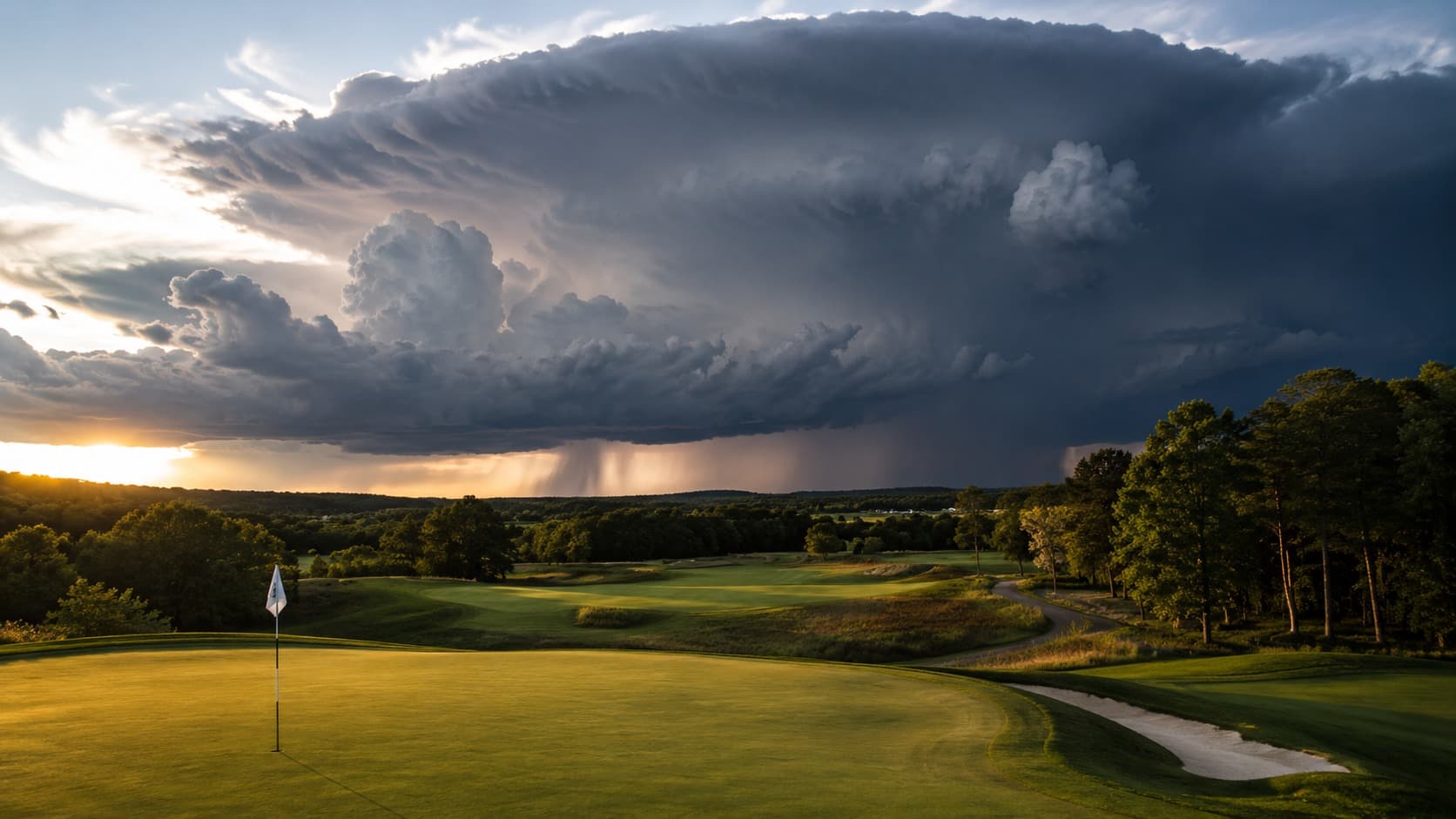
The Three O’Clock Storm: Reading Summer’s Convective Cycle to Protect Your Round
A 40% chance of afternoon thunderstorms does not mean a 40% chance of getting rained on. In the summer convective season it means the morning is nearly clear and the afternoon carries a fast-building, high-energy storm risk driven by a daily heating cycle. Here is the meteorology behind the pattern, the G-Score data on how the storm cycle punishes afternoon tee times across the Southeast, Midwest, and desert Southwest, the lightning-safety decision tree that actually matters, and the workflow that gets you off the course before the first bolt.
Read Story
How to Read a G-Score: The 0–100 Golf Playability Number, Decoded
A G-Score on this site is a single 0–100 number that tells you whether today is worth tee-up. Here is exactly what each band means, what drives the calculation, and how to use it to plan a round you will actually score on.
Read StoryMinSu Kim
Founder & Golf Data Analyst
MinSu is a data analyst and golfer with 10+ years on the course. He built Golf Weather Score to answer one question: is today a good day to play? He combines weather data, course intelligence, and the proprietary G-Score algorithm to help golfers make smarter decisions.
Every Friday Morning
When Battleground Country Club plays best next weekend.
Friday 6am ET: peak G-Score windows for Battleground Country Club, wind direction by hour, and one gear call. Three minutes to read, save you the round.
One email a week. Unsubscribe in one click.
The Caddie's Oracle
Draw your luck before the tee off