
Caddie's Gear Advisor
Curated for today's 60°F · Clear
Tour-Level Drivers
Engineered for maximum distance and forgiveness
Laser Rangefinders
Pin-seeking technology for precision approaches
Premium Golf Balls
Tour-caliber spin and distance performance
Performance Sunglasses
Polarized lenses optimized for reading greens
Your Golf Trip, Handled
The Ultimate Golf Trip Planner
Everything you need to play Bay Harbor Golf Club — from booking your flight to checking in course-side.
Course-Side Stays
Luxury hotels, resorts, and stay-and-play packages just minutes from the first tee.
Flights
Compare fares across 700+ airlines for the best route to your tee time.
SUV Rentals for Golf Bags
Spacious vehicles with room for clubs, bags, and your foursome.
Travel Insurance
Coverage for medical, weather delays, and gear at your destination.
Bay Harbor Golf Club: Course Intelligence
Signature Setup
Bay Harbor Golf Club sits on the bluffs above Little Traverse Bay, an arm of Lake Michigan just west of Petoskey. Arthur Hills routed it in 1998 across an unlikely piece of ground — a reclaimed shale quarry and former cement-plant shoreline — and split it into three distinct nines: the Links, the Quarry, and the Preserve. It is part of the Boyne Golf collection in northern Michigan. The Links nine is the postcard: several holes run right along the top of the bluff with the bay 100-plus feet below. The Quarry nine threads between exposed rock walls left over from the industrial site. The Preserve climbs inland through hardwoods. The signature stretch is the back of the Links — the 9th in particular, a par-4 of roughly 430 yards from the tips that finishes with the water on your shoulder the whole way.
Hole-by-Hole Wind & Playing Lines
The three hardest holes here are wind holes, and the wind is almost always off the water.
- The Quarry 7th (the low-handicap hole): a mid-length par-4 squeezed by shale walls. On a W/NW breeze it plays straight into your face. A 150-yard approach becomes a 175-to-180-yard shot. Club up two, aim left-center to take the right wall out of play, and accept the longer putt.
- The Links 9th (signature par-4): with the bay on the right, a left-to-right wind pushes everything toward the edge. Aim at the left rough and let the wind work the ball back. Bailing left long leaves an awkward downhill chip.
- The Links 7th (short par-3 over a gap): deceptive because it sits high and exposed. A helping wind can add a full club of carry — I have seen a 7-iron number play like a 9-iron up there.
Green & Fairway Characteristics
The greens are bentgrass and roll true; in firm, dry stretches of summer they get quick and release hard on the bluff-top holes, where the surfaces tilt toward the water. Fairways on the Links sit on sandy, well-drained ground and stay firm — expect run-out and plan your landing zones short. The Quarry plays tighter and more target-style between the rock. From the back tees the slope rating runs into the 140s, so it is a genuine test; most resort golfers are better off one set forward. Front and back nines on a given 18-hole combination land in the 3,100-to-3,400-yard range each, depending on which two nines you draw.
Seasonal Weather Pattern
This is far-northern Michigan, so the golf calendar is short and weather-driven. The season realistically runs May through October. Mornings in May and again in late September often start in the upper 40s°F, with the bay water keeping a damp chill on the bluff longer than inland courses. July and August daytime highs typically sit in the upper 70s to low 80s°F — comfortable, but the lake breeze almost always builds in the afternoon. Lake-effect cloud and sudden cool-downs are common shoulder-season; what starts as a calm, sunny tee time can turn 10-15°F cooler with a stiff onshore wind by the turn.
Local Play Tips
The routing rotates among the three nines, so confirm at check-in which two you are playing that day — the Links is the one worth requesting, and it is worth planning your tee time to be on the Links holes before the afternoon wind. I have not played the Preserve nine in the dead heat of July, so I will not pretend to know how firm those wooded greens get mid-summer — but the bluff-top Links surfaces are the ones that change most with the lake breeze. Bring a layer even in summer; the temperature on the exposed bluff can sit several degrees below the parking-lot reading.
Pre-Round Weather Workflow
Check the 7-day G-Score for Bay Harbor and weight the wind direction heavily — this course lives and dies on the W/NW lake breeze. A morning slot with light wind and a G-Score in the 8-12 range over the afternoon means you can attack the Links bluff holes before the breeze stiffens. Use the windExposure reading to decide club selection on the exposed par-3s (Links 7th, the Quarry approaches) the night before, and pack a windproof layer if the onshore forecast shows the breeze building past mid-morning.
Related Reading
Before you tee off at Bay Harbor Golf Club
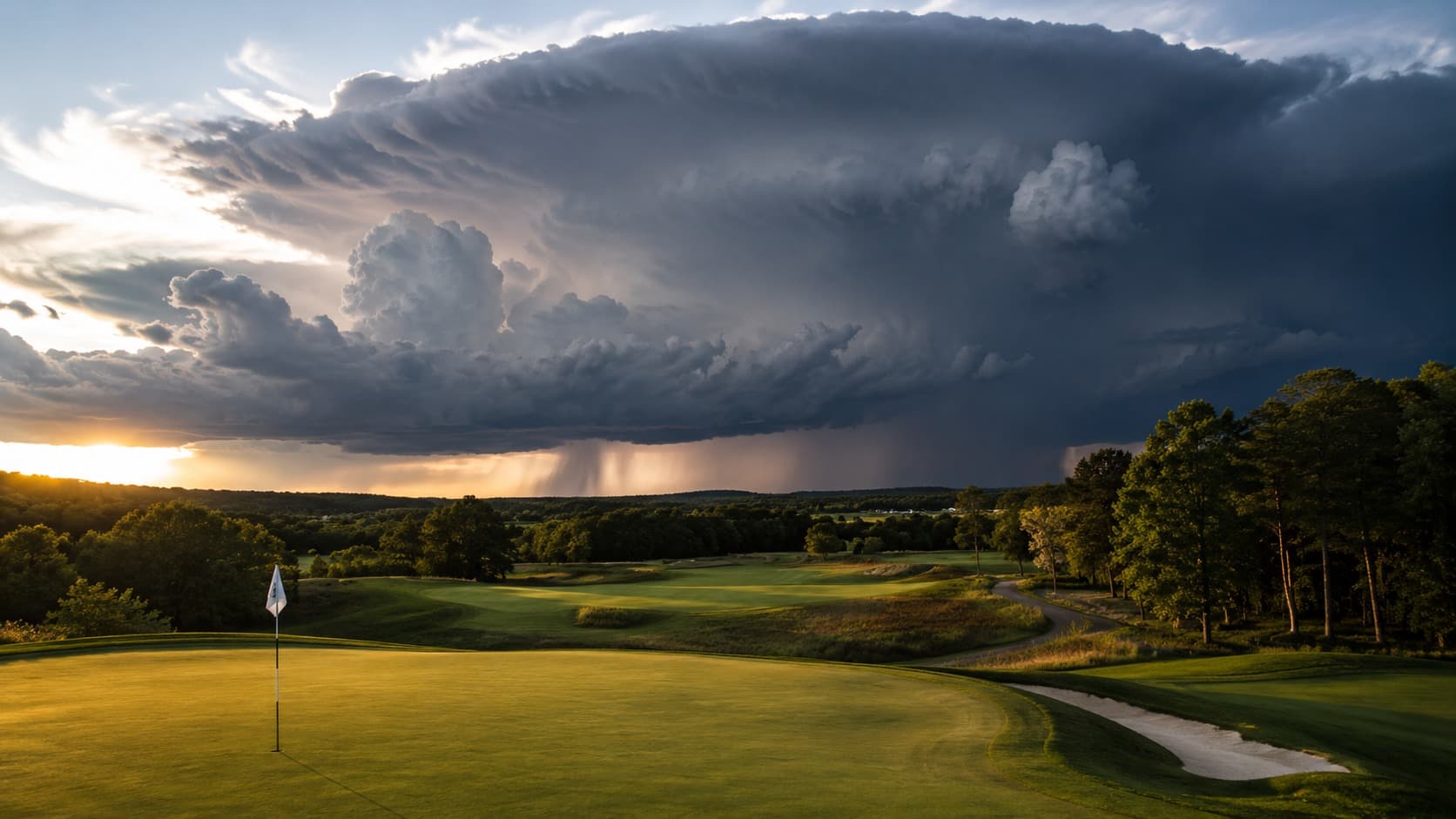
The Three O’Clock Storm: Reading Summer’s Convective Cycle to Protect Your Round
A 40% chance of afternoon thunderstorms does not mean a 40% chance of getting rained on. In the summer convective season it means the morning is nearly clear and the afternoon carries a fast-building, high-energy storm risk driven by a daily heating cycle. Here is the meteorology behind the pattern, the G-Score data on how the storm cycle punishes afternoon tee times across the Southeast, Midwest, and desert Southwest, the lightning-safety decision tree that actually matters, and the workflow that gets you off the course before the first bolt.
Read Story
How to Read a G-Score: The 0–100 Golf Playability Number, Decoded
A G-Score on this site is a single 0–100 number that tells you whether today is worth tee-up. Here is exactly what each band means, what drives the calculation, and how to use it to plan a round you will actually score on.
Read StoryMinSu Kim
Founder & Golf Data Analyst
MinSu is a data analyst and golfer with 10+ years on the course. He built Golf Weather Score to answer one question: is today a good day to play? He combines weather data, course intelligence, and the proprietary G-Score algorithm to help golfers make smarter decisions.
Every Friday Morning
When Bay Harbor Golf Club plays best next weekend.
Friday 6am ET: peak G-Score windows for Bay Harbor Golf Club, wind direction by hour, and one gear call. Three minutes to read, save you the round.
One email a week. Unsubscribe in one click.
The Caddie's Oracle
Draw your luck before the tee off