
Caddie's Gear Advisor
Curated for today's 51°F · Clouds
Cold-Weather Performance Layers
Thermal mid-layers that move with your swing
Tour Hand Warmers
Rechargeable warmers trusted by caddies
Thermal Base Layers
Lightweight compression that traps heat
Winter Golf Headwear
Beanies and ear warmers built for the links
Your Golf Trip, Handled
The Ultimate Golf Trip Planner
Everything you need to play Bay Meadows Golf Course — from booking your flight to checking in course-side.
Course-Side Stays
Luxury hotels, resorts, and stay-and-play packages just minutes from the first tee.
Flights
Compare fares across 700+ airlines for the best route to your tee time.
SUV Rentals for Golf Bags
Spacious vehicles with room for clubs, bags, and your foursome.
Travel Insurance
Coverage for medical, weather delays, and gear at your destination.
Bay Meadows Golf Course: Course Intelligence
Signature Setup
I'll be honest before I say anything else: I have not teed it up at Bay Meadows myself. I built the reads below from the club's scorecard, the layout details published for the course, and Adirondack-region climate records — the wind and temperature reasoning is profile work, not a round I'm dressing up as memory. Bay Meadows Golf Club sits in Queensbury, New York, about 2 miles from downtown Glens Falls and minutes from Lake George and Saratoga Springs. It was designed by Warren Gallagher and opened in 1953, and it has stayed a 9-hole course — 3,155 yards to a par of 35, played twice for an 18-hole round. From the blue tees the full eighteen measures 6,114 yards with a course rating of 68.7 and a slope of 117; the white set plays 5,492 yards at slope 120, and the red 4,648 yards. Halfway Brook runs through the property and crosses the holes in several places, and that water — not length — is what defends this card.
TL;DR: Short, walkable 9-hole Adirondack course (Warren Gallagher, 1953) near Glens Falls, NY. 3,155y / par 35; 6,114y / slope 117 from the blues over 18. Halfway Brook is the real hazard, the season is short, and cold mornings play softer than the daytime high suggests.
Hole-by-Hole Wind & Playing Lines
I won't invent hole numbers and per-hole yardages I can't verify, so here is how wind and water dictate play on a layout this size:
- The longest par-4s into a NW spring wind: When upstate's dry post-front northwesterly is up at 12–18 mph, a flushed 150-yard club behaves like 165–170. Slope is only 117 here, so the trouble is position, not punishment — club up one and flight the ball low rather than ballooning it into the gust and short of the water.
- The Halfway Brook crossings: On the holes where the creek cuts across the line, this becomes a carry-or-layup decision before it is a distance decision. Into a head wind the carry number climbs fast; take the layup and a wedge rather than forcing a hero carry your wind-adjusted yardage no longer supports.
- Any crosswind hole: With an open Adirondack-valley layout and limited tree shelter on the exposed holes, a player who holds a shaped ball into a crosswind scores better than one who simply hits it far. On a 3,155-yard nine, ball flight is worth more than power.
The habit that travels: read the wind off the flag on the first exposed hole, decide whether it's a dry NW post-front wind or a humid southerly, and re-club all the way around.
Green & Fairway Characteristics
The fairways are lush and the greens run fast but fair — fair being the operative word at a slope of 117, where the test is exposure and water rather than severe contour. Because it is a nine played twice, you see every green and every Halfway Brook crossing a second time, so the back-nine round is where local knowledge pays: you already know which putts break toward the creek and which approaches the wind shortened the first time through. With the blue card at 6,114 yards over eighteen, a straight hitter is flattered on a calm, dry day; the catch is that this northern course firms and softens hard with the weather, baking out under a summer high and going soft and slow under the region's frequent rain.
Seasonal Weather Pattern
Queensbury sits in a continental Adirondack-foothills climate with a genuinely short golf season — roughly April or May through October, with the shoulders cut short by frost. Spring (Apr–May): cold, raw mornings and gusty NW winds behind passing fronts; the ground is soft, the brook runs high with snowmelt, and stock yardages are unreliable. Summer (Jun–Aug): the prime window — highs in the low-to-mid 80s°F, a lighter prevailing breeze, and the firmest, fastest turf of the year, though afternoon thunderstorms roll through the region regularly. Fall (Sep–Oct): crisp, bright, and the prettiest stretch in the Lake George foothills, but morning frost can delay the first tee times and the low ground along Halfway Brook stays cold and damp well past sunrise. Winter: the course closes for upstate snow; I lean on NOAA Glens Falls–area historicals for that stretch rather than anything firsthand.
Local Play Tips
Here's the one thing a flatlander's instinct will get wrong: on a valley course like this, the air pools. Cold, dense air drains downhill overnight and settles in the low ground along Halfway Brook, so the holes nearest the creek play noticeably colder, softer, and slower in the first hour than the day's forecast high would tell you — the ball won't carry or release the way it will by mid-morning. If you have the choice in spring or fall, let the frost burn off and give the low holes an hour of sun before you expect your normal numbers. A mid-morning tee time on this course is often worth more than an early one — the reverse of the coastal "beat the sea breeze" rule.
Pre-Round Weather Workflow
Treat golfweatherscore's 7-day G-Score and windExposure as your go/no-go and timing tools — read them for a short-season northern course, not a coastal one:
- Three days out: scan the G-Score trend for frontal passages. Upstate, the swing between a 9 and a 4 is usually a weather system arriving, plus how cold the mornings are running.
- The night before: lock in wind direction and speed. A dry NW flow behind a front means firm, fast, downwind-shortened holes; a humid southerly means soft turf and storm risk later in the day.
- Round morning: if windExposure flags sustained gusts over ~20 mph — common here in spring — accept that a 6,114-yard, slope-117 card plays a full club longer into the breeze, and that the Halfway Brook carries get harder. In spring or fall, check the overnight low too: if it dropped near freezing, push your tee time later and let the creek-side holes thaw before you trust your yardages.
Related Reading
Before you tee off at Bay Meadows Golf Course
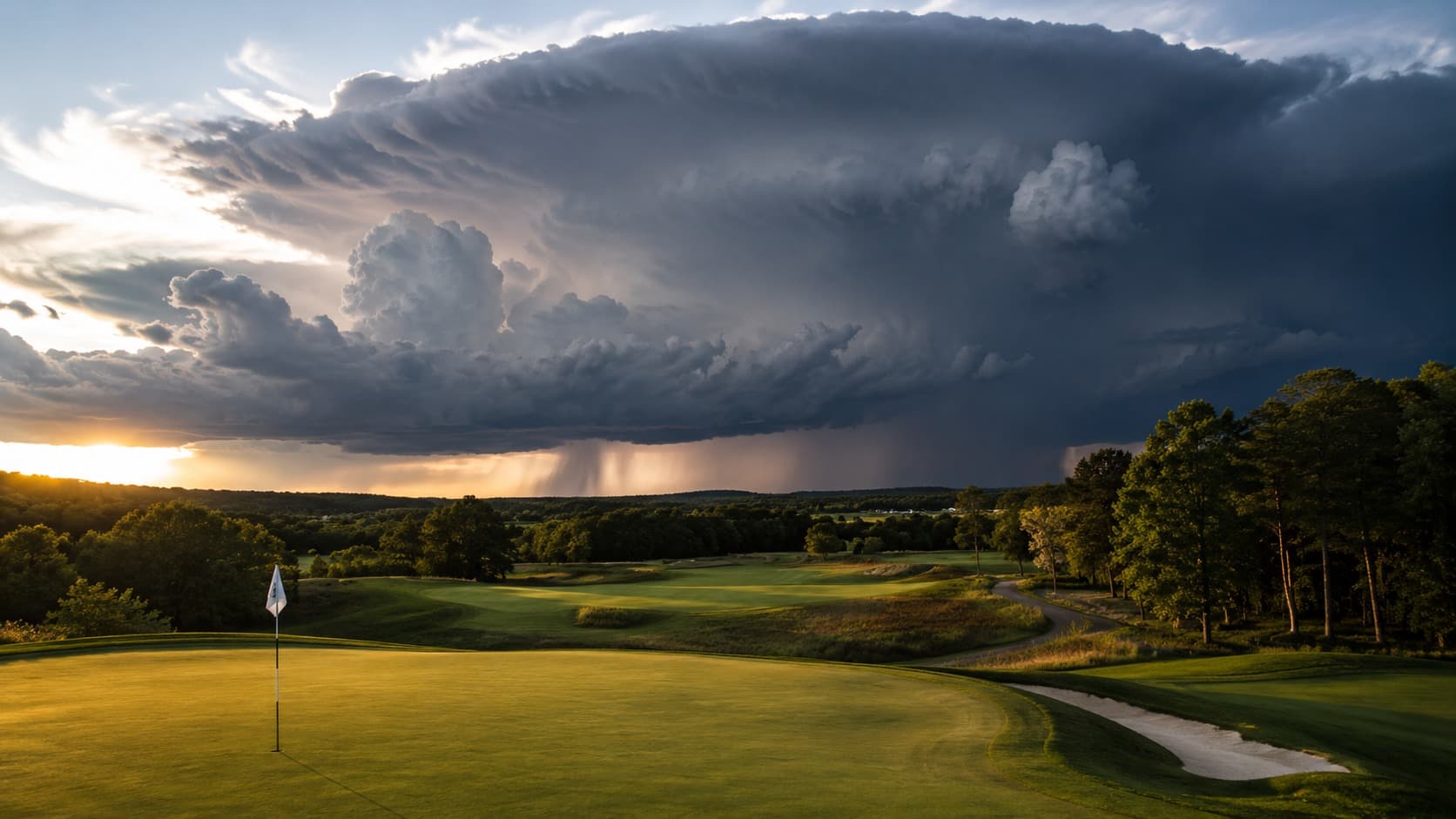
The Three O’Clock Storm: Reading Summer’s Convective Cycle to Protect Your Round
A 40% chance of afternoon thunderstorms does not mean a 40% chance of getting rained on. In the summer convective season it means the morning is nearly clear and the afternoon carries a fast-building, high-energy storm risk driven by a daily heating cycle. Here is the meteorology behind the pattern, the G-Score data on how the storm cycle punishes afternoon tee times across the Southeast, Midwest, and desert Southwest, the lightning-safety decision tree that actually matters, and the workflow that gets you off the course before the first bolt.
Read Story
How to Read a G-Score: The 0–100 Golf Playability Number, Decoded
A G-Score on this site is a single 0–100 number that tells you whether today is worth tee-up. Here is exactly what each band means, what drives the calculation, and how to use it to plan a round you will actually score on.
Read StoryMinSu Kim
Founder & Golf Data Analyst
MinSu is a data analyst and golfer with 10+ years on the course. He built Golf Weather Score to answer one question: is today a good day to play? He combines weather data, course intelligence, and the proprietary G-Score algorithm to help golfers make smarter decisions.
Every Friday Morning
When Bay Meadows Golf Course plays best next weekend.
Friday 6am ET: peak G-Score windows for Bay Meadows Golf Course, wind direction by hour, and one gear call. Three minutes to read, save you the round.
One email a week. Unsubscribe in one click.
The Caddie's Oracle
Draw your luck before the tee off