
Caddie's Gear Advisor
Curated for today's 92°F · Thunderstorm
Storm-Ready Outerwear
Waterproof layers built for 18 holes in the rain
Tour-Grade Umbrellas
68" double-canopy wind-resistant coverage
Wet-Weather Gloves
All-weather grip that performs in the rain
Waterproof Golf Shoes
Keep your feet dry through every fairway
Your Golf Trip, Handled
The Ultimate Golf Trip Planner
Everything you need to play Bay Point Resort Golf Club — from booking your flight to checking in course-side.
Course-Side Stays
Luxury hotels, resorts, and stay-and-play packages just minutes from the first tee.
Flights
Compare fares across 700+ airlines for the best route to your tee time.
SUV Rentals for Golf Bags
Spacious vehicles with room for clubs, bags, and your foursome.
Travel Insurance
Coverage for medical, weather delays, and gear at your destination.
Bay Point Resort Golf Club: Course Intelligence
Signature Setup
Bay Point Resort sits on the Grand Lagoon side of St. Andrews Bay in Panama City Beach, Florida, ringed by salt marsh and tidal water. It carries two very different 18s. The headline layout is the Nicklaus Course — born in 1986 as the Lagoon Legend, designed by Bruce Devlin and Robert von Hagge, and once ranked by Golf Digest among the very hardest courses in the country, with a slope that flirted with 152 from the back tees. Nicklaus Design rebuilt it in 2005, softening the meanest edges into the first signature Nicklaus course in Northwest Florida while keeping the marsh and lagoon as the central hazard. The second course, the Meadows, is the older and friendlier of the pair — a Willard Byrd routing from 1971 that plays more open and forgiving through pines and water. The signature moment is the Nicklaus Course's par-3 17th, a long carry over salt marsh and lagoon that frames the whole property.
Hole-by-Hole Wind & Playing Lines
The defining variable here is the Gulf sea breeze, which tends to set up from the south or southwest and stiffens as the day warms. The hardest holes are the marsh-carry holes, and they get materially longer into that wind.
- The long par-4 marsh carry (the toughest hole): roughly 440 yards across tidal marsh off the tee. On a SW breeze the carry line gets longer and the approach gets longer with it — a 150-yard number plays nearer 170. Take a conservative carry line off the tee rather than flirting with the marsh edge, and club up on the approach.
- The par-3 17th (signature): water and marsh the whole way. A helping tailwind tempts you to fly the flag, but the surface releases firm; land it short-center and let it feed. Into the breeze, take the extra club and aim at the fat of the green, not the pin.
- A lagoon-guarded par-4 on the back: the lagoon squeezes the landing zone. A crosswind off the bay pushes the tee ball toward the water — favor the dry side and accept a longer second rather than chasing yardage into the hazard.
Green & Fairway Characteristics
The greens are warm-season Bermuda surfaces built to take heat, salt air and humidity; in firm, dry stretches they get quick and release hard, which is why the marsh-carry approaches reward landing short and letting the ball run. Fairways thread through low-country lagoon and salt marsh, so accuracy off the tee matters more than raw distance — the trouble here is wet trouble, and it does not give the ball back. The Nicklaus Course plays as the genuine test of the two, with a slope into the 140s from the tips and a back nine that asks for repeated carries; most resort guests score better one set of tees forward. The Meadows is the smarter warm-up round, more open and less penal off the tee. Each 18 lands in the mid-6,000-yard range from the regular tees, stretching past 7,000 on the Nicklaus tips.
Seasonal Weather Pattern
This is the Florida Panhandle — Gulf coast, subtropical, and very seasonal in its weather risk rather than its temperature. Peak summer, June through August, runs hot and humid with daytime highs in the upper 80s to low 90s°F and near-daily afternoon thunderstorms that build off the Gulf heat; morning tee times are not a preference here, they are a strategy to finish before the storms fire. Spring and fall are the prime windows: October through April daytime highs commonly sit in the 60s to mid-70s°F with lower humidity. Winter brings periodic cold fronts down out of the northwest — a NW wind behind a front can drop the temperature 15-20°F overnight and blow hard across the exposed marsh holes, the opposite feel of the warm SW sea breeze.
Local Play Tips
Confirm which course you are booked on at check-in — the Nicklaus Course and the Meadows play like two different rounds, and the marsh-carry Nicklaus layout is the one worth requesting if you want the real test. The lagoons and salt marsh here are live habitat, so treat a ball near the water's edge as lost rather than wading after it. I have not played the Meadows in the dead heat of a July afternoon, so I will not pretend to know exactly how firm those greens get when the storms hold off — but on the Nicklaus Course, the firmer the marsh-carry approaches play, the more you want to land short and run it on. Pack rain protection in summer regardless of a clear morning sky; the afternoon build-up is the rule, not the exception.
Pre-Round Weather Workflow
Check the 7-day G-Score for Bay Point and read the wind direction first — a warm SW sea breeze lengthens the marsh carries through the day, while a post-front NW wind both chills and stiffens the exposed holes. In summer, weight the afternoon thunderstorm risk heavily and take the earliest slot a good G-Score allows so you finish ahead of the build-up. Use the windExposure reading the night before to settle club selection on the par-3 17th and the long marsh-carry par-4, and pack rain gear any time the summer forecast shows afternoon storms forming off the Gulf. My own rule on Gulf-coast layouts like this one is simple: get the marsh carries behind me before the breeze fills in, because every one of them gets a club longer once the sea breeze sets up.
Related Reading
Before you tee off at Bay Point Resort Golf Club
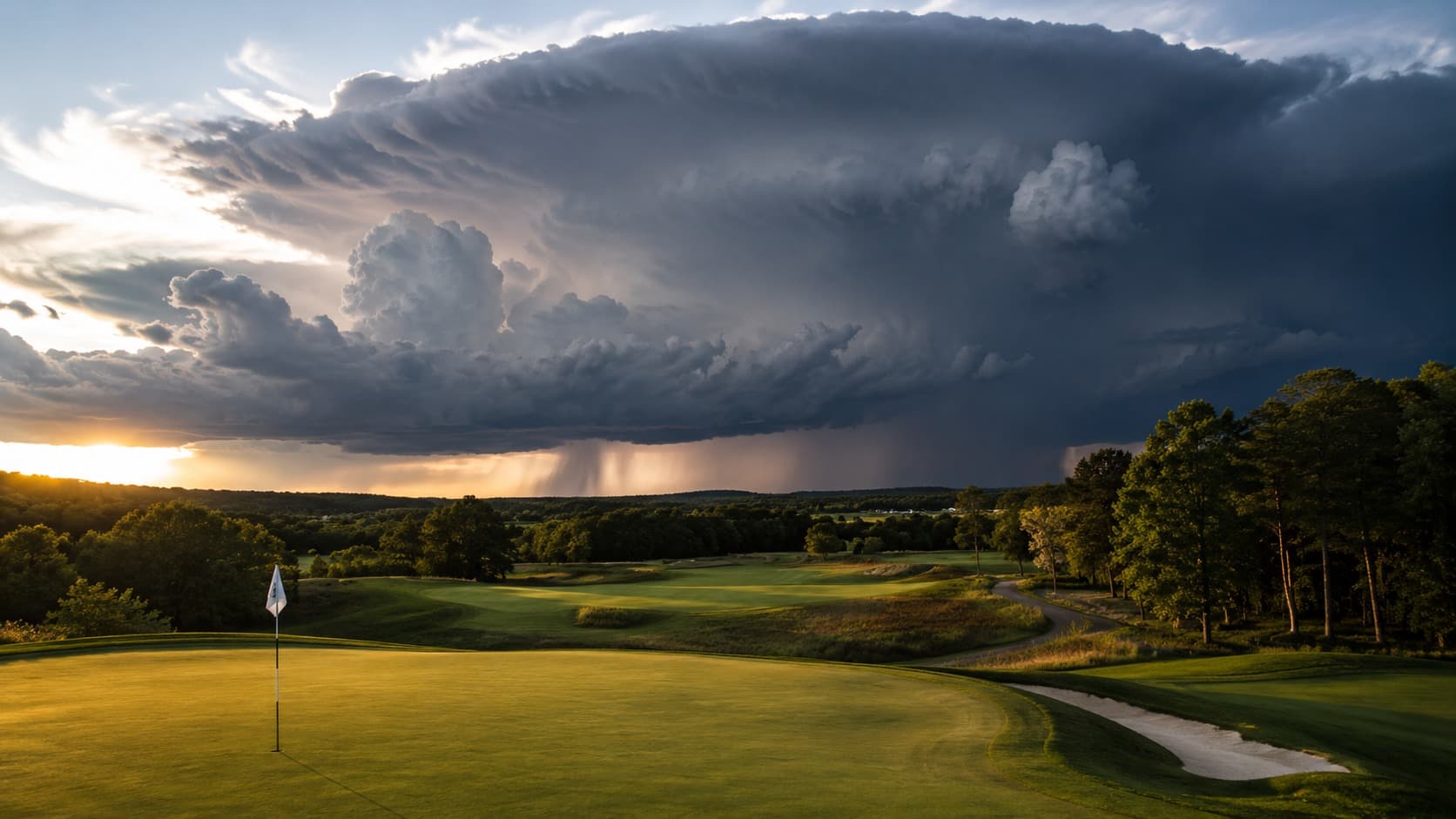
The Three O’Clock Storm: Reading Summer’s Convective Cycle to Protect Your Round
A 40% chance of afternoon thunderstorms does not mean a 40% chance of getting rained on. In the summer convective season it means the morning is nearly clear and the afternoon carries a fast-building, high-energy storm risk driven by a daily heating cycle. Here is the meteorology behind the pattern, the G-Score data on how the storm cycle punishes afternoon tee times across the Southeast, Midwest, and desert Southwest, the lightning-safety decision tree that actually matters, and the workflow that gets you off the course before the first bolt.
Read Story
How to Read a G-Score: The 0–100 Golf Playability Number, Decoded
A G-Score on this site is a single 0–100 number that tells you whether today is worth tee-up. Here is exactly what each band means, what drives the calculation, and how to use it to plan a round you will actually score on.
Read StoryMinSu Kim
Founder & Golf Data Analyst
MinSu is a data analyst and golfer with 10+ years on the course. He built Golf Weather Score to answer one question: is today a good day to play? He combines weather data, course intelligence, and the proprietary G-Score algorithm to help golfers make smarter decisions.
Every Friday Morning
When Bay Point Resort Golf Club plays best next weekend.
Friday 6am ET: peak G-Score windows for Bay Point Resort Golf Club, wind direction by hour, and one gear call. Three minutes to read, save you the round.
One email a week. Unsubscribe in one click.
The Caddie's Oracle
Draw your luck before the tee off