
Caddie's Gear Advisor
Curated for today's 85°F · Clear
Tour-Level Drivers
Engineered for maximum distance and forgiveness
Laser Rangefinders
Pin-seeking technology for precision approaches
Premium Golf Balls
Tour-caliber spin and distance performance
Performance Sunglasses
Polarized lenses optimized for reading greens
Your Golf Trip, Handled
The Ultimate Golf Trip Planner
Everything you need to play Bayside Golf Club — from booking your flight to checking in course-side.
Course-Side Stays
Luxury hotels, resorts, and stay-and-play packages just minutes from the first tee.
Flights
Compare fares across 700+ airlines for the best route to your tee time.
SUV Rentals for Golf Bags
Spacious vehicles with room for clubs, bags, and your foursome.
Travel Insurance
Coverage for medical, weather delays, and gear at your destination.
Bayside Golf Club: Course Intelligence
Signature Setup
The first thing that surprised me at Bayside was that there are no trees to hide behind. I drove up from the lake road on a July morning, 64°F at 7:30, and the wind was already pulling at my cap on the practice green — and that was the calm part of the day. This is a true prairie links sitting on the high bluffs above Lake McConaughy in Brule, Nebraska, and the lake is both the view and the problem.
Dave Axland and Dan Proctor — the same hands behind Wild Horse in Gothenburg — built Bayside in 2002, routing a par-72 layout of roughly 7,000 yards across open, treeless High Plains ground. There is almost no shelter anywhere on the property. What defines this course isn't a famous hole; it's that the wind off the reservoir is in play on all 18, and the firm fescue lets it do real damage.
Hole-by-Hole Wind & Playing Lines
The long par-4 on the front (#1 handicap, ~450y). This is the hole that exposed me. It runs straight into the prevailing SSW summer wind, and into a 15–20 mph breeze it is genuinely a driver-plus-long-iron hole, not the mid-iron approach the yardage implies. I aimed up the right side and let the crosswind component walk the ball back toward center. Bailing left here leaves a longer, more exposed second.
The signature par-3 over the bluff edge (~165y card). With the lake behind you the wind is rarely neutral. On my round a quartering tailwind turned a stock 7-iron into a soft 9, and an hour later the same hole into a freshening breeze would have been a 5-iron. Club off the flagstick dance, not the number — watch how the pin behaves before you commit.
A reachable downwind par-5 on the back. When the SSW wind is at your back this becomes a two-shot hole, but the green sits firm and the run-up is fast — I landed 20 yards short on purpose and let it chase on. Flying it in downwind is a fool's errand on this turf.
Green & Fairway Characteristics
Bayside is fine fescue through the fairways, firm and fast the way a links should be, so the ground game is not optional — it's the smart play. Approaches that land soft and stop are the exception; plan for release on nearly every shot. The greens are bentgrass and run true, with slope ratings in the low-130s from the back markers. They're not severely contoured, but they're exposed enough that putting into wind matters — a downhill, downwind putt gets away from you. Front nine and back nine both stay open; there is no sheltered stretch where you can reset, which is unusual and worth bracing for mentally.
Seasonal Weather Pattern
This is western Nebraska's semi-arid High Plains — Keith County sits near 3,300 feet of elevation, which adds a little carry but also dries everything out. Summer (June–August) brings warm days in the mid-80s to low-90s°F with cool mornings near 60, and the playing season runs roughly April through October. The constant here is wind: this part of Nebraska averages double-digit mph wind speeds year-round, and the open lake fetch amplifies it on the bluffs. I haven't played Bayside in late October, so I won't pretend to know its shoulder-season firmness firsthand — but NOAA records for the area show fast-dropping evening temps and frequent frost delays by mid-fall.
Local Play Tips
The local read no scorecard gives you: the lake side of the property is windier than the inland side, even on holes that look identically exposed. The bluff drops straight to the water, and the air coming up that face is faster and more turbulent than the steadier prairie wind on the back of the property. On bluff-edge shots I added a club and aimed away from the drop every time. Second tip — the High Plains elevation flatters your distances slightly, so don't recalibrate your clubs upward and then get burned when you turn downwind.
Pre-Round Weather Workflow
Use the 7-day G-Score on this page the way I do at any exposed links. Three days out, check whether your tee window lands before or after the midday wind build — at a course this open that single choice can move your score 8–12 points, and the first morning tee time is almost always the higher number. The morning of, read the windExposure panel for direction: a SSW wind means the front-nine long holes play dead into it while the downwind par-5 on the back becomes reachable, so map your aggressive clubs accordingly. If the forecast shows sustained wind over 20 mph, commit fully to the ground game — keep approaches low, expect firm-fescue release on every green, and never try to fly a downwind shot to a tucked pin.
Related Reading
Before you tee off at Bayside Golf Club

America's 20 Windiest Golf Courses: A G-Score Wind Analysis
We ranked America's 20 windiest golf courses using G-Score wind penalty data. See how coastal gusts and prairie gales reshape playability scores.
Read Story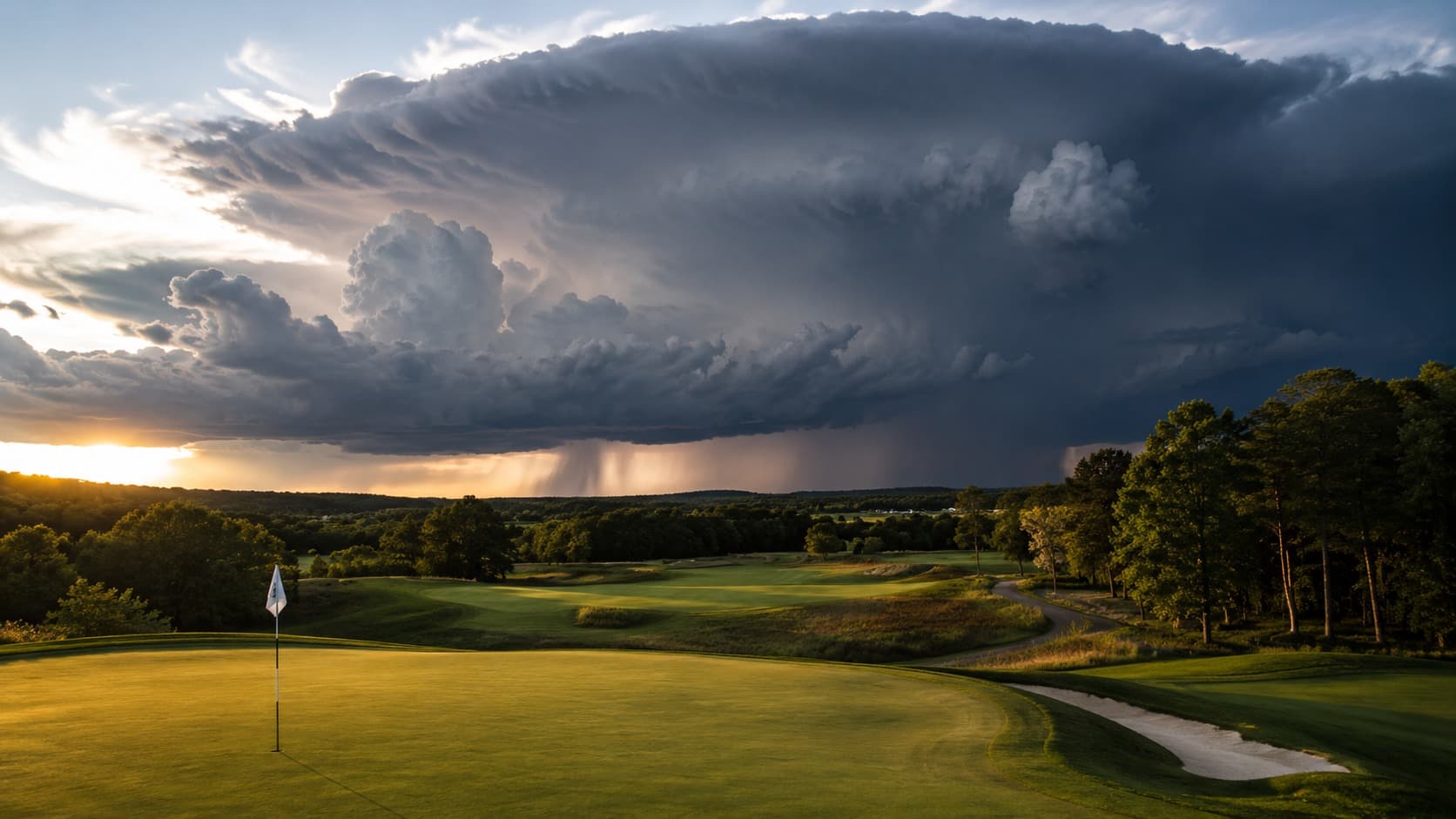
The Three O’Clock Storm: Reading Summer’s Convective Cycle to Protect Your Round
A 40% chance of afternoon thunderstorms does not mean a 40% chance of getting rained on. In the summer convective season it means the morning is nearly clear and the afternoon carries a fast-building, high-energy storm risk driven by a daily heating cycle. Here is the meteorology behind the pattern, the G-Score data on how the storm cycle punishes afternoon tee times across the Southeast, Midwest, and desert Southwest, the lightning-safety decision tree that actually matters, and the workflow that gets you off the course before the first bolt.
Read StoryMinSu Kim
Founder & Golf Data Analyst
MinSu is a data analyst and golfer with 10+ years on the course. He built Golf Weather Score to answer one question: is today a good day to play? He combines weather data, course intelligence, and the proprietary G-Score algorithm to help golfers make smarter decisions.
Every Friday Morning
When Bayside Golf Club plays best next weekend.
Friday 6am ET: peak G-Score windows for Bayside Golf Club, wind direction by hour, and one gear call. Three minutes to read, save you the round.
One email a week. Unsubscribe in one click.
The Caddie's Oracle
Draw your luck before the tee off