
Caddie's Gear Advisor
Curated for today's 56°F · Clouds
Tour-Level Drivers
Engineered for maximum distance and forgiveness
Laser Rangefinders
Pin-seeking technology for precision approaches
Premium Golf Balls
Tour-caliber spin and distance performance
Performance Sunglasses
Polarized lenses optimized for reading greens
Your Golf Trip, Handled
The Ultimate Golf Trip Planner
Everything you need to play Bear Creek Country Club — from booking your flight to checking in course-side.
Course-Side Stays
Luxury hotels, resorts, and stay-and-play packages just minutes from the first tee.
Flights
Compare fares across 700+ airlines for the best route to your tee time.
SUV Rentals for Golf Bags
Spacious vehicles with room for clubs, bags, and your foursome.
Travel Insurance
Coverage for medical, weather delays, and gear at your destination.
Bear Creek Country Club: Course Intelligence
Signature Setup
Let me be straight up front, the way I always am: I have studied Bear Creek from its design pedigree, the scorecard, and the inland Riverside County climate I drive through often from Irvine — but I have not walked all 18 here myself, so the wind reads below are profile-and-pattern reasoning, not a round I'm dressing up as memory. What is well documented is the bones of the place: this is a Jack Nicklaus Signature design that opened in 1981, set in the Temecula-valley wine country southeast of Los Angeles, and it has long carried a reputation as one of Southern California's sterner private tests — a tree-lined, water-touched layout with a slope said to sit in the mid-140s from the tips at around 6,900 yards. That is the honest headline: this is a shotmaker's course where Nicklaus's demand for precision off the tee meets a hot, dry inland climate that swings the greens from soft to glassy across a single afternoon.
TL;DR: Jack Nicklaus Signature design (1981) in inland Riverside County wine country. Tight, tree-lined, water in play, tournament-grade slope reputed in the mid-140s at ~6,900y. The real variable is the daily swing from a still, soft marine-layer morning to a hot, firm, WNW-windy afternoon. Tee off early.
Hole-by-Hole Wind & Playing Lines
The club does not publish a per-hole handicap card I can independently verify, so I won't invent hole numbers and exact yardages — instead, here is how this inland wind pattern dictates play by hole type:
- The long par-4s into an afternoon WNW desert flow: When the dry inland wind builds to 12–18 mph after 1 p.m., a flushed 150-yard club plays like 170–175. With a slope in the mid-140s the penalty for short-siding is real — club up two and start the ball at the safe center of the green, letting the wind drift it back.
- The water-guarded short holes (par-3s and reachable par-4s): In the soft marine-layer morning a high approach holds; by the firm, windy afternoon the same shot skips toward the hazard. Land it short and let it release in the heat of the day rather than carrying the flag.
- Any crosswind hole through the trees: The tree lines funnel and gust the wind unpredictably, so a player who can hold a low, shaped ball scores better than a long, high hitter who gets knocked around. On a Nicklaus track, position off the tee is the whole game.
The habit that travels: read the flags on the first exposed hole, decide whether you're playing a calm morning or a building-wind afternoon, and re-club every approach from there.
Green & Fairway Characteristics
The greens run fast and firm through the summer — bentgrass/poa surfaces over inland Riverside County clay that bakes hard under dry heat — and on a Nicklaus Signature layout they tend to be generous in size but heavily contoured, defending par with tier and tilt rather than tiny targets. The fairways are tight and tree-lined, which is the design's first line of defense: with a slope reputed in the mid-140s from roughly 6,900 yards, missing the short grass off the tee turns a manageable approach into a recovery. Firmness swings hard with the weather here — soft and receptive under the late-spring/early-summer marine layer, glassy and running by mid-summer afternoons — so your stock yardages are only fully reliable in the calm morning window.
Seasonal Weather Pattern
Bear Creek sits in an inland Southern California climate — hot, dry, and continental compared to the coast just 30-some miles west. Late spring (May–Jun): the marine layer, the local "May Gray / June Gloom," often blankets mornings with cool grey before burning off — the best scoring window, with still air and receptive greens early. Summer (Jul–Sep): hot and dry, afternoon highs commonly in the low-to-mid 90s°F inland, firm greens, and a building afternoon wind; this is when the morning-vs-afternoon scoring gap is widest. Fall (Oct–Nov): the Santa Ana season — dry, gusty WNW/NE offshore winds that can arrive hot and hard, the trickiest wind reads of the year. Winter (Dec–Feb): mild and playable by most US standards, cooler mornings, occasional rain softening the greens; I lean on NOAA/weather.com Riverside-County historicals for that stretch rather than anything firsthand.
Local Play Tips
Here's the one thing a coastal-golf instinct gets wrong inland: you do not tee off late to let the marine layer burn off for sunshine — you tee off into the grey on purpose. That cool morning cloud is doing two jobs for your score: it stills the wind and it keeps the greens soft enough to hold an approach. By early afternoon the inland heat has fired the surfaces and a WNW flow is building, and the same course plays a club or two longer and far less forgiving. The Santa Ana wind in fall is the wildcard — it can blow hot and dry from the desert side and reverse the normal read entirely, so on those days check the offshore forecast before you decide which side of the green to favor.
Pre-Round Weather Workflow
Treat golfweatherscore's 7-day G-Score and windExposure as your go/no-go and your tee-time tool — read it for a hot inland course, not a coastal one:
- Three days out: scan the G-Score trend and the temperature curve. Inland, the gap between a 9 and a 4 is usually the afternoon heat and the building wind, not a passing storm.
- The night before: lock in wind direction and speed. A still marine-layer morning means soft, receptive golf; a WNW or Santa Ana flow means firm, fast, longer-playing conditions where the downwind holes shrink and the into-wind par-4s balloon.
- Round morning: if windExposure flags sustained gusts over ~15 mph for the afternoon — common in summer and in the fall Santa Ana season — take the earliest tee time you can, accept that a mid-140s-slope card will punish a short-side miss, and let position-golf protect your number.
Related Reading
Before you tee off at Bear Creek Country Club
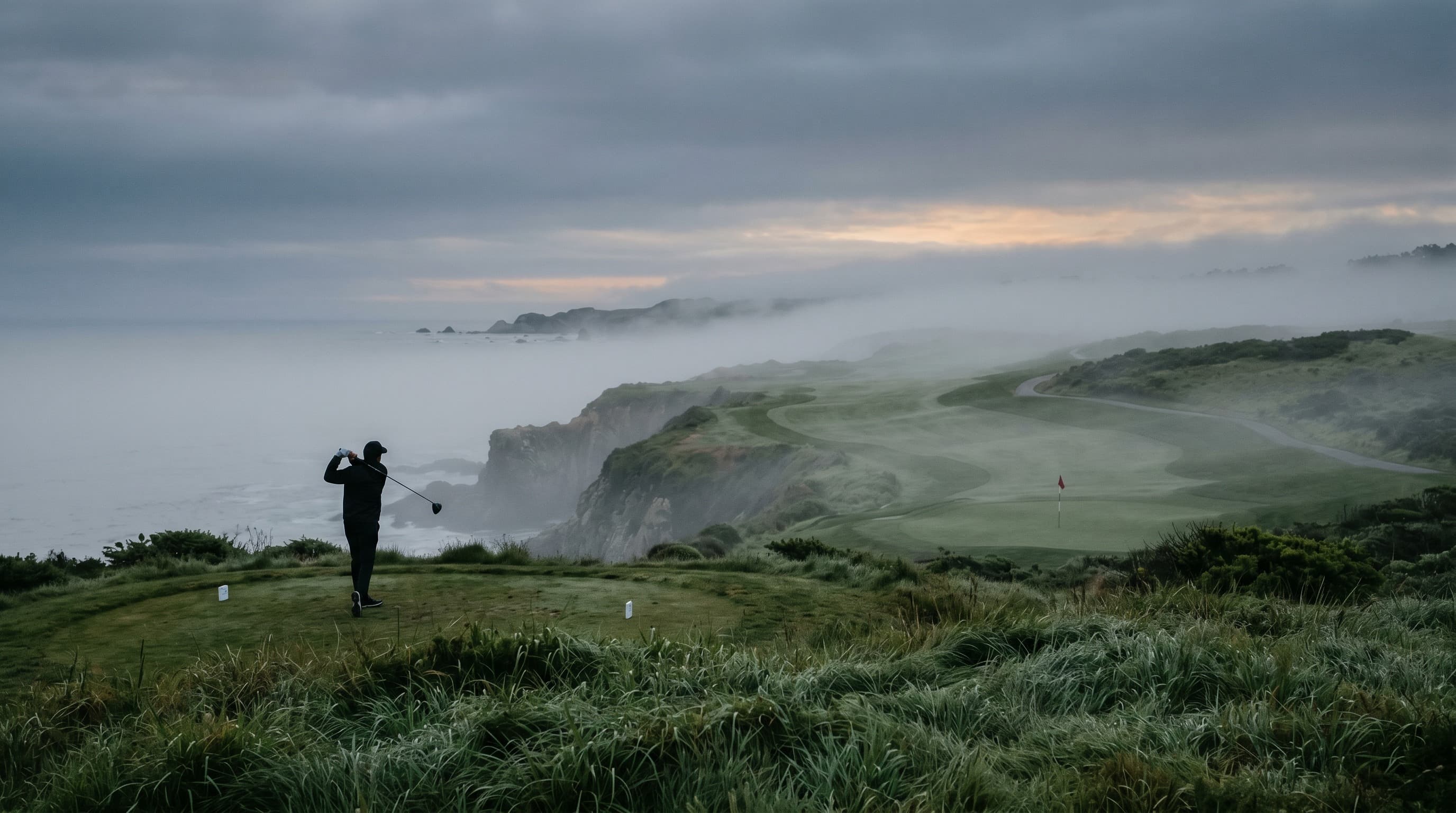
Reading Coastal Wind: How the Marine Layer Reshapes Pebble Beach, Bandon, and the Pacific Coast Game
Coastal golf does not play by inland rules. The marine layer suppresses wind in the morning, then releases it through midday in a thermal cycle that turns a calm 7am tee into a 22mph back nine. Here is the meteorology behind the pattern, the G-Score data that confirms it across the Pacific coast, and the morning workflow that turns the marine layer from a confusion into a competitive advantage.
Read Story
America's 20 Windiest Golf Courses: A G-Score Wind Analysis
We ranked America's 20 windiest golf courses using G-Score wind penalty data. See how coastal gusts and prairie gales reshape playability scores.
Read StoryMinSu Kim
Founder & Golf Data Analyst
MinSu is a data analyst and golfer with 10+ years on the course. He built Golf Weather Score to answer one question: is today a good day to play? He combines weather data, course intelligence, and the proprietary G-Score algorithm to help golfers make smarter decisions.
Every Friday Morning
When Bear Creek Country Club plays best next weekend.
Friday 6am ET: peak G-Score windows for Bear Creek Country Club, wind direction by hour, and one gear call. Three minutes to read, save you the round.
One email a week. Unsubscribe in one click.
The Caddie's Oracle
Draw your luck before the tee off