
Caddie's Gear Advisor
Curated for today's 93°F · Clear
Ultralight Distance Drivers
Maximum carry in hot, low-drag conditions
UV Protection Apparel
UPF 50+ cooling fabrics for peak-sun rounds
Precision Rangefinders
Slope-adjusted yardage in any condition
Hydration & Cooling
Insulated bottles and cooling towels
Your Golf Trip, Handled
The Ultimate Golf Trip Planner
Everything you need to play Belle Meade — from booking your flight to checking in course-side.
Course-Side Stays
Luxury hotels, resorts, and stay-and-play packages just minutes from the first tee.
Flights
Compare fares across 700+ airlines for the best route to your tee time.
SUV Rentals for Golf Bags
Spacious vehicles with room for clubs, bags, and your foursome.
Travel Insurance
Coverage for medical, weather delays, and gear at your destination.
Belle Meade: Course Intelligence
Signature Setup
Belle Meade Country Club opened in 1901 as the Nashville Golf and Country Club, moved to its current Belle Meade ground in 1916, and that is where its design story gets interesting. Herbert Barker signed the contract to lay out the new course in October 1914, but family illness pulled him away, and in 1917 the club brought in Donald Ross to finish the job. By the time the club took the Belle Meade name in 1921, it was — and is still — known as a Ross course. Robert Trent Jones reworked it in the 1950s, and in 2003 Rees Jones and Bryce Swanson restored it. Today it plays to 6,885 yards, par 72, course rating 74.6, slope 139, and the USGA has tapped it to host senior amateur championship golf — a credible sign the bones are tournament-grade.
Hole-by-Hole Wind & Playing Lines
Belle Meade is private and I have not walked all 18 here, so I will be honest: I am reading this from Ross's transition-zone DNA and Nashville's wind record, not from my own scorecard on this property. On Ross parkland routings like this, the prevailing summer flow is light and out of the southwest; the danger is not raw wind speed but how a 5–8 mph crosswind interacts with firm, crowned greens. Into even a soft SW breeze, a 150-yard approach that lands pin-high will release off the back collar — the green gives back the yardage the wind took. The defensive play on the harder two-shotters is to take one more club, start the ball at the fat center of the green, and accept a 20-foot putt over a fired-at flag and a chip from a shaved run-off. North and northwest fronts after a fall cold front stiffen the par-4s on the back nine and turn the longer approaches into genuine 3-iron / hybrid shots.
Green & Fairway Characteristics
The greens are bentgrass, the fairways Bermuda — the classic Tennessee transition-zone pairing, and the reason conditioning swings with the calendar. In spring and fall the bent runs fast and true; in deep summer it is syrup-thick by mid-afternoon as heat stress sets in. The Ross complexes are the whole examination: turtleback shapes that repel a ball missed to the high side and run-offs that leave you putting from off the surface. Fairways are Bermuda and firm, so a well-struck drive chases out and rewards position over raw length — at slope 139 the trouble is the angle into the green, not the tee shot.
Seasonal Weather Pattern
Nashville is humid subtropical and the transition months are the prize. April and October highs sit in the upper-60s to mid-70s°F with low dewpoints — that is when the bent is quick and the air is dry enough that the ball flies normally. July and August are the tax: highs near 89–90°F, dewpoints in the low-70s°F, and afternoon thunderstorm odds spiking after 2 p.m. Winter is playable but raw, with January highs in the upper-40s°F and a slower, dormant-Bermuda look to the fairways.
Local Play Tips
The single best edge here is the clock. On a humid-subtropical morning the bentgrass is at its firmest and fastest before the day heats up, and the afternoon storm risk that defines a Nashville summer has not yet built. An 8 a.m. tee time on this kind of property routinely plays several G-Score points better than a 2 p.m. one — drier greens, calmer air, no lightning delay. Because it is a private club, plan around a member host and a confirmed window rather than walk-up access.
Pre-Round Weather Workflow
Use the 7-day G-Score and windExposure read before you book the morning. First, check the dewpoint, not just the temperature — a 70°F+ dewpoint is the real summer signal that the greens will slow and you will sweat through a glove by the turn. Second, scan the afternoon thunderstorm probability and bias your tee time to the morning half of the day. Third, read the windExposure direction: a SW flow pushes approaches long over these crowned greens, so club up and aim center; a post-front NW flow stiffens the back nine into-the-wind. Lock the earliest dry window the forecast offers and let the firm, fast Ross greens reward you for being early.
Related Reading
Before you tee off at Belle Meade
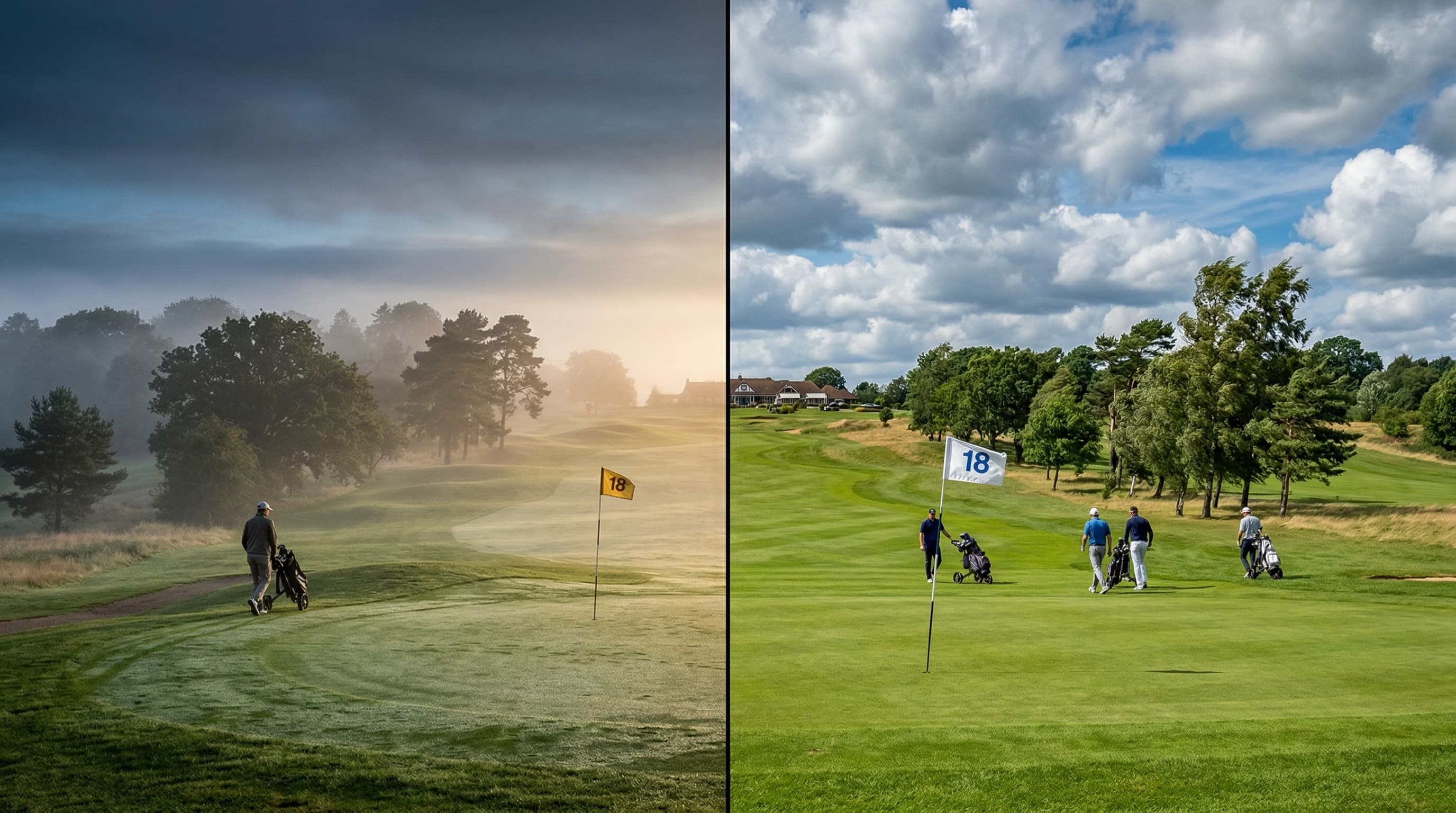
Morning vs Afternoon Tee Times: What Weather Data Reveals About When to Play
Hourly weather data reveals morning tee times score 8-12 G-Score points higher than afternoon slots. Here is what the numbers say about optimal timing.
Read Story
Best Golf Weather by State: Ranking America by Average G-Score
We ranked all 50 US states by average G-Score golf playability. California tops the list, but the results beyond the top five may surprise you.
Read StoryMinSu Kim
Founder & Golf Data Analyst
MinSu is a data analyst and golfer with 10+ years on the course. He built Golf Weather Score to answer one question: is today a good day to play? He combines weather data, course intelligence, and the proprietary G-Score algorithm to help golfers make smarter decisions.
Every Friday Morning
When Belle Meade plays best next weekend.
Friday 6am ET: peak G-Score windows for Belle Meade, wind direction by hour, and one gear call. Three minutes to read, save you the round.
One email a week. Unsubscribe in one click.
The Caddie's Oracle
Draw your luck before the tee off