
Caddie's Gear Advisor
Curated for today's 97°F · Clear
Ultralight Distance Drivers
Maximum carry in hot, low-drag conditions
UV Protection Apparel
UPF 50+ cooling fabrics for peak-sun rounds
Precision Rangefinders
Slope-adjusted yardage in any condition
Hydration & Cooling
Insulated bottles and cooling towels
Your Golf Trip, Handled
The Ultimate Golf Trip Planner
Everything you need to play Belle Terre Country Club — from booking your flight to checking in course-side.
Course-Side Stays
Luxury hotels, resorts, and stay-and-play packages just minutes from the first tee.
Flights
Compare fares across 700+ airlines for the best route to your tee time.
SUV Rentals for Golf Bags
Spacious vehicles with room for clubs, bags, and your foursome.
Travel Insurance
Coverage for medical, weather delays, and gear at your destination.
Belle Terre Country Club: Course Intelligence
Signature Setup
Let me be honest up front: I studied Belle Terre Country Club from the scorecard, the course's Pete Dye pedigree, and southeast Louisiana climate records — I have not teed it up myself, so the wind reads below are profile-and-pattern reasoning, not a round I'm dressing up as memory. The course sits in LaPlace, Louisiana, in St. John the Baptist Parish, a low, flat stretch of ground between the Mississippi River and Lake Pontchartrain about 30 miles west of New Orleans. It carries a Pete Dye design from around 1979–1980, and it plays to a par of 72 at roughly 7,000 yards from the tips. The number that matters here is not the yardage — it's the elevation. This is near-sea-level terrain, fully exposed to Gulf moisture, and the weather, not the routing, is what defends your score.
TL;DR: Pete Dye par-72 (~7,000y) in LaPlace, Louisiana, on flat near-sea-level Gulf-margin ground. Bermuda greens, no tree shelter, humid-subtropical weather. Heat, humidity, and afternoon storms decide the round — tee off early.
Hole-by-Hole Wind & Playing Lines
I won't invent a per-hole handicap card I can't verify, so here is how the wind dictates play on a flat Dye layout this size:
- The longer par-4s into a S/SE Gulf flow: When the warm southerly is up at 12–18 mph — the default summer pattern here — a flushed 150-yard club behaves like 165–170. On open LaPlace ground nothing blocks it, so club up one and flight the ball low rather than ballooning it into the breeze.
- The forced-carry water holes: Dye loves a carry over wetland or bayou. Into a headwind those carries get a full club longer; lay back to a comfortable number rather than gambling on a hero line that the wind can swallow.
- Any crosswind hole: With no tree cover to break the flow, a player who holds a shaped ball into a crosswind scores better than one who just hits it far. Length is the cheap yard here; ball flight is the expensive one.
The habit that travels: read the wind off the first exposed flag, decide whether it's a steady Gulf thermal or a frontal wind, and re-club all the way in.
Green & Fairway Characteristics
The greens are Bermuda — standard for the Gulf South, where bentgrass cannot survive the summer heat — set on flat, low-lying ground. Firmness swings hard with the weather: a dry high-pressure spell bakes the surfaces fast and running, while the region's frequent rain leaves them soft and slow, holding even an aggressive approach. The fairways are flat and exposed, and at par 72 around 7,000 yards the card flatters a straight hitter on a calm day. The catch is that calm days are rare on this coast — and when the ground is wet, you lose the run-out that makes the back tees playable.
Seasonal Weather Pattern
LaPlace sits in a humid-subtropical, Gulf-margin climate — the opposite of a dry continental course. Spring (Mar–May): the prime window — warm, drier air behind passing fronts, firmer greens, and the most comfortable scoring conditions before the humidity builds. Summer (Jun–Aug): hot and oppressive, highs in the low-90s°F with a heat index well past 100, a prevailing S/SE Gulf breeze, and near-daily afternoon thunderstorms that build by 2–3 p.m. This is also Atlantic hurricane season (June–November), when the course can close outright for a tropical system. Fall (Sep–Oct): the humidity eases and the golf turns excellent, though the tropical risk lingers into October. Winter (Dec–Feb): mild and playable — frost is rare this far south — but wetter, with frequent rain softening the ground; I rely on NOAA New Orleans-area historicals for that stretch rather than anything firsthand.
Local Play Tips
The one thing that decides your round here is the clock, but not for the reason a coastal-California golfer would think. On the Gulf, the enemy isn't a midday sea breeze — it's the afternoon convective storm. Summer heating off the wetlands fires thunderstorms that build almost daily by early-to-mid afternoon, and lightning will clear the course faster than any starter. Combine that with a heat index that can top 100°F by noon, and the math is simple: a 7 a.m. tee time gives you cooler air, calmer wind, and a finished round before the cells go up. Golfers who sleep in trade a pleasant morning for a sweaty, storm-interrupted afternoon.
Pre-Round Weather Workflow
Treat golfweatherscore's 7-day G-Score and windExposure as your go/no-go and your timing tool — but read it for a Gulf-margin course, not a links:
- Three days out: scan the G-Score trend for frontal passages and tropical activity. From June through November, check whether anything is spinning in the Gulf before you commit to a tee time.
- The night before: lock in wind direction and the storm risk. A steady S/SE flow means humid, storm-prone afternoon golf; a post-front NW flow means drier, firmer, more comfortable conditions.
- Round morning: if windExposure flags sustained Gulf gusts over ~18 mph, accept that a flat, treeless ~7,000-yard card will play a full club longer into the breeze — and if the afternoon storm probability is high, take the earliest tee time you can and let position-golf protect your number before the cells build.
Related Reading
Before you tee off at Belle Terre Country Club
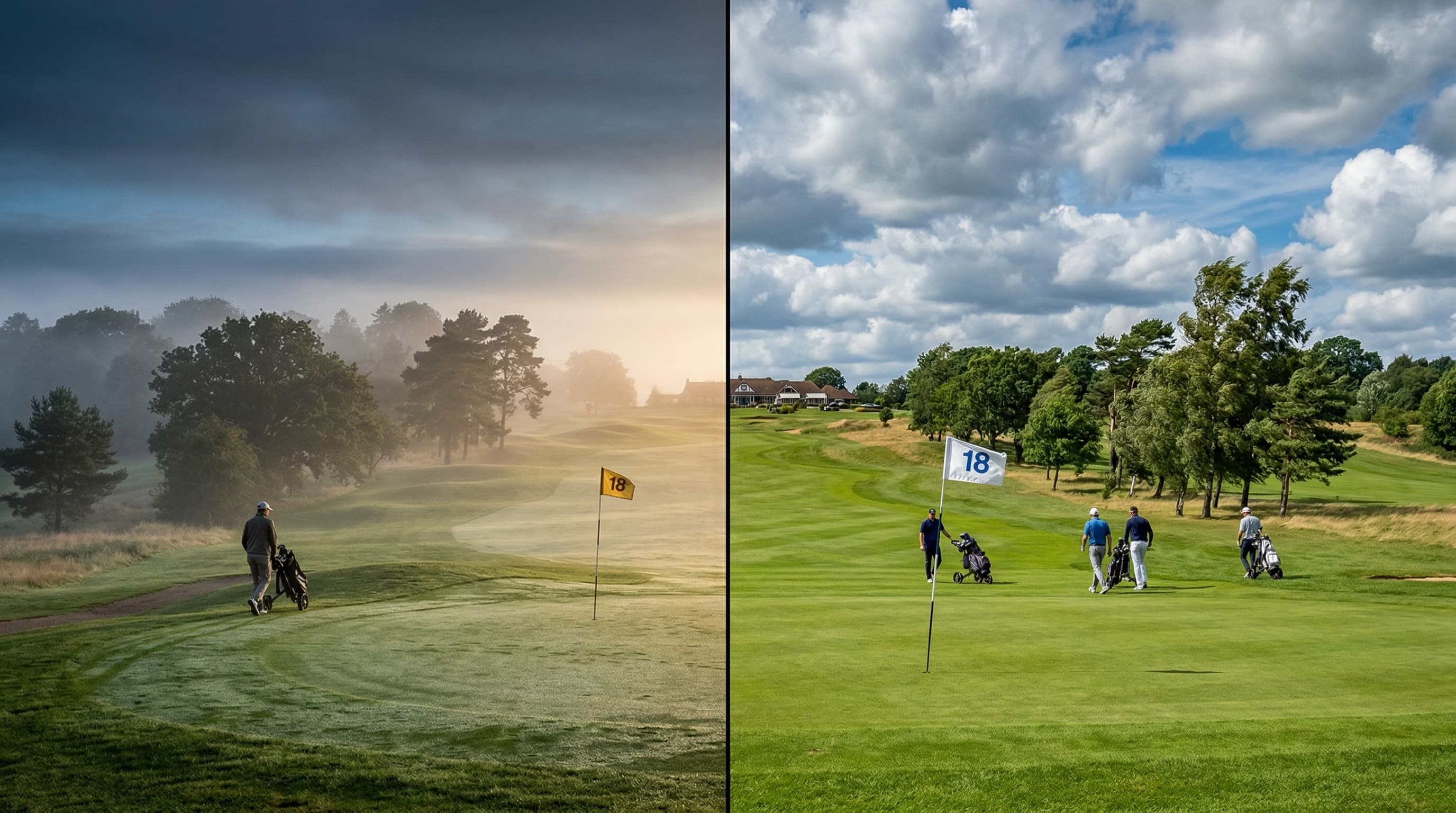
Morning vs Afternoon Tee Times: What Weather Data Reveals About When to Play
Hourly weather data reveals morning tee times score 8-12 G-Score points higher than afternoon slots. Here is what the numbers say about optimal timing.
Read Story
Best Golf Weather by State: Ranking America by Average G-Score
We ranked all 50 US states by average G-Score golf playability. California tops the list, but the results beyond the top five may surprise you.
Read StoryMinSu Kim
Founder & Golf Data Analyst
MinSu is a data analyst and golfer with 10+ years on the course. He built Golf Weather Score to answer one question: is today a good day to play? He combines weather data, course intelligence, and the proprietary G-Score algorithm to help golfers make smarter decisions.
Every Friday Morning
When Belle Terre Country Club plays best next weekend.
Friday 6am ET: peak G-Score windows for Belle Terre Country Club, wind direction by hour, and one gear call. Three minutes to read, save you the round.
One email a week. Unsubscribe in one click.
The Caddie's Oracle
Draw your luck before the tee off