
Caddie's Gear Advisor
Curated for today's 62°F · Clouds
Tour-Level Drivers
Engineered for maximum distance and forgiveness
Laser Rangefinders
Pin-seeking technology for precision approaches
Premium Golf Balls
Tour-caliber spin and distance performance
Performance Sunglasses
Polarized lenses optimized for reading greens
Your Golf Trip, Handled
The Ultimate Golf Trip Planner
Everything you need to play Bello Woods Golf Course — from booking your flight to checking in course-side.
Course-Side Stays
Luxury hotels, resorts, and stay-and-play packages just minutes from the first tee.
Flights
Compare fares across 700+ airlines for the best route to your tee time.
SUV Rentals for Golf Bags
Spacious vehicles with room for clubs, bags, and your foursome.
Travel Insurance
Coverage for medical, weather delays, and gear at your destination.
Bello Woods Golf Course: Course Intelligence
Signature Setup
Straight with you up front: I worked Bello Woods from its scorecard layout, the regional Macomb County climate record, and Lake St. Clair weather patterns — I have not teed it up myself, so the wind reads below are profile-and-pattern reasoning, not a round I'm dressing up as memory. Bello Woods is a public, 27-hole facility in Macomb Township, Michigan, northeast of Detroit and just a few miles inland of Lake St. Clair. It runs as three nine-hole loops that combine into different 18-hole rounds — the kind of affordable, walkable municipal-style parkland golf that defines southeast Michigan. It is not a championship monster; the defense here is tree-lined corridors and inland wind, not water carries or brute length.
TL;DR: Public 27-hole parkland course in Macomb Township, MI (Detroit metro, near Lake St. Clair). Flat, walkable, three nine-hole loops. The challenge is the wind funneling through tree corridors and a possible afternoon lake breeze — not length. Play position over power and watch the wind direction shift after midday.
Hole-by-Hole Wind & Playing Lines
Bello Woods does not publish a verifiable per-hole stroke-index card I could confirm, so I won't invent hole numbers — instead, here is how the wind dictates play on a parkland layout this size:
- The longest par-4s into a W/SW afternoon flow: When the prevailing westerly is up at 10–15 mph, a flushed 150-yard club plays closer to 165. With the trees lining the corridor, the high recovery ball gets pushed around — club up one and flight it low under the canopy line rather than carrying it.
- The tree-corridor par-4s on a crosswind: On the holes where mature trees frame both sides, a crosswind off the open Macomb farmland turns the gap narrow. A player who can hold a shaped ball into the wind beats one who just hits it far — length is the cheap yard here, control is the expensive one.
- Any hole during a SE lake breeze: On a hot afternoon the wind can flip onto a SE/E flow off Lake St. Clair. A downwind morning hole becomes an into-the-wind afternoon hole on the back nine — re-read the flags after the turn, don't trust your morning clubbing.
The habit that travels: read the wind off the flags on the first exposed hole, decide whether it's the prevailing westerly or a lake-breeze reversal, and re-club all the way in.
Green & Fairway Characteristics
The greens are bentgrass/poa over flat Macomb County clay-loam, with gentle parkland contours rather than severe tiers — fair surfaces, not punitive ones. The fairways sit on heavy clay ground, which matters for firmness: this soil holds water, so after the frequent spring rains and summer thunderstorms the course plays soft and your stock yardages run true with little release. In a dry July high-pressure stretch the clay bakes and firms, and the ball releases more on landing. With three nine-hole loops combining for full rounds, the yardages are modest and the layout is walkable — a straight hitter is flattered on a calm day. The catch is that clay-loam firmness swings hard with the weather, so check recent rainfall before you trust a number.
Seasonal Weather Pattern
Macomb Township sits in a humid-continental Great Lakes climate, moderated slightly by nearby Lake St. Clair. Spring (Apr–May): cold and wet — April highs near 55°F, lows around 38°F, soft clay fairways and the windiest, most variable scoring conditions of the year. Summer (Jun–Aug): warm and humid, July highs in the low-to-mid 80s°F, a prevailing W/SW breeze, frequent afternoon thunderstorms, and the recurring SE/E lake-breeze reversal on hot days. Fall (Sep–Oct): the prime window — crisp mornings, drier air behind passing cold fronts, firmer greens, and the calmest scoring weather of the season. Winter: the course closes for Michigan snow and cold; for that stretch I rely on NOAA Detroit-area historicals rather than anything firsthand.
Local Play Tips
Here's the one thing an out-of-region instinct will get wrong at Bello Woods: don't assume the wind you clubbed for on the front nine is the wind you'll get on the back. On hot summer afternoons near Lake St. Clair, the daytime heating can pull a SE/E lake breeze inland that opposes the usual W/SW flow — so a downwind hole at 9 a.m. can be an into-the-wind hole by 2 p.m. The local move is to tee off early for calmer, more predictable air, and if you're playing the afternoon, re-read the flags after the turn instead of trusting your morning notes. Combine that with the clay-loam firmness factor — soft after rain, fast after a dry spell — and you'll read this course better than a visitor who just plays it like a flat muni.
Pre-Round Weather Workflow
Treat golfweatherscore's 7-day G-Score and windExposure as your go/no-go and your timing tool — read it for an inland Great Lakes parkland course:
- Three days out: scan the G-Score trend for passing cold fronts and rain. On clay ground, recent rainfall decides whether the fairways run or hold, so factor precipitation, not just wind.
- The night before: lock in wind direction and speed. A W/SW flow is the prevailing baseline; flag the chance of a SE lake-breeze reversal on hot afternoons that will change your club on the back nine.
- Round morning: if windExposure flags sustained gusts over ~15 mph through the tree corridors, accept that the longest par-4s will play a club longer into the breeze — let low, controlled ball flight under the canopy, not heroics, protect your number.
Related Reading
Before you tee off at Bello Woods Golf Course
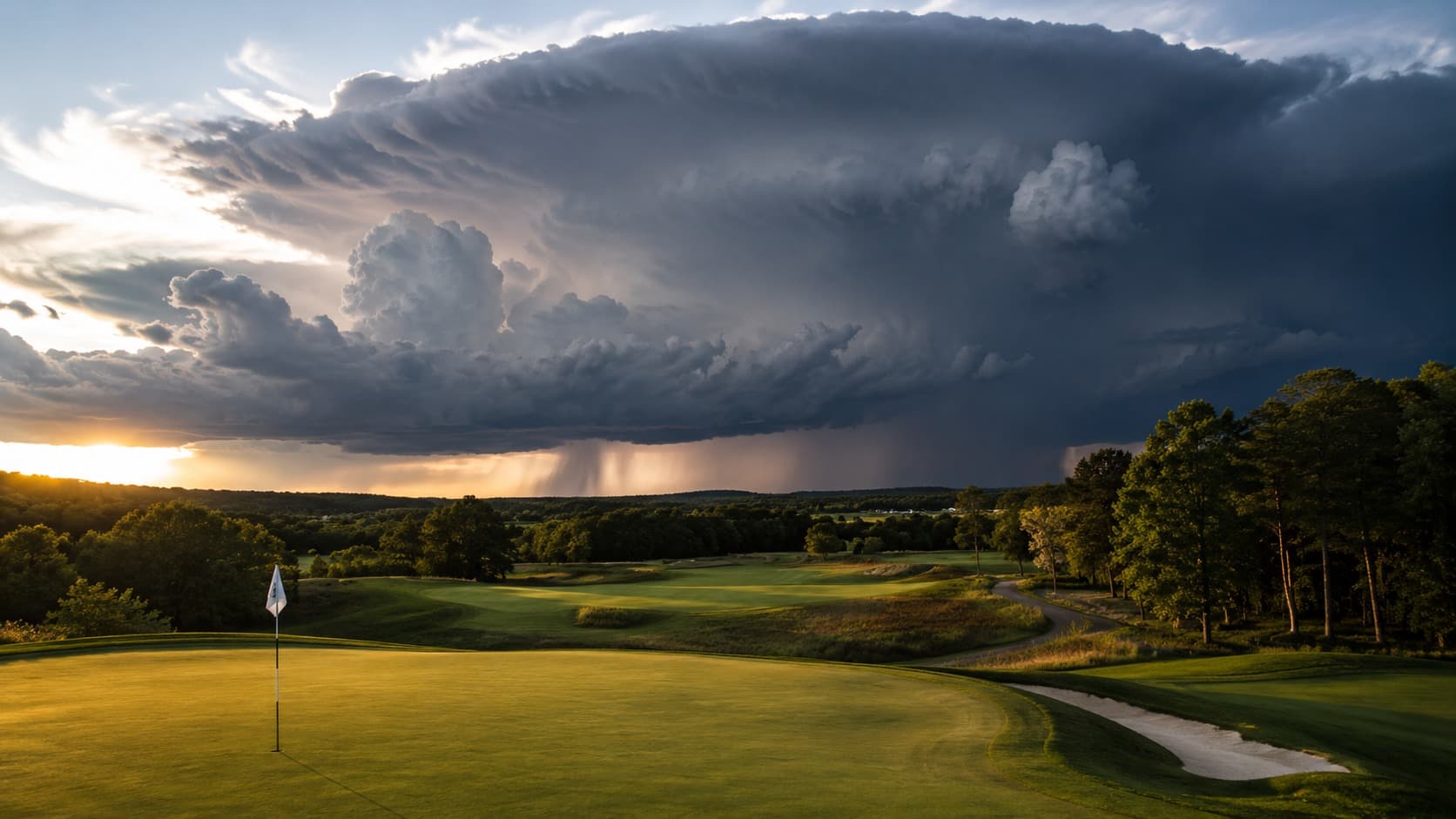
The Three O’Clock Storm: Reading Summer’s Convective Cycle to Protect Your Round
A 40% chance of afternoon thunderstorms does not mean a 40% chance of getting rained on. In the summer convective season it means the morning is nearly clear and the afternoon carries a fast-building, high-energy storm risk driven by a daily heating cycle. Here is the meteorology behind the pattern, the G-Score data on how the storm cycle punishes afternoon tee times across the Southeast, Midwest, and desert Southwest, the lightning-safety decision tree that actually matters, and the workflow that gets you off the course before the first bolt.
Read Story
How to Read a G-Score: The 0–100 Golf Playability Number, Decoded
A G-Score on this site is a single 0–100 number that tells you whether today is worth tee-up. Here is exactly what each band means, what drives the calculation, and how to use it to plan a round you will actually score on.
Read StoryMinSu Kim
Founder & Golf Data Analyst
MinSu is a data analyst and golfer with 10+ years on the course. He built Golf Weather Score to answer one question: is today a good day to play? He combines weather data, course intelligence, and the proprietary G-Score algorithm to help golfers make smarter decisions.
Every Friday Morning
When Bello Woods Golf Course plays best next weekend.
Friday 6am ET: peak G-Score windows for Bello Woods Golf Course, wind direction by hour, and one gear call. Three minutes to read, save you the round.
One email a week. Unsubscribe in one click.
The Caddie's Oracle
Draw your luck before the tee off