
Caddie's Gear Advisor
Curated for today's 94°F · Thunderstorm
Storm-Ready Outerwear
Waterproof layers built for 18 holes in the rain
Tour-Grade Umbrellas
68" double-canopy wind-resistant coverage
Wet-Weather Gloves
All-weather grip that performs in the rain
Waterproof Golf Shoes
Keep your feet dry through every fairway
Your Golf Trip, Handled
The Ultimate Golf Trip Planner
Everything you need to play Belmont Golf Course (The Villages) — from booking your flight to checking in course-side.
Course-Side Stays
Luxury hotels, resorts, and stay-and-play packages just minutes from the first tee.
Flights
Compare fares across 700+ airlines for the best route to your tee time.
SUV Rentals for Golf Bags
Spacious vehicles with room for clubs, bags, and your foursome.
Travel Insurance
Coverage for medical, weather delays, and gear at your destination.
Belmont Golf Course (The Villages): Course Intelligence
Signature Setup
Let me be honest before anything else: Belmont is one of The Villages' free executive courses in central Florida, and I've walked The Villages' short courses but cannot tell you I've kept a card at this specific nine — so the playing reads below come from the executive-course profile and the region's climate records, not from a round I'm dressing up as memory. The course is part of the sprawling Villages retirement community in Sumter County, Florida, and like the development's other neighborhood "executive" layouts it is a 9-hole, walkable, par-3-heavy course meant for daily play by residents — not a championship test. Public records don't credit a single outside architect; these courses were built in-house as a community amenity, and I'd rather say that plainly than invent a famous name. What that means for you: this is a precision course. The yardage is short, the greens are Bermuda, and the weather — not the scorecard — is what will move your number.
TL;DR: A free 9-hole executive course inside The Villages, Sumter County, Florida. Short and walkable, Bermuda greens, par-3 heavy. Wedge control and the central-Florida afternoon storm cycle decide your day far more than length does. Play it early in summer.
Hole-by-Hole Wind & Playing Lines
The Villages doesn't publish a verifiable per-hole handicap card for its executive nines that I'd stake a hole number on, so I won't fabricate specific yardages. Here's how the wind actually plays on an exposed central-Florida short course like this:
- The longest holes into the afternoon SE flow: Central Florida's daily sea-breeze convergence builds a 10–15 mph southeasterly by early afternoon. A flushed 120-yard wedge then behaves like 135–140. Club up, flight it down, and accept the longer putt.
- Downwind short par-3s on that same flow: With the breeze behind you, a high wedge to a firm Bermuda green won't hold — land it short and let the grain release the ball, rather than spinning a hot one off the back.
- Any crosswind pitch: On open, lightly-treed Villages ground there's little to block the wind. The golfer who holds a low, controlled wedge into a crosswind out-scores the one who flies it high every time — on a course this short, spin and trajectory are the only yards that matter.
The habit worth carrying: on a 9-hole executive layout your scoring club is the wedge, so re-club for wind by trajectory, not just distance.
Green & Fairway Characteristics
The greens are Bermuda — standard for central Florida heat — and typically overseeded with ryegrass through the winter to stay green and a touch slower while the Bermuda is dormant. In the dry season (roughly Nov–May) they firm up and the grain gets pronounced: putts break with the grain more than the contour suggests, and approach shots release rather than check. The fairways on these executive nines are short and walkable, well under 2,000 yards for the loop, so a straight hitter is never reaching for driver. The real defense is the putting surface — read the grain off the setting sun and the direction of nearby drainage, not just the slope, and you'll three-putt a lot less than a visitor who treats them like bentgrass.
Seasonal Weather Pattern
Central Florida (Sumter County) is humid subtropical, and the season splits cleanly. Winter/dry season (Dec–Feb): the prime window — mild highs in the 70s°F, low humidity, firm greens, light wind, and the snowbird peak when tee sheets are busiest. Spring (Mar–May): warming and drier still, often the firmest and fastest the course plays before the rains arrive. Summer (Jun–Sep): hot and humid, highs in the low-90s°F with heat-index well above that, and a near-daily afternoon thunderstorm cycle — central Florida sits in the most lightning-prone corridor in the United States, so the storms are a genuine safety issue, not a nuisance. Fall (Oct–Nov): the rains taper, humidity eases, and conditions return toward the firm, pleasant dry-season profile.
Local Play Tips
Here's the local knowledge that matters more than any swing tip on this course: in summer, the clock beats the wind. Central Florida's afternoon convection fires almost on schedule — clear and calm at 8 a.m., towering cumulus by noon, lightning and downpour by 2–4 p.m. across June through September. On a free resident executive course where you can walk on most mornings, the smart play is simply to be on the first tee early and finished before the storms build. A visitor who books an afternoon round in July to "beat the heat" usually gets chased off the course by lightning instead. Treat the morning tee time as the whole strategy in summer; in the dry-season winter, that pressure lifts and you can play comfortably any time of day.
Pre-Round Weather Workflow
Use golfweatherscore's 7-day G-Score and windExposure as your timing tool — and read it for a summer-storm climate, not a wind one:
- Three days out: scan the G-Score trend for the dry-season vs. wet-season pattern. In winter the scores will run high and stable; in summer they'll dip sharply in the afternoon blocks as storm probability climbs.
- The night before: check the afternoon storm and lightning outlook specifically. A clean morning means nothing if convection is forecast by 2 p.m. — plan your tee time around the storm window, not the temperature.
- Round morning: if windExposure flags the afternoon SE sea-breeze building past ~12 mph, expect your wedges to play a club longer into it after midday — one more reason, on top of the lightning, to start your nine early and let the morning calm do the work.
Related Reading
Before you tee off at Belmont Golf Course (The Villages)
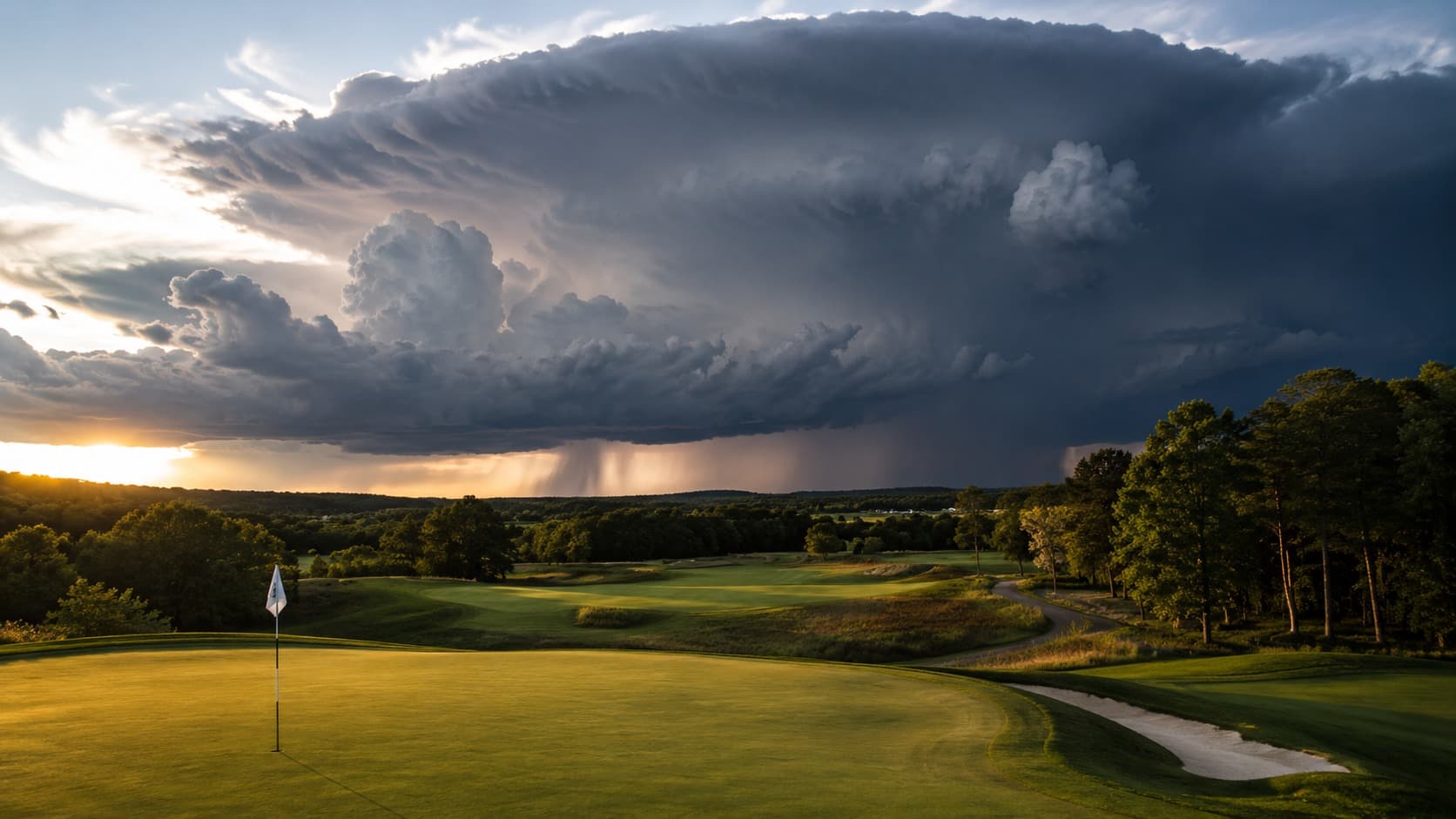
The Three O’Clock Storm: Reading Summer’s Convective Cycle to Protect Your Round
A 40% chance of afternoon thunderstorms does not mean a 40% chance of getting rained on. In the summer convective season it means the morning is nearly clear and the afternoon carries a fast-building, high-energy storm risk driven by a daily heating cycle. Here is the meteorology behind the pattern, the G-Score data on how the storm cycle punishes afternoon tee times across the Southeast, Midwest, and desert Southwest, the lightning-safety decision tree that actually matters, and the workflow that gets you off the course before the first bolt.
Read Story
How to Read a G-Score: The 0–100 Golf Playability Number, Decoded
A G-Score on this site is a single 0–100 number that tells you whether today is worth tee-up. Here is exactly what each band means, what drives the calculation, and how to use it to plan a round you will actually score on.
Read StoryMinSu Kim
Founder & Golf Data Analyst
MinSu is a data analyst and golfer with 10+ years on the course. He built Golf Weather Score to answer one question: is today a good day to play? He combines weather data, course intelligence, and the proprietary G-Score algorithm to help golfers make smarter decisions.
Every Friday Morning
When Belmont Golf Course (The Villages) plays best next weekend.
Friday 6am ET: peak G-Score windows for Belmont Golf Course (The Villages), wind direction by hour, and one gear call. Three minutes to read, save you the round.
One email a week. Unsubscribe in one click.
The Caddie's Oracle
Draw your luck before the tee off