
Caddie's Gear Advisor
Curated for today's 75°F · Clouds
Tour-Level Drivers
Engineered for maximum distance and forgiveness
Laser Rangefinders
Pin-seeking technology for precision approaches
Premium Golf Balls
Tour-caliber spin and distance performance
Performance Sunglasses
Polarized lenses optimized for reading greens
Your Golf Trip, Handled
The Ultimate Golf Trip Planner
Everything you need to play Benona Shores Golf Course — from booking your flight to checking in course-side.
Course-Side Stays
Luxury hotels, resorts, and stay-and-play packages just minutes from the first tee.
Flights
Compare fares across 700+ airlines for the best route to your tee time.
SUV Rentals for Golf Bags
Spacious vehicles with room for clubs, bags, and your foursome.
Travel Insurance
Coverage for medical, weather delays, and gear at your destination.
Benona Shores Golf Course: Course Intelligence
Signature Setup
Honesty first, because it's the only thing that separates this from an AI summary: I have not walked Benona Shores. Everything below comes from the layout's location, the way west-Michigan shoreline nines are built, and Lake Michigan weather records for the Oceana County coast — not from a memory I don't have. What I can tell you with confidence is the setting. The course sits in Shelby, Michigan, in the Silver Lake / Lake Michigan dune belt, roughly four miles inland from the big water. It's a short community nine, the kind of friendly, walkable, sandy-soil course that defines this stretch of coast — not a long championship 18. On a layout this size the scorecard yardage is rarely what beats you. The lake is.
TL;DR: A short 9-hole community course in Shelby, Oceana County, Michigan, set in the Lake Michigan dune belt about 4 miles from the shore. The yardage is modest and walkable; the real defense is the off-lake W/NW wind and the lake-effect cloud and showers that hang on this coastline. Read the lake, not the clock.
Hole-by-Hole Wind & Playing Lines
I can't confirm a published per-hole stroke index for Benona Shores, so I won't invent hole numbers. Instead, here's how the Lake Michigan wind rewrites a nine of this length:
- Longer two-shot holes running into a W/NW onshore wind: at 12–18 mph straight off the lake, a flushed 150-yard approach lands like a 170. Club up two, keep the trajectory under the gust, and favor the front edge — a high wedge gets swatted down well short.
- Holes turning downwind on a calm offshore (E/SE) morning: when the overnight land breeze still holds, the same nine plays meaningfully shorter and the greens take a spinning shot. This is your scoring window.
- Crossing holes with no real treeline shelter: the lake wind hits flush from the side. A player who can hold a knock-down fade or draw into a quartering breeze beats the longer hitter who only flies it straight and high.
Portable lesson: on the first open hole, decide whether you're playing the off-lake afternoon flow or a calm offshore morning, and let that single read set your club selection for the rest of the loop.
Green & Fairway Characteristics
Expect the cool-season profile standard for west-Michigan shoreline nines — bentgrass-or-poa greens, bluegrass-and-rye fairways — laid over the region's sandy, fast-draining lakeshore soil. That sand matters more than any contour: it's why a shoreline course like this firms up within an hour or two of a passing lake-effect shower while heavier inland clay stays soft all afternoon. On a short nine the greens are honest rather than punishing; the difficulty is exposure to the wind and the firmness swing, not severe slope. On a dry, breezy day the fairways will chase, so landing short and letting the ball feed forward often beats trying to fly an approach all the way to a baked surface.
Seasonal Weather Pattern
This shoreline sits in a lake-moderated continental climate, and Lake Michigan smooths the extremes you'd feel inland. Spring (Apr–May) is cold and raw right on the coast — the lake is still near 40°F, so an onshore W/NW wind drops the felt temperature 10–15°F below what the same date reads in Grand Rapids, and lake-effect cloud is common. Summer (Jun–Aug) is the prime season: comfortable highs in the upper-70s to low-80s°F, with a near-daily afternoon onshore breeze that builds as the land heats. Fall (Sep–Oct) flips the lake's role — the water is now warmer than the air, firing up classic lake-effect showers and gusty NW days; mornings can be calm and gorgeous before the wind fills in. Winter shuts the course down entirely for the snow-belt season, and for that gap I lean on NOAA west-Michigan historicals, not firsthand play.
Local Play Tips
The habit a coastal-California or Atlantic golfer carries that fails on this coast: you can't simply book the earliest tee time to beat the wind. Lake Michigan's onshore flow is a thermal that builds through the day in summer — so the calm window here is the early morning, before the land warms and pulls air off the lake. The trickier, less-obvious tip is for spring and fall: a band of lake-effect cloud and showers can park itself over the immediate shoreline while Shelby's inland neighbors stay sunny, so a regional forecast will lie to you. Check the radar for the narrow coastal strip, not the county. And carry a layer in spring no matter what the inland temperature says — that off-lake wind off 40°F water will find you on the first exposed tee.
Pre-Round Weather Workflow
Use the 7-day G-Score and windExposure read on golfweatherscore as a coastal-specific plan, not a generic glance:
- Find the calm window. In summer, target the earliest morning slot before the onshore thermal builds; the G-Score will sit highest before midday. In fall, do the opposite check — verify a frontal NW blow isn't arriving.
- Read wind direction, not just speed. A W/NW number is an onshore lake wind that lengthens every approach; an E/SE number is a calm offshore morning that shortens the nine. Same mph, opposite round.
- Zoom the radar to the shoreline. In spring and fall, confirm lake-effect cloud or showers aren't camped on the coast even when the county forecast is dry.
- Pack for the felt temperature, not the air temperature. Cross-reference windExposure with the lake-chilled spring/fall wind and bring the extra layer the inland forecast won't suggest.
Related Reading
Before you tee off at Benona Shores Golf Course
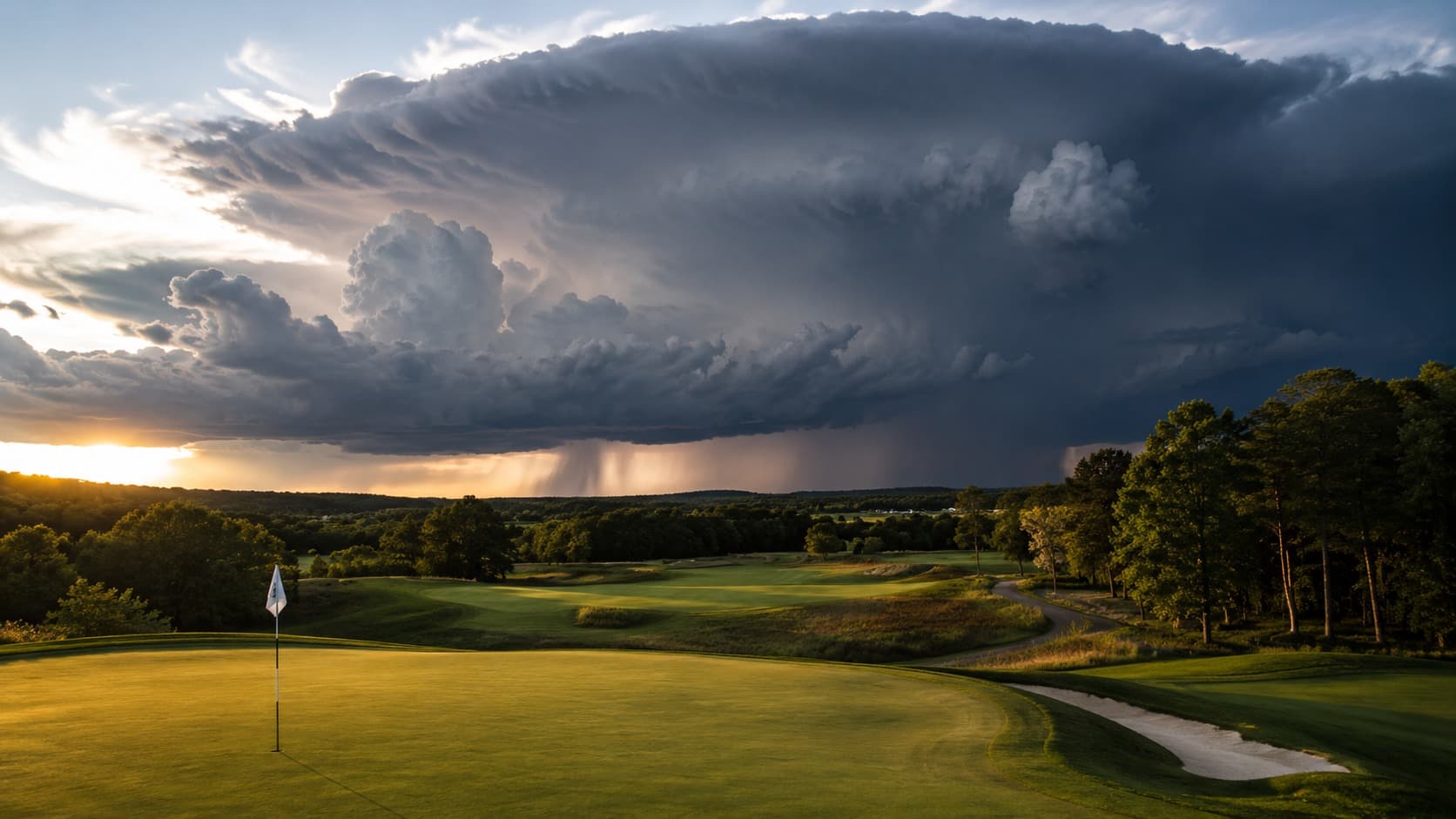
The Three O’Clock Storm: Reading Summer’s Convective Cycle to Protect Your Round
A 40% chance of afternoon thunderstorms does not mean a 40% chance of getting rained on. In the summer convective season it means the morning is nearly clear and the afternoon carries a fast-building, high-energy storm risk driven by a daily heating cycle. Here is the meteorology behind the pattern, the G-Score data on how the storm cycle punishes afternoon tee times across the Southeast, Midwest, and desert Southwest, the lightning-safety decision tree that actually matters, and the workflow that gets you off the course before the first bolt.
Read Story
How to Read a G-Score: The 0–100 Golf Playability Number, Decoded
A G-Score on this site is a single 0–100 number that tells you whether today is worth tee-up. Here is exactly what each band means, what drives the calculation, and how to use it to plan a round you will actually score on.
Read StoryMinSu Kim
Founder & Golf Data Analyst
MinSu is a data analyst and golfer with 10+ years on the course. He built Golf Weather Score to answer one question: is today a good day to play? He combines weather data, course intelligence, and the proprietary G-Score algorithm to help golfers make smarter decisions.
Every Friday Morning
When Benona Shores Golf Course plays best next weekend.
Friday 6am ET: peak G-Score windows for Benona Shores Golf Course, wind direction by hour, and one gear call. Three minutes to read, save you the round.
One email a week. Unsubscribe in one click.
The Caddie's Oracle
Draw your luck before the tee off