
Caddie's Gear Advisor
Curated for today's 56°F · Clear
Tour-Level Drivers
Engineered for maximum distance and forgiveness
Laser Rangefinders
Pin-seeking technology for precision approaches
Premium Golf Balls
Tour-caliber spin and distance performance
Performance Sunglasses
Polarized lenses optimized for reading greens
Your Golf Trip, Handled
The Ultimate Golf Trip Planner
Everything you need to play Bent Pine Golf Club — from booking your flight to checking in course-side.
Course-Side Stays
Luxury hotels, resorts, and stay-and-play packages just minutes from the first tee.
Flights
Compare fares across 700+ airlines for the best route to your tee time.
SUV Rentals for Golf Bags
Spacious vehicles with room for clubs, bags, and your foursome.
Travel Insurance
Coverage for medical, weather delays, and gear at your destination.
Bent Pine Golf Club: Course Intelligence
TL;DR: Bent Pine Golf Club in Vero Beach, Florida is a Joe Lee design that opened in 1981, a private par-72 layout of roughly 6,890 yards from the tips along the Treasure Coast. The thing that decides scores here isn't the routing — it's the Atlantic sea breeze and the time you tee off. I haven't played inside Bent Pine's gates myself (it's a private club), so the on-green reads below lean on the scorecard and the Vero Beach wind record — but the way an east-coast Florida sea breeze reshapes an afternoon round is something I've felt on enough Treasure Coast mornings to trust.
Signature Setup
Bent Pine opened in 1981 to a design by Joe Lee, the Florida architect behind dozens of the state's resort and club layouts. It plays as a par 72, measuring about 6,890 yards from the back tees and stepping down through multiple sets to a forward yardage near 5,200. The closing 18th — a 430-yard par 4 with water guarding the left side — is the hole the membership talks about, and it happens to face the prevailing afternoon wind, which is exactly why it bites. This is a members' club, not a resort track: no marketed "stay-and-play," just a quiet, mature layout with pines and water hazards laced through the routing.
Hole-by-Hole Wind & Playing Lines
The hardest stretch is the finish, and the wind direction is the whole story. Hole 18 (430y, par 4): the Atlantic sea breeze on Florida's east coast typically builds out of the ESE by late morning. Played into that 12–15 mph breeze, a 430-yard 4 stretches toward a played 460 — club up one off the tee, and favor the right half of the fairway to keep the left-hand water out of the approach line.
A long par 4 on the front (around 415–420y): into the same ESE flow before the turn, the approach holds two extra clubs of carry. Take the longer iron and trust it; the breeze knocks down anything thrown high.
A short par 3 (mid-150s): downwind in the afternoon it becomes a half-club knockdown to hold a firm bermuda green; into the morning calm it's a stock number. The wind clock, not the yardage, picks your club here.
Green & Fairway Characteristics
Greens are warm-season bermuda — the east-coast Florida standard — typically overseeded for winter play, which firms and quickens them through the spring dry season before summer softening (I'm reading turf from region and climate, not a posted agronomy spec). The slope sits in the mid-130s from the tips, telling you the defense is positional water and wind rather than raw length. Fairways run firm and fast in the March–May dry stretch, so a low running approach into the closing holes will chase up better than a high spinner the breeze refuses to stop. Front and back both carry water in play; the par-72 routing loads its teeth onto the longer two-shotters rather than the par 5s.
Seasonal Weather Pattern
Vero Beach golf is a year-round proposition, but the quality of the round swings hard by season. December–February mornings start in the upper-50s to low-60s°F — the genuinely calm, low-humidity window, and the best scoring air of the year. March–May is the firm, dry, sea-breeze season: pleasant early, but the afternoon ESE flow is at its most reliable. June–September flips to mid-80s°F heat, oppressive humidity, and the daily 2–4 p.m. convective thunderstorm risk that defines a Florida summer afternoon. The ball that carries 150 in muggy August air will carry noticeably shorter into a stiff January sea breeze for the same swing.
Local Play Tips
Two things the scorecard won't tell you. First, the sea breeze here is a clock, not a wildcard: on a typical spring or summer day the morning is glassy and the wind fills from the Atlantic by late morning, so the back nine you played downwind at 8 a.m. is a different course into the breeze at 1 p.m. Second, because the greens firm up through the dry season, the smart approach into the water-guarded closers is the running shot that releases — not the high ball the wind will balloon and push toward the hazard.
Pre-Round Weather Workflow
Use the 7-day G-Score before booking. (1) Check the tee-time hour against the sea-breeze clock — anything before 10 a.m. in spring/summer buys you calm air and is worth 8–12 G-Score points over an afternoon slot. (2) Read the windExposure flag: an ESE reading means the closing 18th and the long front-nine par 4 both play a full club-plus longer — plan to club up before you stand on the tee. (3) In June–September, finish before the 2 p.m. thunderstorm window; in December–February, the morning chill means an extra club on the first few holes until the air warms.
Sources: GolfLink — Bent Pine Golf Club, Vero Beach FL, NOAA Vero Beach climate normals for sea-breeze timing
Related Reading
Before you tee off at Bent Pine Golf Club

America's 20 Windiest Golf Courses: A G-Score Wind Analysis
We ranked America's 20 windiest golf courses using G-Score wind penalty data. See how coastal gusts and prairie gales reshape playability scores.
Read Story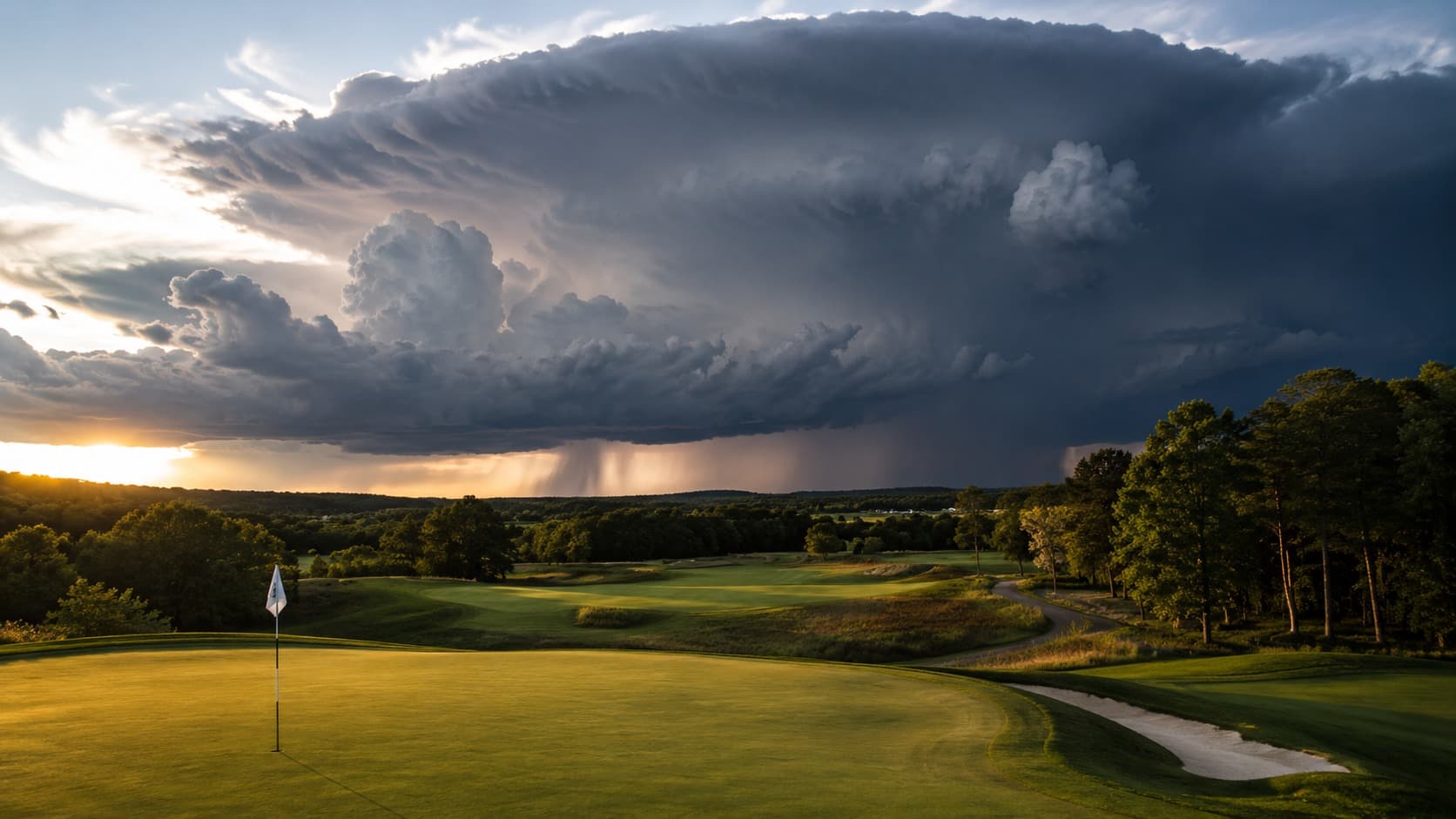
The Three O’Clock Storm: Reading Summer’s Convective Cycle to Protect Your Round
A 40% chance of afternoon thunderstorms does not mean a 40% chance of getting rained on. In the summer convective season it means the morning is nearly clear and the afternoon carries a fast-building, high-energy storm risk driven by a daily heating cycle. Here is the meteorology behind the pattern, the G-Score data on how the storm cycle punishes afternoon tee times across the Southeast, Midwest, and desert Southwest, the lightning-safety decision tree that actually matters, and the workflow that gets you off the course before the first bolt.
Read StoryMinSu Kim
Founder & Golf Data Analyst
MinSu is a data analyst and golfer with 10+ years on the course. He built Golf Weather Score to answer one question: is today a good day to play? He combines weather data, course intelligence, and the proprietary G-Score algorithm to help golfers make smarter decisions.
Every Friday Morning
When Bent Pine Golf Club plays best next weekend.
Friday 6am ET: peak G-Score windows for Bent Pine Golf Club, wind direction by hour, and one gear call. Three minutes to read, save you the round.
One email a week. Unsubscribe in one click.
The Caddie's Oracle
Draw your luck before the tee off