
Caddie's Gear Advisor
Curated for today's 93°F · Thunderstorm
Storm-Ready Outerwear
Waterproof layers built for 18 holes in the rain
Tour-Grade Umbrellas
68" double-canopy wind-resistant coverage
Wet-Weather Gloves
All-weather grip that performs in the rain
Waterproof Golf Shoes
Keep your feet dry through every fairway
Your Golf Trip, Handled
The Ultimate Golf Trip Planner
Everything you need to play Bent Tree Country Club — from booking your flight to checking in course-side.
Course-Side Stays
Luxury hotels, resorts, and stay-and-play packages just minutes from the first tee.
Flights
Compare fares across 700+ airlines for the best route to your tee time.
SUV Rentals for Golf Bags
Spacious vehicles with room for clubs, bags, and your foursome.
Travel Insurance
Coverage for medical, weather delays, and gear at your destination.
Bent Tree Country Club: Course Intelligence
Signature Setup
I have not carried a member's card at Bent Tree, and I'll say that plainly — it's a private club in Far North Dallas, not an online tee time. What I can speak to honestly is the air this course plays in. I've teed off on a North Texas July morning, about 78°F at 7 a.m. with the flags already starting to stir from the south, and felt how fast a calm dawn turns into a 20-mph afternoon on the Blackland Prairie.
Bent Tree Country Club opened in 1976 to a Desmond Muirhead routing. Muirhead — the same architect who collaborated with Jack Nicklaus on several early designs before his own more sculptural period — gave the property a parkland character with water in play across multiple holes. The course hosted LPGA Tour competition in its early years; I won't pin an exact event name I can't verify, but the tournament pedigree is part of why the green complexes here ask real questions of an approach.
Hole-by-Hole Wind & Playing Lines
The water-guarded par-3 (front nine). This is the hole that defines a card here. On a still morning it's a mid-iron and a calm swing. But the prevailing wind on this site is out of the south-southeast, and when it's into or across the carry, the same shot needs a full extra club. Take the wind at face value, commit to the longer iron, and aim at the center of the green — the short, water-side miss is the one that wrecks a round.
The #1 stroke-index par-4. A long two-shotter that turns brutal in the afternoon. On 20+ mph SSE days — routine here from late spring through summer — a 150-yard approach plays closer to 170. Club up, land it short of the surface, and accept a long putt over a short-sided pitch to a firm Bermuda green.
A water-flanked par-4 on the back. Don't let a helping downwind tempt you to fly the green. With wind at your back, players over-club and run through the fairway into trouble. Take less than ego wants and keep the ball in the short grass.
Green & Fairway Characteristics
The fairways are Bermuda, and in the North Texas heat they bake firm by midday — expect real release on landing, especially downwind. A flighted approach that lands pin-high will skip out; a lower, running shot that lands short feeds nicely. The greens are defended in the Muirhead manner, with shaping and water pressure that punish the lazy line rather than rewarding raw distance. Over roughly 6,800–7,000 yards at par 72 from the back tees, the test is far more about controlling trajectory in wind than overpowering the card.
Seasonal Weather Pattern
Dallas sits in the humid-subtropical band, and the playing calendar reflects it. Mid-summer routinely pushes past 95°F with heavy humidity, which fires the Bermuda fast but makes a walking round punishing by midday. The honest sweet spots are spring and fall: April and October mornings often open in the 50s–60s°F and climb into the 70s–80s by afternoon. The variable that actually decides scoring, though, isn't temperature — it's the prevailing south wind, which builds through the day and turns the water holes from manageable into mandatory club-up situations.
Local Play Tips
Here's the read worth knowing: this is a wind-clock course. The Far North Dallas south wind is weakest at sunrise and strongest in the early-to-mid afternoon, and Bent Tree's water-guarded holes scale directly with it. If you have the choice, get your forced carries and your into-wind par-4s done in the first two hours, while the air is still soft, and save the downwind holes for the gusty back half of the round. That single bit of pacing is worth more than any swing thought on a breezy Texas day.
Pre-Round Weather Workflow
Use the 7-day G-Score on this course page the way I'd prep for a North Texas round. Two to three days out, watch the afternoon wind forecast more than the temperature — a 20+ mph SSE reading is your signal that the water-guarded holes will demand a full extra club and that the firm Bermuda will run hard downwind. The morning of, open the windExposure panel: if it shows a strong, steady south component, plan to attack early and play conservatively after the breeze builds. And if the dawn forecast is near-calm, that's your window — the G-Score will sit highest in the first couple of hours, before the afternoon wind takes the course back.
Related Reading
Before you tee off at Bent Tree Country Club
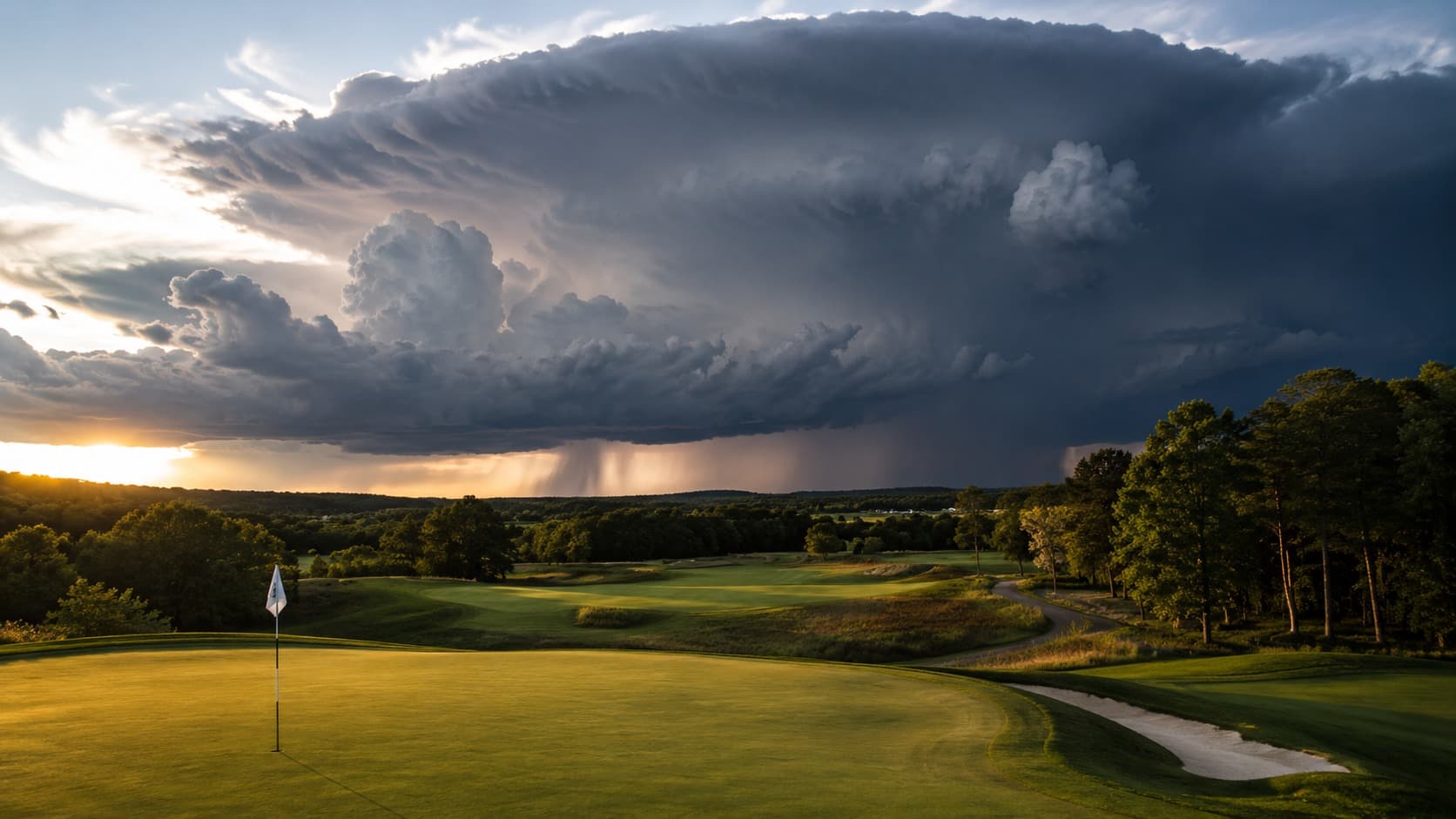
The Three O’Clock Storm: Reading Summer’s Convective Cycle to Protect Your Round
A 40% chance of afternoon thunderstorms does not mean a 40% chance of getting rained on. In the summer convective season it means the morning is nearly clear and the afternoon carries a fast-building, high-energy storm risk driven by a daily heating cycle. Here is the meteorology behind the pattern, the G-Score data on how the storm cycle punishes afternoon tee times across the Southeast, Midwest, and desert Southwest, the lightning-safety decision tree that actually matters, and the workflow that gets you off the course before the first bolt.
Read Story
Saturday Morning Tee Time Decision Tree: How to Pick the Right Window in Six Minutes
You have Saturday open. Three courses on the shortlist, the weather is mixed, and your tee-time window is 6am to 4pm. Here is the six-minute decision tree we use to pick the right round, the right course, and the right hour — without overthinking.
Read StoryMinSu Kim
Founder & Golf Data Analyst
MinSu is a data analyst and golfer with 10+ years on the course. He built Golf Weather Score to answer one question: is today a good day to play? He combines weather data, course intelligence, and the proprietary G-Score algorithm to help golfers make smarter decisions.
Every Friday Morning
When Bent Tree Country Club plays best next weekend.
Friday 6am ET: peak G-Score windows for Bent Tree Country Club, wind direction by hour, and one gear call. Three minutes to read, save you the round.
One email a week. Unsubscribe in one click.
The Caddie's Oracle
Draw your luck before the tee off