
Caddie's Gear Advisor
Curated for today's 56°F · Clouds
Tour-Level Drivers
Engineered for maximum distance and forgiveness
Laser Rangefinders
Pin-seeking technology for precision approaches
Premium Golf Balls
Tour-caliber spin and distance performance
Performance Sunglasses
Polarized lenses optimized for reading greens
Your Golf Trip, Handled
The Ultimate Golf Trip Planner
Everything you need to play Berrien Hills Golf Club — from booking your flight to checking in course-side.
Course-Side Stays
Luxury hotels, resorts, and stay-and-play packages just minutes from the first tee.
Flights
Compare fares across 700+ airlines for the best route to your tee time.
SUV Rentals for Golf Bags
Spacious vehicles with room for clubs, bags, and your foursome.
Travel Insurance
Coverage for medical, weather delays, and gear at your destination.
Berrien Hills Golf Club: Course Intelligence
Signature Setup
The honest caveat first: I built this read from Berrien Hills' location, the southwest Michigan golf calendar, and Berrien County climate records — I have not teed it up, so the wind notes below are pattern reasoning, not a round I'm recalling. The club sits in Berrien County in the far southwest corner of Michigan, near 42°N and roughly 10 miles inland from the Lake Michigan shoreline, on rolling ground about 600 feet above sea level. It's a long-standing private club going back to the early 1900s, but I couldn't confirm a verified architect of record, so I won't hand you a name I can't back up. What I can back up is the geography: a cool-climate, lake-influenced inland site in one of the most weather-driven golf corridors in the Midwest.
TL;DR: Established private club in Berrien County, southwest Michigan near 42°N and ~10 miles inland from Lake Michigan. The defining test is a prevailing W/SW lake wind and lake-effect cloud across a roughly April–October season. Place the ball, track the lake breeze and front timing over the clock.
Hole-by-Hole Wind & Playing Lines
Berrien Hills doesn't publish a per-hole handicap card I can independently verify, so rather than invent hole numbers I'll explain how the wind dictates play on a rolling inland layout this close to the lake:
- The longer par-4s into the prevailing W/SW lake wind: with the westerly flow at 12–18 mph — routine on spring and fall afternoons here — a 150-yard shot plays closer to 170. Club up two and flight it down; a high ball gets eaten twice, once by the gust and once by the cool, dense lake air that sits over this corner of Michigan.
- The downwind holes after a NW post-front shift: once a cold front drops through off Lake Michigan, the drier tailwind shortens the card and the firmer fairways start running. Land it short and let it release rather than flying a hot pitch onto a surface that has firmed overnight.
- The crossing holes: on open, rolling ground little blocks a side wind, so a player who can hold a shaped ball into the breeze beats one who only hits it far and high.
The carryover habit: on the opening exposed hole, decide whether this is steady onshore W/SW lake flow or post-front NW wind, and let that single read set your clubbing through the green.
Green & Fairway Characteristics
Expect cool-season Northern turf — bentgrass or Poa greens with bluegrass-fescue fairways, the standard for southwest Michigan. These surfaces firm up and quicken under a dry late-summer high and soften within hours of a passing front or lake-effect rain, so your stock yardages only hold in a genuinely settled window. The ground rolls rather than lies flat, which rewards a player who can work the slope on a calm morning. But in this corridor calm rarely lasts past mid-morning once the lake breeze builds, so I'd treat an early, still green as the exception rather than the rule.
Seasonal Weather Pattern
Berrien County's golf season runs roughly April through October, and the calendar here is unusually lake-bound. April and May mornings can sit in the mid-40s°F with the ground still cold off winter, and Lake Michigan — slow to warm — keeps spring afternoons cooler than the inland map suggests. July and August are the settled stretch, with daytime highs often in the low-to-mid 80s°F, but even then the lake breeze typically fills in by late morning. September and October bring the sharpest swings: a 60°F calm dawn can turn into a raw, 15–20 mph onshore wind by early afternoon, and lake-effect cloud rolls in fast off the water. The single number that matters most here isn't temperature — it's how settled the front pattern is on any given day.
Local Play Tips
One thing the tee sheet won't tell you: because the club sits about 10 miles in from the shore, you get the lake's wind and cloud without the steady cooling you'd find right on the beach — so a July afternoon can feel genuinely warm and humid while still being shoved around by an onshore breeze. Plan the front nine for the calmest window of the day. If you have any choice in tee time this far north, an early-morning slot before the lake breeze organizes is worth more strokes here than at a typical inland course.
Pre-Round Weather Workflow
Use the 7-day G-Score the way I do for any lake-influenced course:
- Three days out: scan the G-Score trend and note any front crossing Lake Michigan — that front, not the daily high, decides your wind.
- The morning of: check windExposure and the W/SW vs NW wind direction. Onshore W/SW means club up into it on the exposed holes; post-front NW means a firmer, faster track.
- At the first tee: read whether the lake breeze has filled in yet. If it's still calm, push your scoring holes early — the still window here is short. Let that one read set your clubbing for the round.
Related Reading
Before you tee off at Berrien Hills Golf Club

America's 20 Windiest Golf Courses: A G-Score Wind Analysis
We ranked America's 20 windiest golf courses using G-Score wind penalty data. See how coastal gusts and prairie gales reshape playability scores.
Read Story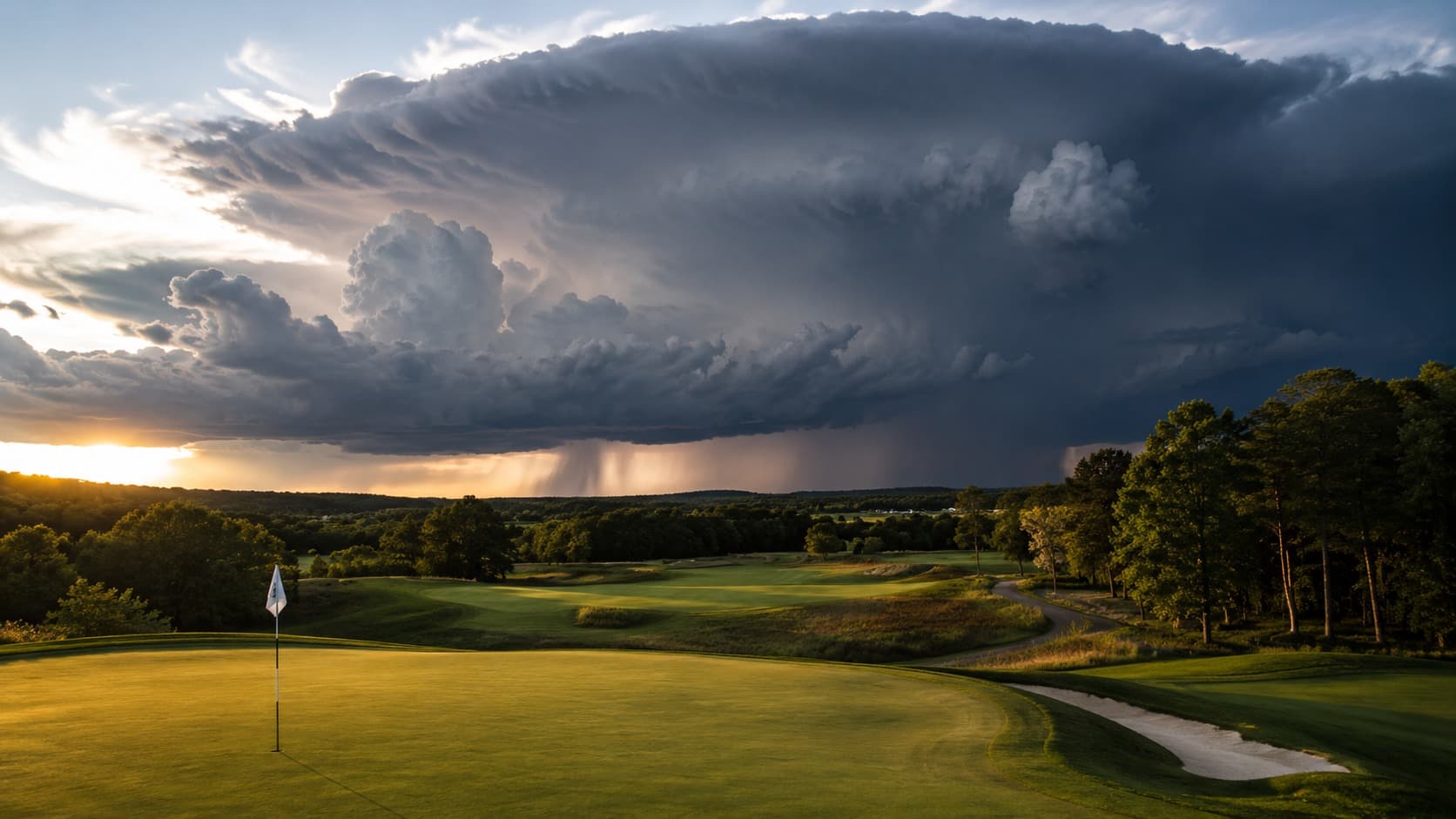
The Three O’Clock Storm: Reading Summer’s Convective Cycle to Protect Your Round
A 40% chance of afternoon thunderstorms does not mean a 40% chance of getting rained on. In the summer convective season it means the morning is nearly clear and the afternoon carries a fast-building, high-energy storm risk driven by a daily heating cycle. Here is the meteorology behind the pattern, the G-Score data on how the storm cycle punishes afternoon tee times across the Southeast, Midwest, and desert Southwest, the lightning-safety decision tree that actually matters, and the workflow that gets you off the course before the first bolt.
Read StoryMinSu Kim
Founder & Golf Data Analyst
MinSu is a data analyst and golfer with 10+ years on the course. He built Golf Weather Score to answer one question: is today a good day to play? He combines weather data, course intelligence, and the proprietary G-Score algorithm to help golfers make smarter decisions.
Every Friday Morning
When Berrien Hills Golf Club plays best next weekend.
Friday 6am ET: peak G-Score windows for Berrien Hills Golf Club, wind direction by hour, and one gear call. Three minutes to read, save you the round.
One email a week. Unsubscribe in one click.
The Caddie's Oracle
Draw your luck before the tee off