
Caddie's Gear Advisor
Curated for today's 96°F · Thunderstorm
Storm-Ready Outerwear
Waterproof layers built for 18 holes in the rain
Tour-Grade Umbrellas
68" double-canopy wind-resistant coverage
Wet-Weather Gloves
All-weather grip that performs in the rain
Waterproof Golf Shoes
Keep your feet dry through every fairway
Your Golf Trip, Handled
The Ultimate Golf Trip Planner
Everything you need to play Biltmore Golf Course — from booking your flight to checking in course-side.
Course-Side Stays
Luxury hotels, resorts, and stay-and-play packages just minutes from the first tee.
Flights
Compare fares across 700+ airlines for the best route to your tee time.
SUV Rentals for Golf Bags
Spacious vehicles with room for clubs, bags, and your foursome.
Travel Insurance
Coverage for medical, weather delays, and gear at your destination.
Biltmore Golf Course: Course Intelligence
Signature Setup
Honesty first: what follows comes from the scorecard, the course's published Donald Ross history, the 2007 Brian Silva restoration record, and South Florida weather data — I have walked South Florida muni layouts on the same coastal breeze, but I'd rather frame the Biltmore from the record than fake a hole-by-hole memory of a round I can't document. The course sits beside the 1926 Biltmore Hotel in Coral Gables, Miami-Dade County, and it's a genuine Donald Ross design opened in 1925. Silva's restoration peeled back decades of drift, returning Ross's bunkering and green shaping and re-grassing the property in seashore paspalum. The card runs roughly 6,800 yards to par 71, course rating near 73.0 and slope around 130. That's the key reading: this is dead-flat coastal parkland, so the layout doesn't beat you with elevation or blind shots. The wind and the water do.
TL;DR: A real Donald Ross course (1925) at the historic Biltmore Hotel, Coral Gables. ~6,800y / par 71 / slope ~130, paspalum since the 2007 Silva restoration, pancake-flat with lakes in play. No hills means the defense is the east-coast sea breeze — beat it by teeing off early.
Hole-by-Hole Wind & Playing Lines
The Biltmore publishes its layout but I won't invent a stroke-index hole number I can't confirm, so here's how the Coral Gables breeze rewrites a Ross card at sea level:
- Long par-4s into a late-morning E/SE sea breeze: once the onshore flow fills to 12–16 mph, a clean 150-yard approach flies like a 170. With water guarding several greens, the bigger-club-plus-flatter-flight play beats the high wedge that balloons and comes up short in the hazard.
- Par-5s running downwind on the morning NE trade flow: in winter the dry northeasterly turns the back of the property reachable. Land short of the paspalum greens and let the firm surface chase — spinning a high third shot just skids off baked turf.
- Crossing holes with lakes on one side: flat ground and little canopy mean the wind hits flush from the side. A knockdown that holds its line into a quartering breeze will out-score a longer hitter who only flies it high and straight over water.
The portable lesson: on the first exposed hole, read whether you're playing the morning trade wind or the afternoon sea breeze, and let that set club selection for the rest of the round.
Green & Fairway Characteristics
Since 2007 the Biltmore is seashore paspalum tee-to-green — a salt-tolerant grass that handles brackish irrigation and South Florida heat, and that runs firm and fast when the sun bakes it. The greens carry Ross's restored contours, more subtle than severe, so the difficulty is reading grain and firmness rather than big slope. Fairways are flat Miami parkland threaded with lakes, and from ~6,800 yards (with multiple forward sets) the card flatters a straight driver on a still morning. The catch: still mornings are a winter luxury. Firmness swings with the sky — paspalum bakes out under a high-pressure ridge and softens within an hour of the region's daily summer storms, so your stock yardages only hold in the calm early windows.
Seasonal Weather Pattern
Coral Gables is subtropical, governed by the Atlantic and a sharp wet/dry split. Winter (Dec–Mar) is peak golf: dry NE trade winds, highs in the mid-70s°F, low humidity, firm paspalum and the calmest, most playable conditions of the year. Spring (Apr–May) warms fast and the sea breeze strengthens, with breezy, mostly dry afternoons. Summer (Jun–Sep) is hot and humid — highs near 90°F with oppressive dew points — and brings near-daily afternoon thunderstorms; lightning closures are routine, which is the real argument for an early tee time. Fall (Oct–Nov) stays warm and humid and overlaps the back of hurricane season, so watch tropical systems. For the months I can't observe firsthand I lean on NOAA Miami-area historicals rather than memory.
Local Play Tips
The instinct that costs visitors strokes here is treating the Biltmore like an inland course where the wind is random. It isn't — South Florida runs a reliable daily land-sea cycle. Mornings open under the offshore/NE trade flow, often calm and cool; then, on most non-frontal days, the Atlantic sea breeze fills in from the E/SE by mid-to-late morning and builds through the afternoon. That means the same hole plays two different golf courses depending on your tee time. Book the earliest slot you can get, push the front nine before about 10 a.m., and you'll often finish the harder approaches before the breeze stiffens. In summer the clock matters even more: the morning round isn't just calmer, it's your best odds of finishing eighteen before the afternoon storm cells and lightning shut play down.
Pre-Round Weather Workflow
Use golfweatherscore's 7-day G-Score and windExposure as decision tools, read for a flat coastal layout:
- Three days out: scan the G-Score curve. A high holding steady signals a dry trade-wind window; a sharp summer dip almost always means storm cells, not a cooler tee time.
- The evening before: pin down wind direction. An E/SE flow means the sea breeze is in play — plan the early tee time. A dry NE winter flow means firm, fast paspalum where downwind par-5s open up.
- Round morning: if windExposure shows the sea breeze building past ~15 mph, accept that a ~6,800-yard, slope-130 card plays a club or two longer into the breeze over water, and let placement, not aggression, protect your score.
Related Reading
Before you tee off at Biltmore Golf Course
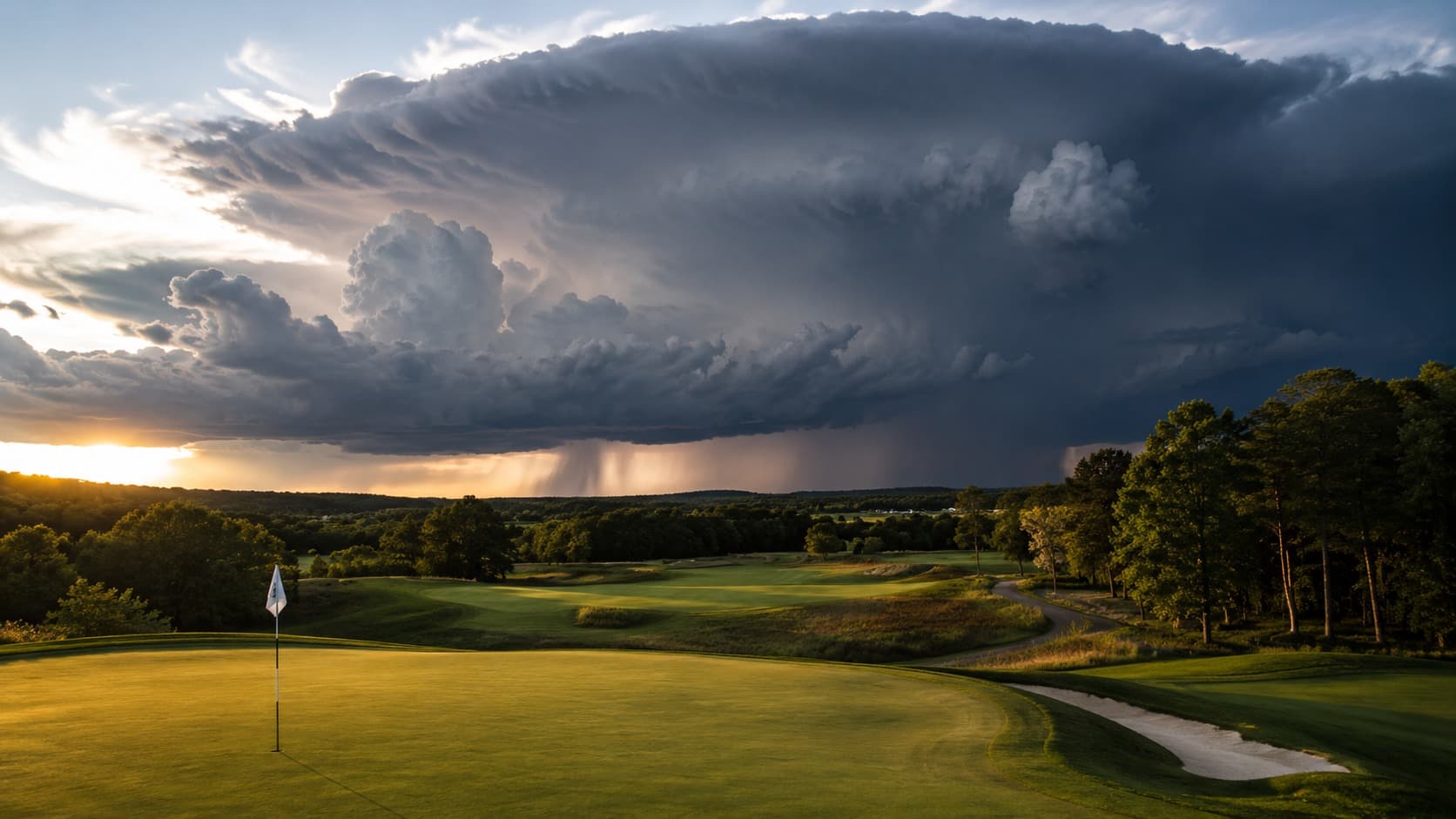
The Three O’Clock Storm: Reading Summer’s Convective Cycle to Protect Your Round
A 40% chance of afternoon thunderstorms does not mean a 40% chance of getting rained on. In the summer convective season it means the morning is nearly clear and the afternoon carries a fast-building, high-energy storm risk driven by a daily heating cycle. Here is the meteorology behind the pattern, the G-Score data on how the storm cycle punishes afternoon tee times across the Southeast, Midwest, and desert Southwest, the lightning-safety decision tree that actually matters, and the workflow that gets you off the course before the first bolt.
Read Story
How to Read a G-Score: The 0–100 Golf Playability Number, Decoded
A G-Score on this site is a single 0–100 number that tells you whether today is worth tee-up. Here is exactly what each band means, what drives the calculation, and how to use it to plan a round you will actually score on.
Read StoryMinSu Kim
Founder & Golf Data Analyst
MinSu is a data analyst and golfer with 10+ years on the course. He built Golf Weather Score to answer one question: is today a good day to play? He combines weather data, course intelligence, and the proprietary G-Score algorithm to help golfers make smarter decisions.
Every Friday Morning
When Biltmore Golf Course plays best next weekend.
Friday 6am ET: peak G-Score windows for Biltmore Golf Course, wind direction by hour, and one gear call. Three minutes to read, save you the round.
One email a week. Unsubscribe in one click.
The Caddie's Oracle
Draw your luck before the tee off