
Caddie's Gear Advisor
Curated for today's 97°F · Thunderstorm
Storm-Ready Outerwear
Waterproof layers built for 18 holes in the rain
Tour-Grade Umbrellas
68" double-canopy wind-resistant coverage
Wet-Weather Gloves
All-weather grip that performs in the rain
Waterproof Golf Shoes
Keep your feet dry through every fairway
Your Golf Trip, Handled
The Ultimate Golf Trip Planner
Everything you need to play Binks Forest Golf Club — from booking your flight to checking in course-side.
Course-Side Stays
Luxury hotels, resorts, and stay-and-play packages just minutes from the first tee.
Flights
Compare fares across 700+ airlines for the best route to your tee time.
SUV Rentals for Golf Bags
Spacious vehicles with room for clubs, bags, and your foursome.
Travel Insurance
Coverage for medical, weather delays, and gear at your destination.
Binks Forest Golf Club: Course Intelligence
Signature Setup
Let me be candid up front: I have not teed it up at Binks Forest, so what follows leans on the course's design pedigree, the Palm Beach County climate record, and how tree-lined Florida parkland layouts of this era tend to play — pattern reasoning, not a recalled round. Binks Forest Golf Club sits in Wellington, Florida, in western Palm Beach County, and it is a Johnny Miller Signature design that opened in 1990. The name is the tell: the routing threads through mature pine and live oak corridors that frame nearly every hole, a rarity on the otherwise flat, open South Florida palette. From the back tees it stretches into the high-6,000s/low-7,000s as a par 72 — a real test that defends par through tight tree lines and Bermuda green complexes rather than raw length.
TL;DR: Public Johnny Miller Signature course (1990) in Wellington, Florida, near West Palm Beach. Par 72, tree-lined corridors over flat ground, Bermudagrass throughout. The Atlantic sea breeze is the dominant weather lever — it arrives late inland, so the early tee times are calm and the most scorable. Play position between the trees; club up once the ESE breeze fills in.
Hole-by-Hole Wind & Playing Lines
Binks Forest doesn't publish a per-hole handicap card I can independently verify, so rather than inventing hole numbers I'll lay out how the wind dictates play on a tree-framed Miller build of this length:
- The long par-4s into the afternoon sea breeze: once the ESE flow fills in past late morning, a flushed 150-yard club starts behaving like a 165. The tree corridors funnel that wind into a single direction down each hole, so there's no bailout angle — take the extra club and a flatter flight.
- The dogleg holes framed by oak: the trees punish the overcooked draw or fade. Drive to the open center gap rather than flirting with a tree line; a blocked second shot from under a live oak costs more than the 10 yards you'd gain cutting the corner.
- The downwind holes in the morning calm: before the breeze builds, the air is still and the Bermuda fairways hold. This is when you attack — land short and release into the grainy greens rather than spinning a high pitch back off a firm surface.
The habit to carry: judge on the first open hole whether the sea breeze has filled in yet, and let that one read set your clubbing for the rest of the round.
Green & Fairway Characteristics
Expect Bermudagrass from tee to green — standard for a South Florida build — over essentially flat ground, with the tree corridors doing the shaping that the terrain doesn't. The greens are the defense: grainy Bermuda surfaces that quicken sharply when the summer sun bakes them and slow when afternoon rain softens the property. Grain matters more than slope here — a downgrain putt under firm conditions can get away from you, while the same line into the grain dies short. From the back tees in the high-6,000s the course asks for placement off the tee far more than distance, because the trees, not the yardage, set the scoring pressure. Your stock numbers only hold in the calm morning windows before the breeze and the heat change the surfaces.
Seasonal Weather Pattern
Wellington has a tropical/subtropical climate on the inland edge of Palm Beach County. Winter (Dec–Feb) is the prime season — highs commonly in the low 70s°F, low humidity, steady but manageable ESE trade-wind flow, and the firmest, most pleasant golf of the year, which is exactly why the area fills with snowbirds. Spring (Mar–May) warms quickly and dries out before the rains; firm and fast, with the sea breeze building earlier each week. Summer (Jun–Sep) is hot and humid, highs in the low 90s°F with brutal afternoon thunderstorms that stall play almost daily around mid-afternoon — the early tee time isn't a preference, it's survival. Fall carries hurricane-season risk through November; for that volatility I lean on NOAA West Palm Beach historicals rather than anything firsthand.
Local Play Tips
The thing a first-timer misreads about Wellington: it is not coastal golf, even though the Atlantic drives the wind. Sitting roughly 12 miles inland, Binks Forest gets the sea breeze later and softer than a course on the beach — the morning can stay genuinely calm well past sunrise, and the breeze often doesn't fill until late morning. That delay is the edge. Book the earliest tee time you can in summer and you'll play several holes in still air and cooler temperatures before the ESE flow and the heat both arrive, and you'll likely be off the course before the afternoon storm cells build inland off the heated peninsula. The golfer who sleeps in pays twice: stronger wind and a real chance of a lightning delay.
Pre-Round Weather Workflow
On an inland-but-sea-breeze-driven course like Binks Forest, golfweatherscore's 7-day G-Score and windExposure earn their keep when you read them around the daily sea-breeze cycle, not just the daily average. A few days out, the G-Score trend flags the broad pattern — a settled winter high versus a summer storm regime. The night before, check the timing of the ESE breeze and the afternoon storm probability: if windExposure shows the flow building by late morning, take the earliest tee time and plan to attack the first several holes in the calm. On the tee, if windExposure is calling steady mid-teens gusts, expect this tree-framed, high-6,000-yard layout to stretch a club into the wind down those funneled corridors — favor the open center off the tee, club up into the breeze, and respect the grain on greens that bake fast under the South Florida sun.
Related Reading
Before you tee off at Binks Forest Golf Club
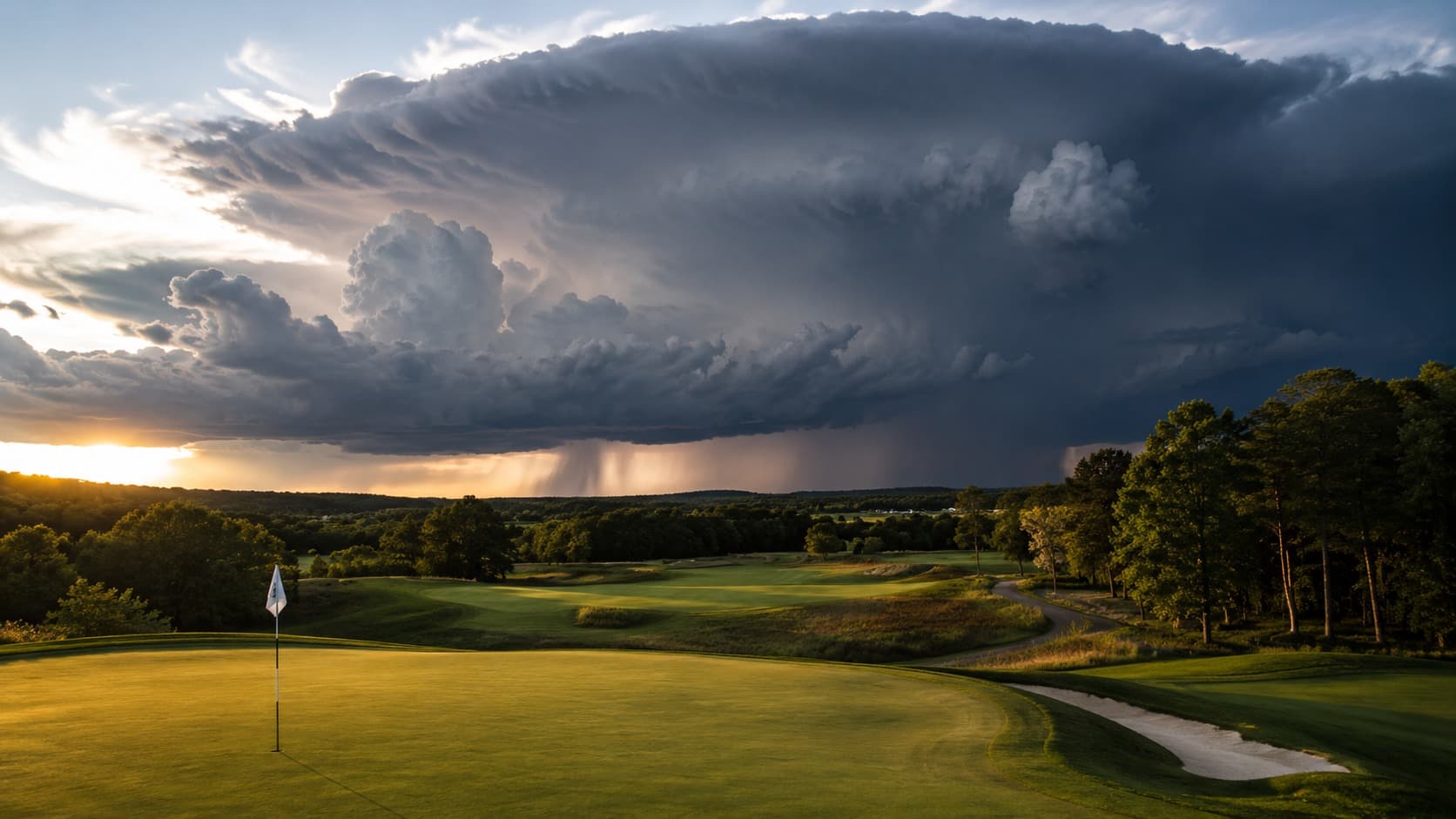
The Three O’Clock Storm: Reading Summer’s Convective Cycle to Protect Your Round
A 40% chance of afternoon thunderstorms does not mean a 40% chance of getting rained on. In the summer convective season it means the morning is nearly clear and the afternoon carries a fast-building, high-energy storm risk driven by a daily heating cycle. Here is the meteorology behind the pattern, the G-Score data on how the storm cycle punishes afternoon tee times across the Southeast, Midwest, and desert Southwest, the lightning-safety decision tree that actually matters, and the workflow that gets you off the course before the first bolt.
Read Story
How to Read a G-Score: The 0–100 Golf Playability Number, Decoded
A G-Score on this site is a single 0–100 number that tells you whether today is worth tee-up. Here is exactly what each band means, what drives the calculation, and how to use it to plan a round you will actually score on.
Read StoryMinSu Kim
Founder & Golf Data Analyst
MinSu is a data analyst and golfer with 10+ years on the course. He built Golf Weather Score to answer one question: is today a good day to play? He combines weather data, course intelligence, and the proprietary G-Score algorithm to help golfers make smarter decisions.
Every Friday Morning
When Binks Forest Golf Club plays best next weekend.
Friday 6am ET: peak G-Score windows for Binks Forest Golf Club, wind direction by hour, and one gear call. Three minutes to read, save you the round.
One email a week. Unsubscribe in one click.
The Caddie's Oracle
Draw your luck before the tee off