
Caddie's Gear Advisor
Curated for today's 60°F · Clear
Tour-Level Drivers
Engineered for maximum distance and forgiveness
Laser Rangefinders
Pin-seeking technology for precision approaches
Premium Golf Balls
Tour-caliber spin and distance performance
Performance Sunglasses
Polarized lenses optimized for reading greens
Your Golf Trip, Handled
The Ultimate Golf Trip Planner
Everything you need to play Birchwood Farms Golf & Country Club — from booking your flight to checking in course-side.
Course-Side Stays
Luxury hotels, resorts, and stay-and-play packages just minutes from the first tee.
Flights
Compare fares across 700+ airlines for the best route to your tee time.
SUV Rentals for Golf Bags
Spacious vehicles with room for clubs, bags, and your foursome.
Travel Insurance
Coverage for medical, weather delays, and gear at your destination.
Birchwood Farms Golf & Country Club: Course Intelligence
Signature Setup
Birchwood Farms Golf & Country Club sits inland from Little Traverse Bay near Harbor Springs, in the far northwest corner of Michigan's lower peninsula. It is a private, member-and-resident club built inside a gated residential community that took shape from the early 1970s onward, and the golf grew with it — 27 holes split across three nines rather than a single 18. Unlike the exposed bluff courses a few miles west on the bay, Birchwood plays through hardwoods and birch stands on rolling, glacial terrain. That changes the whole character: less constant lake wind, more elevation change, and tree lines that frame nearly every tee shot. Combine any two nines and you get a par-72 routing in the rough 6,400-to-6,800-yard range from the back markers, depending on the pairing. The signature moments are the downhill par-3s that drop over wetland and the tree-lined doglegs that reward a worked tee ball over raw distance.
Hole-by-Hole Wind & Playing Lines
Because the course is inland and wooded, the wind matters less hole-to-hole than on the bay bluffs — but it still decides the long holes, and the dominant warm-season flow here is out of the SW.
- The long dogleg par-4 stroke hole (~440y): the toughest test on the property. On a SW breeze the second shot plays both uphill and into the wind, stretching a 160-yard approach toward 185. Take an extra club, favor the inside of the dogleg off the tee, and accept a longer putt over a short-side miss.
- The downhill par-3 over wetland (~165y): deceptive because the trees mask the wind at the tee. A helping SW gust above the canopy can turn a 165-yard club into a 150-yard carry — better to be pin-high than long into the back fringe.
- A tight tree-lined par-4 turning the other way: when the wind crosses left-to-right, it pushes the tee ball toward the trees on the short side. Aim down the protected side and let the breeze drift it back to center rather than starting it at the fairway edge.
Green & Fairway Characteristics
The greens are bentgrass and run true, with subtle internal slope rather than the dramatic bluff-top tilt you find on the bay courses. In a firm, dry July stretch they pick up speed by early afternoon, but the shaded wooded holes stay slower in the morning until the sun reaches them. Fairways roll over glacial humps and into hollows, so flat lies are not guaranteed — expect uneven stances on the doglegs. From the back tees the slope rating sits in the low-to-mid 130s, a fair but honest test; many members play a set forward to keep the long par-4s reachable in regulation. Each nine runs roughly 3,100 to 3,400 yards.
Seasonal Weather Pattern
This is far-northern Michigan, so the calendar is short and weather-driven, realistically May through October. Spring mornings in May and again in late September often open in the upper 40s°F, and the tree cover holds that chill on the wooded holes well past sunrise. July and August daytime highs typically settle in the upper 70s to low 80s°F. Because Birchwood sits inland rather than on the open bay, it avoids the constant onshore breeze — but it also traps cool, damp air under the canopy, so the first few holes can feel 8-12°F cooler than the parking-lot reading until the sun burns it off. Lake-effect cloud rolling in off Lake Michigan can drop the temperature quickly in the shoulder seasons.
Local Play Tips
Confirm at check-in which two of the three nines are in play that day, since the rotation changes the yardage and the tree exposure you'll face. I have not walked all 27 holes in mid-summer firmness myself, so I won't pretend to know exactly how fast the wooded greens get in an August dry spell — but the pattern up here is consistent: shaded surfaces lag the open ones, and early groups putt on slower greens. Bring a layer even in July; under the birches at 8 a.m. it plays cooler than the forecast high suggests.
Pre-Round Weather Workflow
Check the 7-day G-Score for the Harbor Springs area and weight the morning temperature and dew as heavily as the wind — this inland, tree-lined course is more about cool shade and slow early greens than about a constant lake breeze. A late-morning slot, once the sun has dried the wooded holes, with a G-Score in the 8-12 range, gives you the firmest fairways and the truest green speed. Use the windExposure reading to gauge the SW flow on the long par-4 stroke hole the night before, and pack a windproof layer if the forecast shows the breeze building above the canopy by midday.
Related Reading
Before you tee off at Birchwood Farms Golf & Country Club
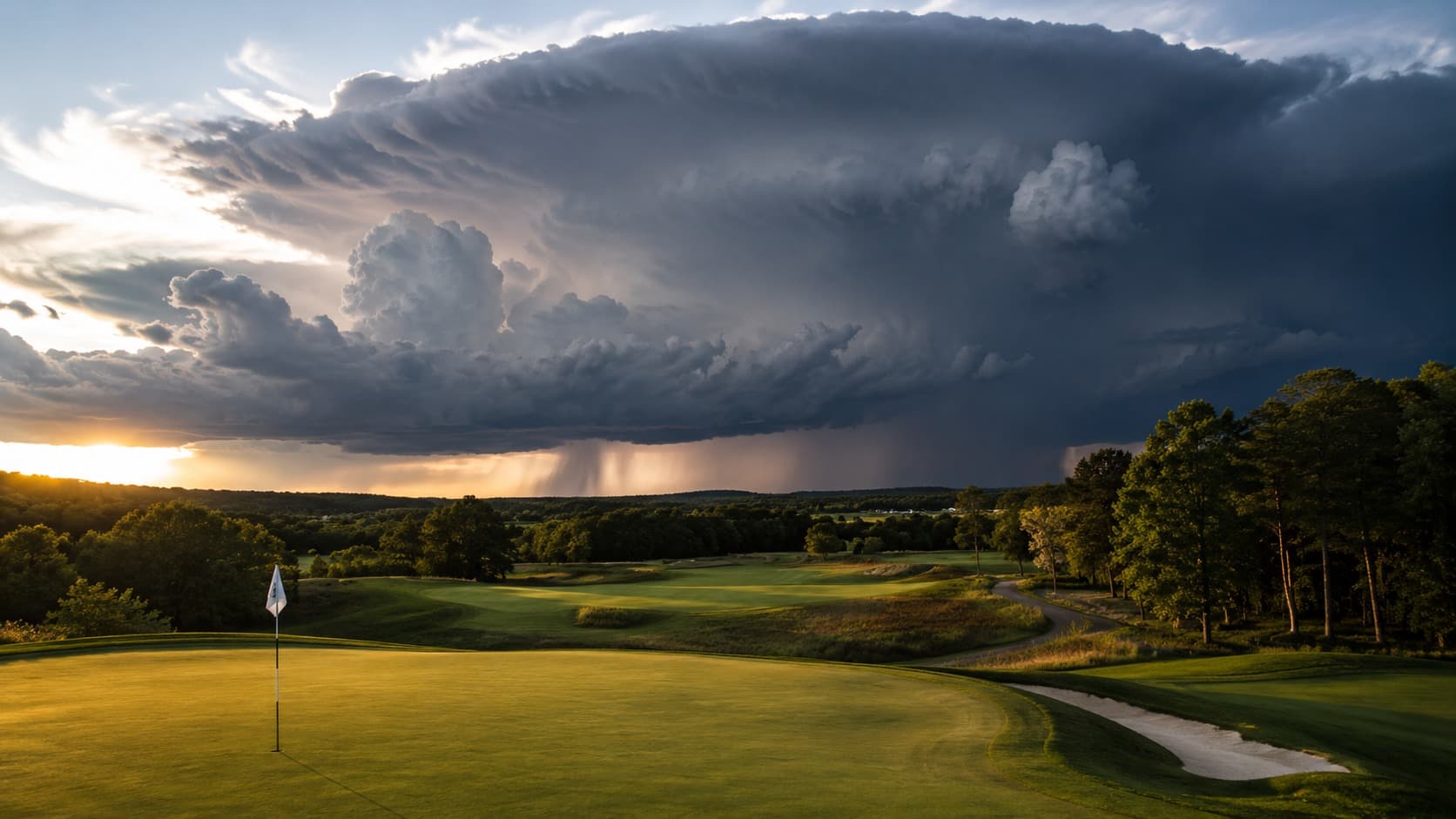
The Three O’Clock Storm: Reading Summer’s Convective Cycle to Protect Your Round
A 40% chance of afternoon thunderstorms does not mean a 40% chance of getting rained on. In the summer convective season it means the morning is nearly clear and the afternoon carries a fast-building, high-energy storm risk driven by a daily heating cycle. Here is the meteorology behind the pattern, the G-Score data on how the storm cycle punishes afternoon tee times across the Southeast, Midwest, and desert Southwest, the lightning-safety decision tree that actually matters, and the workflow that gets you off the course before the first bolt.
Read Story
How to Read a G-Score: The 0–100 Golf Playability Number, Decoded
A G-Score on this site is a single 0–100 number that tells you whether today is worth tee-up. Here is exactly what each band means, what drives the calculation, and how to use it to plan a round you will actually score on.
Read StoryMinSu Kim
Founder & Golf Data Analyst
MinSu is a data analyst and golfer with 10+ years on the course. He built Golf Weather Score to answer one question: is today a good day to play? He combines weather data, course intelligence, and the proprietary G-Score algorithm to help golfers make smarter decisions.
Every Friday Morning
When Birchwood Farms Golf & Country Club plays best next weekend.
Friday 6am ET: peak G-Score windows for Birchwood Farms Golf & Country Club, wind direction by hour, and one gear call. Three minutes to read, save you the round.
One email a week. Unsubscribe in one click.
The Caddie's Oracle
Draw your luck before the tee off