
Caddie's Gear Advisor
Curated for today's 41°F · Clear
Cold-Weather Performance Layers
Thermal mid-layers that move with your swing
Tour Hand Warmers
Rechargeable warmers trusted by caddies
Thermal Base Layers
Lightweight compression that traps heat
Winter Golf Headwear
Beanies and ear warmers built for the links
Blackmoor Golf Club: Course Intelligence
Signature Setup
Blackmoor sits in Murrells Inlet, South Carolina, and it is the only Gary Player design in the Myrtle Beach corridor — that fact alone changes how you read the place. Player routed the 18 holes through the old Longwood Plantation, an antebellum rice plantation on the Waccamaw River, and the rice-field ditches and moss-draped oaks are not decoration; they are the strategy. The course opened in 1990, plays 6,614 yards from the tips to a par of 72, and carries a USGA rating of 71.1 with a slope of 126 — modest numbers that undersell how much the wetlands tighten the back nine. The signature hole is the 8th, a par-4 that asks a question off the tee: take the safe 370-yard line down the dogleg, or carry 270 yards over a small grove and leave a wedge. Most amateurs should take the long way.
Hole-by-Hole Wind & Playing Lines
The hardest hole here is the 10th, a 411-yard par-4 and the course's #1 handicap. It opens the back nine running toward the river, and in the afternoon the sea breeze off the inlet quarters into you. On a SE wind — common from noon onward in spring and summer — a 411-yard hole plays closer to 440. Hold the driver, hit 3-wood to the corner to stay dry, and take one more club into the green: 6-iron where the yardage says 8.
The 8th's risk-reward line is wind-dependent too. The 270-yard carry over the trees is only worth it downwind; into a NE breeze off the marsh, that carry shrinks your margin and the safe 370-yard route is the smart play.
Through the rice-field stretch on the back, crosswinds off the open marsh push approaches toward water on the low side. Aim at the fat side of every green and let the breeze feed it back.
Green & Fairway Characteristics
Fairways and greens are Bermuda, and by late August they run firm and fast — a 150-yard approach that lands soft in April will release ten feet in summer. The greens are well-bunkered rather than severely contoured, so the defense is the surround, not the slope. The front nine plays through pines and oaks with more room than it looks; the back nine narrows hard through cypress and wetland, and the rice-field ditches that abound on the inward holes punish anything pulled. Off the tee, position beats length here — Player's routing rewards the player who lays back to a number.
Seasonal Weather Pattern
Murrells Inlet is humid-subtropical and coastal, which makes Blackmoor a different weather animal than the inland Myrtle Beach tracks. Spring (March–May) is the sweet spot: morning lows around 55–61°F, light winds, firm but receptive Bermuda. Summer is the trap — June through August highs hit 90–93°F with afternoon thunderstorms building off the Atlantic almost daily by 2 or 3 p.m. October is the locals' secret: warm days, cool mornings near 58°F, and the lowest rain odds of the year. Winter stays playable in the 50s, though the dormant Bermuda runs faster and the river wind has more bite. I haven't logged a full summer round here myself, so the August firmness numbers above lean on regional historical data rather than my own card.
Local Play Tips
The detail that does not show up on a scorecard: the sea breeze off the Waccamaw is a clock. Every Murrells Inlet morning I've teed off in has followed the same pattern — dead-calm at 7:30 a.m., then meaningfully up by 11 — so the marsh-side and river holes (8 through 13) play a full club easier in the first wave. Book the earliest tee time you can stand. The other quiet edge is the rice-field ditches — they are not always visible from the tee box on the back nine, so walk up and look on your first visit rather than trusting the yardage book.
Pre-Round Weather Workflow
Use the 7-day G-Score the night before and again at dawn. For Blackmoor specifically: check the windExposure direction first. A SE/NE forecast over 10 mph means the 10th and the river holes will play long — plan to club up before you tee off, not mid-round. If the G-Score flags afternoon thunderstorm risk (standard June–August), move your tee time to the first wave; the early window is both calmer and dry. In spring and fall, a high G-Score morning with light wind is your green light to attack pins. When the score dips on a stiff coastal-wind day, play to the fat side of every green and take the safe lines — Blackmoor gives strokes back to the patient.
Sources: Blackmoor Golf Club — Play Golf Myrtle Beach, Hammock Coast Golf Trail — Blackmoor, Blackmoor scorecard — BlueGolf, GolfPass — Blackmoor
Related Reading
Before you tee off at Blackmoor Golf Club
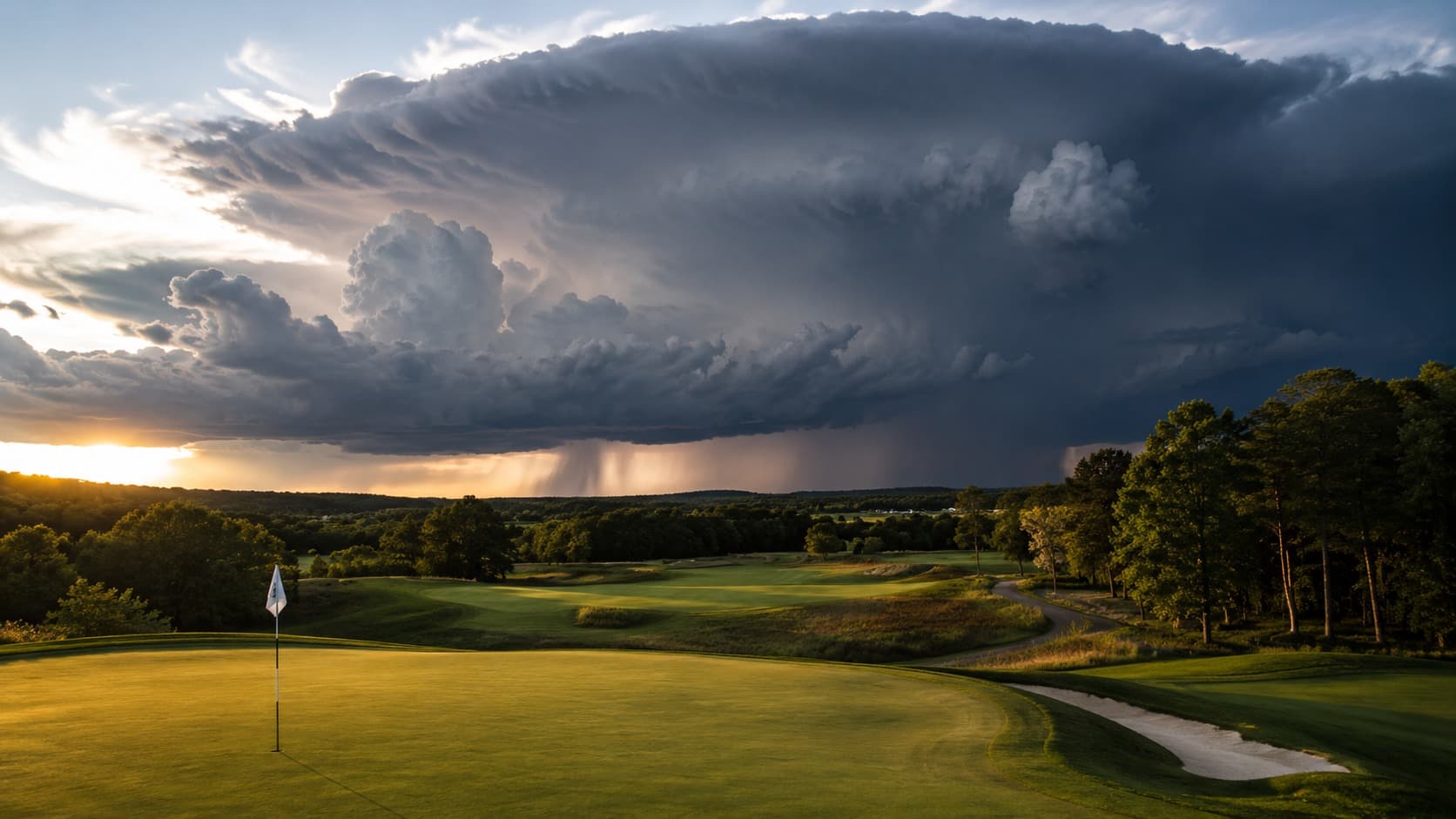
The Three O’Clock Storm: Reading Summer’s Convective Cycle to Protect Your Round
A 40% chance of afternoon thunderstorms does not mean a 40% chance of getting rained on. In the summer convective season it means the morning is nearly clear and the afternoon carries a fast-building, high-energy storm risk driven by a daily heating cycle. Here is the meteorology behind the pattern, the G-Score data on how the storm cycle punishes afternoon tee times across the Southeast, Midwest, and desert Southwest, the lightning-safety decision tree that actually matters, and the workflow that gets you off the course before the first bolt.
Read Story
How to Read a G-Score: The 0–100 Golf Playability Number, Decoded
A G-Score on this site is a single 0–100 number that tells you whether today is worth tee-up. Here is exactly what each band means, what drives the calculation, and how to use it to plan a round you will actually score on.
Read StoryDanorie
Editorial & Data
Golf Weather Score is built by Danorie. We compute the G-Score — our own playability rating — from NOAA forecasts and published course scorecards, so any US course can be compared on any day with a single number. Methodology and data sources are documented on every page.
Every Friday Morning
When Blackmoor Golf Club plays best next weekend.
Friday 6am ET: peak G-Score windows for Blackmoor Golf Club, wind direction by hour, and one gear call. Three minutes to read, save you the round.
One email a week. Unsubscribe in one click.
The Caddie's Oracle
Draw your luck before the tee off