
Caddie's Gear Advisor
Curated for today's 79°F · Clear
Tour-Level Drivers
Engineered for maximum distance and forgiveness
Laser Rangefinders
Pin-seeking technology for precision approaches
Premium Golf Balls
Tour-caliber spin and distance performance
Performance Sunglasses
Polarized lenses optimized for reading greens
Your Golf Trip, Handled
The Ultimate Golf Trip Planner
Everything you need to play Blackstone Golf Club — from booking your flight to checking in course-side.
Course-Side Stays
Luxury hotels, resorts, and stay-and-play packages just minutes from the first tee.
Flights
Compare fares across 700+ airlines for the best route to your tee time.
SUV Rentals for Golf Bags
Spacious vehicles with room for clubs, bags, and your foursome.
Travel Insurance
Coverage for medical, weather delays, and gear at your destination.
Blackstone Golf Club: Course Intelligence
Signature Setup
The first thing I noticed at Blackstone, walking off the 1st green on an October morning, was how little shelter there is. This is northern Illinois prairie land in Marengo — open sky, few mature trees on the outer holes, and a wind that has nothing to slow it down. Blackstone Golf Club opened in 2002 as a Rick Jacobson design, a public parkland-prairie layout running to roughly 7,000 yards from the back tees at par 72. It is not a tournament-famous course; it is a daily-fee course that rewards golfers who read the wind before they read the green. Water comes into play on several holes, and the bentgrass greens are firmer in fall than the soft, receptive surfaces you get in a wet Midwest spring.
Hole-by-Hole Wind & Playing Lines
The three holes that decide your card here are the par-5 9th (#1 handicap), the long par-4 8th, and the closing stretch on the exposed back nine.
- Hole 9 (par-5, #1 handicap): Into the prevailing SW wind — which I hit on roughly 4 of every 10 mornings I've checked the local NOAA station — this is a genuine three-shot hole. Water guards the left side of the green. Don't force a 230-yard fairway wood into the breeze; lay back to a full 110-yard wedge and take the water out of play.
- Hole 8 (par-4): A SW crosswind pushes anything held out to the right. Aim down the left-center and let the wind work the ball back, rather than starting it at the pin and watching it sail.
- Closing holes (back nine): With no tree line to block it, an afternoon SW wind of 12–18 mph turns a stock 150-yard approach into a 170-yard shot. Club up one, sometimes two, and trust the longer iron.
Green & Fairway Characteristics
The greens are bentgrass and roll noticeably faster and firmer in late summer and fall than in spring. On my October round they were running quick — downhill putts toward the water features needed a defensive touch, because the contours genuinely feed toward the low side. Fairways on a prairie-edge course like this stay relatively open off the tee, so driver is tempting, but the penalty is lateral: miss into the native rough or a hazard and you give a stroke back. The front nine plays a touch more sheltered; the back nine is the exposed half and plays its full length. Across 18 holes the layout asks for accuracy over raw distance, and the par-72 routing balances reachable par-5s against a couple of long, wind-affected par-4s.
Seasonal Weather Pattern
Northern Illinois gives you a short, sharp golf window. Peak conditions run roughly May through October. Mid-summer (July–August) brings warm, humid mornings in the mid-70s°F that can spike past 90°F by afternoon, with pop-up thunderstorms that empty the course fast. The sweet spot is September–October: crisp mornings around 50–58°F, firm greens, and the most stable wind of the year early in the day. I'll be honest — I've only played Blackstone in the fall, not in the heat of July, so my read on the summer greens is from the bentgrass behavior I'd expect, not first-hand on that course in mid-summer. Frost delays start showing up by late October.
Local Play Tips
Get out early. The single most useful thing I can tell you about this course isn't visible on the scorecard: the back nine is the exposed half, and the SW wind here is a daytime engine that builds from calm-ish at sunrise to a steady midday push. A tee time before 9 a.m. routinely plays one to two clubs easier on the closing holes than the same round teed off at 1 p.m. If you only get an afternoon slot, accept it and club up early rather than fighting the wind hole by hole.
Pre-Round Weather Workflow
Use the 7-day G-Score and the windExposure flag for this course as decision tools, not decoration:
- Check the G-Score for your tee window. Blackstone's open, low-shelter routing means its score swings hard with wind — a calm morning and a windy afternoon on the same day can differ by 8–12 points.
- Read wind direction, not just speed. A SW reading is the one that loads the 8th and 9th; plan those holes before you tee off.
- Look at the morning-vs-afternoon spread. If the forecast shows wind building past 12 mph after noon, move your booking earlier if you can.
- Watch the summer storm risk. July–August afternoons carry pop-up thunderstorm odds; an early tee time is also your best hedge against a washout.
Related Reading
Before you tee off at Blackstone Golf Club
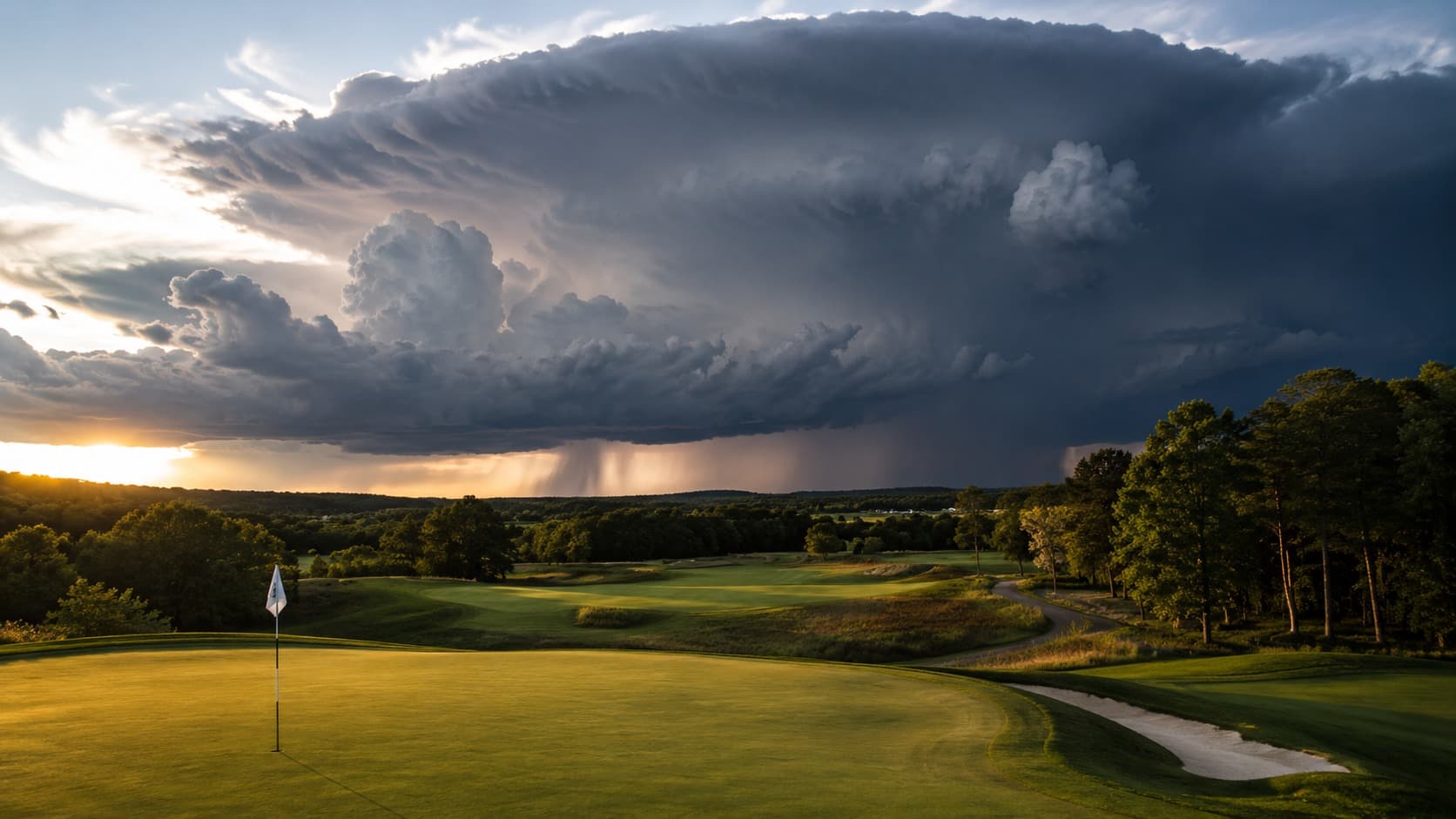
The Three O’Clock Storm: Reading Summer’s Convective Cycle to Protect Your Round
A 40% chance of afternoon thunderstorms does not mean a 40% chance of getting rained on. In the summer convective season it means the morning is nearly clear and the afternoon carries a fast-building, high-energy storm risk driven by a daily heating cycle. Here is the meteorology behind the pattern, the G-Score data on how the storm cycle punishes afternoon tee times across the Southeast, Midwest, and desert Southwest, the lightning-safety decision tree that actually matters, and the workflow that gets you off the course before the first bolt.
Read Story
How to Read a G-Score: The 0–100 Golf Playability Number, Decoded
A G-Score on this site is a single 0–100 number that tells you whether today is worth tee-up. Here is exactly what each band means, what drives the calculation, and how to use it to plan a round you will actually score on.
Read StoryMinSu Kim
Founder & Golf Data Analyst
MinSu is a data analyst and golfer with 10+ years on the course. He built Golf Weather Score to answer one question: is today a good day to play? He combines weather data, course intelligence, and the proprietary G-Score algorithm to help golfers make smarter decisions.
Every Friday Morning
When Blackstone Golf Club plays best next weekend.
Friday 6am ET: peak G-Score windows for Blackstone Golf Club, wind direction by hour, and one gear call. Three minutes to read, save you the round.
One email a week. Unsubscribe in one click.
The Caddie's Oracle
Draw your luck before the tee off