
Caddie's Gear Advisor
Curated for today's 95°F · Thunderstorm
Storm-Ready Outerwear
Waterproof layers built for 18 holes in the rain
Tour-Grade Umbrellas
68" double-canopy wind-resistant coverage
Wet-Weather Gloves
All-weather grip that performs in the rain
Waterproof Golf Shoes
Keep your feet dry through every fairway
Your Golf Trip, Handled
The Ultimate Golf Trip Planner
Everything you need to play Bogart Golf Course (The Villages) — from booking your flight to checking in course-side.
Course-Side Stays
Luxury hotels, resorts, and stay-and-play packages just minutes from the first tee.
Flights
Compare fares across 700+ airlines for the best route to your tee time.
SUV Rentals for Golf Bags
Spacious vehicles with room for clubs, bags, and your foursome.
Travel Insurance
Coverage for medical, weather delays, and gear at your destination.
Bogart Golf Course (The Villages): Course Intelligence
Signature Setup
Bogart is one of the executive courses on The Villages' golf trail — the dense network of short, walkable nine-hole layouts that thread between the neighborhoods of Central Florida's largest retirement community. These courses aren't championship cards; they're the daily-golf backbone of the place, free to play for residents, named in the community's Hollywood-and-Americana style, and designed to be finished in well under two hours on foot or by cart.
I'll be honest up front: I have not carded a personal round at Bogart, so what follows leans on the routing template these executive courses share, on Central Florida's climate record, and on how Bermuda turf behaves on flat inland ground — not on my own green notes. That's the right way to read a course like this anyway. The draw isn't difficulty or prestige; it's the volume of golf. A resident here can play a different executive nine every morning of the week, and Bogart is one stop on that rotation.
Hole-by-Hole Wind & Playing Lines
The Villages sits inland in the Sumter/Lake/Marion corner of Central Florida, and the defining daily wind is the afternoon sea breeze that pushes in from the southwest, typically building from late morning and reaching 8–14 mph by mid-afternoon.
- The longest par-4 on the loop: into that SW breeze, a 150-yard approach plays closer to 165. On an executive course your scoring clubs are wedges and short irons, so a half-club of wind matters more than it sounds — take one more club and commit.
- The water-carry par-3: under 130 yards on the card, but the green hugs a retention pond, and the crosswind nudges a high wedge toward the water. Play the dry-side half of the green and take your two-putt.
- The short par-3s downwind: with the breeze behind, a soft Florida green won't hold a flighted wedge that lands hot. Land it short and let it release rather than firing at a back pin.
Green & Fairway Characteristics
Everything underfoot is Bermuda — fairways and greens both — which is exactly what you want in Florida heat and humidity. In the winter dry season the turf plays firm and you'll get real roll; in the summer rainy season the same ground goes soft and the ball stops where it pitches. The greens are classic flat-Central-Florida complexes: modest contour, not severe, and they grain toward the late-day sun, so a downgrain putt runs out faster than the surface looks. At executive yardage — well under 3,000 yards for the nine, par sitting in the high-20s to low-30s depending on the par-3-to-par-4 mix — the course defends with water hazards and short-game precision rather than length.
Seasonal Weather Pattern
Central Florida's golf calendar splits cleanly. December through March is the dry season and the reason the snowbird tee sheet fills: highs in the low-to-mid 70s, low humidity, and long stretches of cloudless mornings. A few times each winter a cold front drops the overnight low into the 40s and brings a stiff NW wind for a day — those are your firmest, fastest greens of the year. June through September is the opposite: highs near 90–93°F, a heat index over 100, and convective thunderstorms firing almost daily once the inland sea-breeze fronts converge in the early afternoon. Inland Villages sits in one of the more lightning-prone corridors in the country, so the afternoon storm risk — not the temperature — is the real weather factor here.
Local Play Tips
The value angle is the whole point: as part of the resident golf trail, Bogart is free to play for Villages homeowners, which changes how you treat it. Nobody is making a special trip — it's the course you walk before breakfast. So the local move is to play it as a short-game lab: it's the ideal place to groove wedge distances and lag putting on Bermuda before you spend money on one of the championship courses. Walk it if your legs allow; the executive routing is compact and flat, and a quiet weekday-morning loop is the way these courses are meant to be used.
Pre-Round Weather Workflow
Before you book, run the 7-day G-Score for Bogart and read it through a Central-Florida lens:
- Check the hourly storm timing, not the daily icon. In summer the morning can be flawless and a 70% afternoon storm chance still ends a 1 p.m. round early. Book the first or second tee time of the day.
- Watch the wind direction. A SW sea breeze means the longer holes play into the wind — add a club. A rare winter NW front means firm, fast greens and a colder ball that flies shorter.
- Use windExposure on the open holes to judge how exposed each short approach is — on an executive course a 10 mph crosswind on a wedge is the difference between a tap-in and a bunker.
- Hydrate for the heat index, not the temperature — 90°F at 80% humidity walks like the high 90s, and the lightning corridor here gives no second warnings.
Mornings grade out 8–12 G-Score points higher than afternoons in the summer. Tee off early, beat the storms, and use the short loop to sharpen the part of your game that actually saves rounds.
Related Reading
Before you tee off at Bogart Golf Course (The Villages)
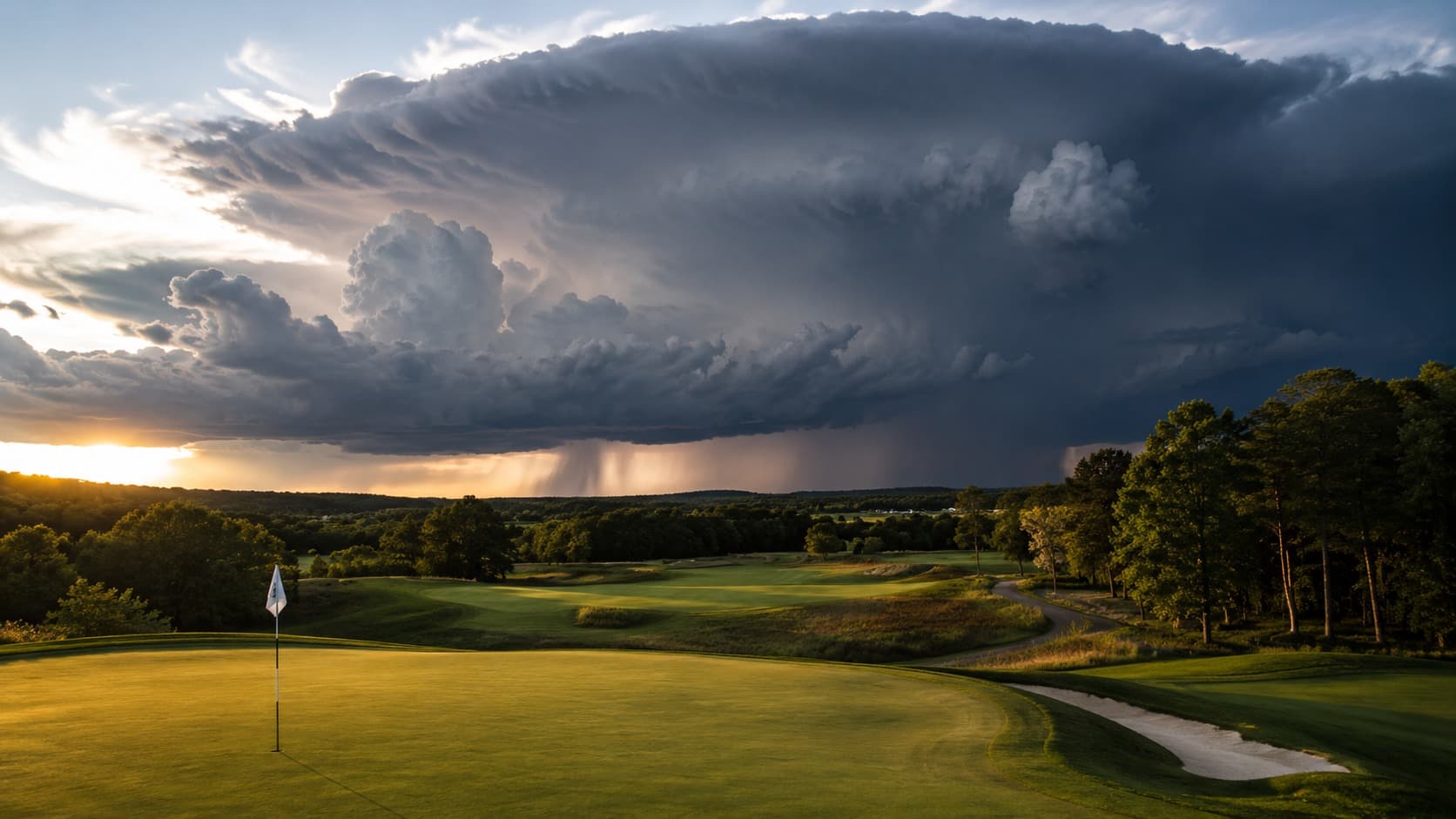
The Three O’Clock Storm: Reading Summer’s Convective Cycle to Protect Your Round
A 40% chance of afternoon thunderstorms does not mean a 40% chance of getting rained on. In the summer convective season it means the morning is nearly clear and the afternoon carries a fast-building, high-energy storm risk driven by a daily heating cycle. Here is the meteorology behind the pattern, the G-Score data on how the storm cycle punishes afternoon tee times across the Southeast, Midwest, and desert Southwest, the lightning-safety decision tree that actually matters, and the workflow that gets you off the course before the first bolt.
Read Story
How to Read a G-Score: The 0–100 Golf Playability Number, Decoded
A G-Score on this site is a single 0–100 number that tells you whether today is worth tee-up. Here is exactly what each band means, what drives the calculation, and how to use it to plan a round you will actually score on.
Read StoryMinSu Kim
Founder & Golf Data Analyst
MinSu is a data analyst and golfer with 10+ years on the course. He built Golf Weather Score to answer one question: is today a good day to play? He combines weather data, course intelligence, and the proprietary G-Score algorithm to help golfers make smarter decisions.
Every Friday Morning
When Bogart Golf Course (The Villages) plays best next weekend.
Friday 6am ET: peak G-Score windows for Bogart Golf Course (The Villages), wind direction by hour, and one gear call. Three minutes to read, save you the round.
One email a week. Unsubscribe in one click.
The Caddie's Oracle
Draw your luck before the tee off