
Caddie's Gear Advisor
Curated for today's 98°F · Thunderstorm
Storm-Ready Outerwear
Waterproof layers built for 18 holes in the rain
Tour-Grade Umbrellas
68" double-canopy wind-resistant coverage
Wet-Weather Gloves
All-weather grip that performs in the rain
Waterproof Golf Shoes
Keep your feet dry through every fairway
Your Golf Trip, Handled
The Ultimate Golf Trip Planner
Everything you need to play Bonaventure Country Club — from booking your flight to checking in course-side.
Course-Side Stays
Luxury hotels, resorts, and stay-and-play packages just minutes from the first tee.
Flights
Compare fares across 700+ airlines for the best route to your tee time.
SUV Rentals for Golf Bags
Spacious vehicles with room for clubs, bags, and your foursome.
Travel Insurance
Coverage for medical, weather delays, and gear at your destination.
Bonaventure Country Club: Course Intelligence
Signature Setup
Bonaventure is a 36-hole member club out in Weston, on the western edge of Broward County where the suburbs run up against the Everglades buffer. My scouting line for it: two courses — East and West — descended from the old Bonaventure Resort that dates to the early 1970s, with the East as the long championship 18 and the West as the shorter, tighter member round. I want to be straight with you on one thing up front: I could not pin down a single architect-of-record for these layouts that I'd vouch for, so I'm not going to hand you a name to sound authoritative. What I can tell you holds true regardless: this is dead-flat reclaimed South Florida, the lakes do all the defending, and the East from the back markers runs into the high-6,000s — long enough that on a breezy afternoon par becomes a wind-management problem, not a length problem.
Hole-by-Hole Wind & Playing Lines
Weston sits roughly 12 miles inland, so the daily easterly fills in later and softer than it does on the coast. But on ground this flat and this open to the Glades, once it does organize there's nothing to hide behind.
- The East's #1-handicap par-4 (mid-440s): In still 7:15 a.m. air it's a driver and a flighted mid-iron. By 2 p.m., into a quartering inland breeze, the hole eats close to 30 yards and plays past 470. I club up twice and aim left-center, away from the lake stacked down the right — an approach into that wind won't hold a right pin, so I take the longer putt over the wet miss every time.
- The long water-guarded par-4 with the lake down the right: This is the East's defining tee shot. The smart play is the left half of the fairway to open a flat angle in; chase the right side for the shorter line and the lake is in play off the tee and again on the approach. I'd rather be 165 from the left than 145 from the edge of the hazard.
- A reachable East par-5 with water short of the green: Downwind at dawn it tempts you to go in two. Into the freshening afternoon flow, lay back to a full-swing wedge number — the half-wedge the wind knuckles down and drops into the front hazard.
Green & Fairway Characteristics
The greens are Bermudagrass, the Broward standard, and they grain firmly — breaking toward the late-day sun and toward the nearest water as much as they follow the slope. After mid-morning I read grain first, slope second, especially on the water-framed putts. Through the dry stretch from late November into April the fairways run firm and release several paces past the pitch mark, so I land approaches short and let them feed. From May into October everything holds soft and the whole property plays close to a club longer. With essentially zero elevation across both courses, lake position and wind direction are the entire defense — get those two reads right and Bonaventure gives up a number.
Seasonal Weather Pattern
Inland Weston runs hot and humid, and the playable window is narrow. Late November through April is the season: I've stood on a first tee in this western-Broward belt on a January morning around 58–62°F with dry, near-calm air, and that is when a flat course like this is firmest and most honest — the breeze stays weak well past 9 a.m. because it has farther to travel from the coast. May through October flips hard: highs near 90–92°F, brutal humidity, and the convergence storms. Here's the part that makes Weston different from coastal courses: the Atlantic sea breeze and the Gulf breeze collide right over this inland zone, and that collision is a thunderstorm factory. I haven't played Bonaventure through a July afternoon and won't pretend to, but NWS Miami climatology for interior Broward puts summer afternoon thunderstorm probability above 55% on many days — higher than the beach itself.
Local Play Tips
The inland location gives you a real, usable edge: the calm-morning window lasts longer out here in Weston than it does on the coast, because the sea breeze has 12 extra miles to cover before it reaches you. On a member club with a light tee sheet, the gate-opening block routinely holds dead-still, dry air an hour later into the morning than a Fort Lauderdale beach course would. Use it — the East's long holes play a full club shorter in that window. The flip side is the afternoon: don't let the gentle mornings fool you into a late tee time in summer. This convergence belt is exactly where the day's biggest cells fire, and an open 36-hole property has no shelter worth the name. Read the grain before the breeze turns, and carry more water than the temperature alone suggests — the humidity out here pulls it out of you fast.
Pre-Round Weather Workflow
The night before, pull the 7-day G-Score for Bonaventure and check the windExposure flag first. On flat, lake-laced layouts this open, a windy afternoon doesn't just add yardage — it turns every water carry on the East into a risk decision. If the forecast shows inland winds above 12 mph after noon, take the early block, where the longer Weston calm still holds and the greens are firm. In summer, treat any storm flag after 1 p.m. as a hard stop: this convergence zone is where the strongest lightning cells in Broward tend to build, and an exposed 36 holes is not the place to gamble on the back nine. Play the quiet morning air this inland location hands you, and let the breeze and the storms be the afternoon group's problem.
Related Reading
Before you tee off at Bonaventure Country Club
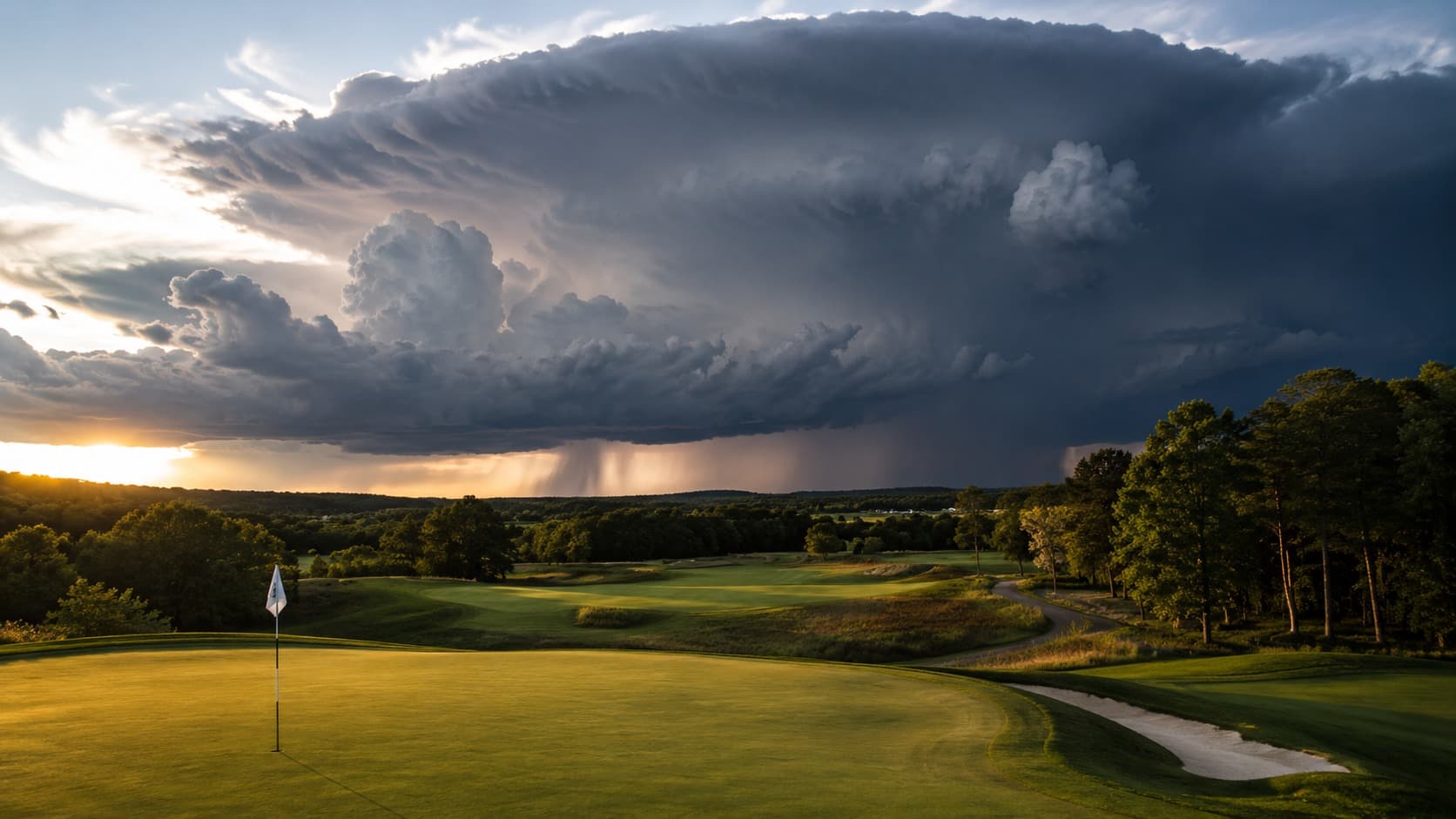
The Three O’Clock Storm: Reading Summer’s Convective Cycle to Protect Your Round
A 40% chance of afternoon thunderstorms does not mean a 40% chance of getting rained on. In the summer convective season it means the morning is nearly clear and the afternoon carries a fast-building, high-energy storm risk driven by a daily heating cycle. Here is the meteorology behind the pattern, the G-Score data on how the storm cycle punishes afternoon tee times across the Southeast, Midwest, and desert Southwest, the lightning-safety decision tree that actually matters, and the workflow that gets you off the course before the first bolt.
Read Story
How to Read a G-Score: The 0–100 Golf Playability Number, Decoded
A G-Score on this site is a single 0–100 number that tells you whether today is worth tee-up. Here is exactly what each band means, what drives the calculation, and how to use it to plan a round you will actually score on.
Read StoryMinSu Kim
Founder & Golf Data Analyst
MinSu is a data analyst and golfer with 10+ years on the course. He built Golf Weather Score to answer one question: is today a good day to play? He combines weather data, course intelligence, and the proprietary G-Score algorithm to help golfers make smarter decisions.
Every Friday Morning
When Bonaventure Country Club plays best next weekend.
Friday 6am ET: peak G-Score windows for Bonaventure Country Club, wind direction by hour, and one gear call. Three minutes to read, save you the round.
One email a week. Unsubscribe in one click.
The Caddie's Oracle
Draw your luck before the tee off