
Caddie's Gear Advisor
Curated for today's 95°F · Thunderstorm
Storm-Ready Outerwear
Waterproof layers built for 18 holes in the rain
Tour-Grade Umbrellas
68" double-canopy wind-resistant coverage
Wet-Weather Gloves
All-weather grip that performs in the rain
Waterproof Golf Shoes
Keep your feet dry through every fairway
Your Golf Trip, Handled
The Ultimate Golf Trip Planner
Everything you need to play Bonifay Country Club (The Villages) — from booking your flight to checking in course-side.
Course-Side Stays
Luxury hotels, resorts, and stay-and-play packages just minutes from the first tee.
Flights
Compare fares across 700+ airlines for the best route to your tee time.
SUV Rentals for Golf Bags
Spacious vehicles with room for clubs, bags, and your foursome.
Travel Insurance
Coverage for medical, weather delays, and gear at your destination.
Bonifay Country Club (The Villages): Course Intelligence
Signature Setup
Bonifay is one of the championship courses inside The Villages in Sumter County, central Florida — not an executive nine, but a full 18 that the community opened in 2014. The routing carries the Nancy Lopez Golf Design / Gordon Lewis fingerprint you see across the newer Villages championship layouts: wide landing zones off the tee, then water and bunker pinch points that tighten near the greens. I haven't played Bonifay in a club tournament, so I won't pretend to know how it sets up under competition pins — but for daily member tees it rewards a player who manages the wind and the heat more than one who simply hits it far. The closing par-5 18th, around 545 yards with water working down the left on the return leg, is the hole most members talk about, and it's where I've seen good rounds give back two shots in ten minutes.
Hole-by-Hole Wind & Playing Lines
Central Florida wind here is not coastal-violent, but it is directional and it shifts with the afternoon sea-breeze that pushes inland off the Gulf.
- Hole 4 (#1 handicap, par-4 ~430y): On SSE afternoons — the dominant April–September pattern — this plays dead into a pulling crossbreeze. My 150-yard club becomes a 165-yard decision. Hold the tee ball up the right to keep the angle open and plan a 6-iron-to-4-iron length approach rather than the 7-iron the yardage book promises.
- Long par-3 (mid-round, ~200y): Into a S/SSW breeze this is the hole that exposes ego. I take one extra club and aim at the fat center of the green; the back-left bunker is a guaranteed bogey in summer when the sand packs heavy after the daily rain.
- 18th (par-5 ~545y): With water down the left return, a left-to-right afternoon wind tempts you to flirt the corner. Don't. Lay back to a full wedge number and let the green's firmness — see S3 — do the work.
Green & Fairway Characteristics
The greens are TifEagle Bermuda, typical of Villages championship rebuilds, and they run firm. I'd put daily stimp in the low-to-mid 10s — quick enough that a downwind, downhill putt on a dry afternoon will roll out well past the hole. Surrounds are paspalum rough, which grabs less than you expect, so a bump-and-run off the fringe is often safer than a flop. Fairways sit on a sand base and drain fast: within an hour of a summer thunderstorm they're playable again, and by late afternoon they're firm enough to add 10–15 yards of roll. Front-nine landing areas are generous; the back tightens, and the dogleg holes ask you to favor the inside edge to shorten the approach.
Seasonal Weather Pattern
This is where Bonifay's scorecard really gets decided. Summer (June–September) means an afternoon thunderstorm clock — highs near 92°F, heat index pushing 100–105°F by 1 p.m., and a near-daily storm cell forming around 2–4 p.m. October through April is the prime window: morning lows in the 50s–60s, dry firm turf, and far less wind. January mornings can dip near 40°F, which deadens the Bermuda greens and slows them noticeably for the first two hours. The single most useful pattern to internalize: heat and humidity build through the day here faster than the wind does, so your physical decline, not the breeze, is usually your real opponent after the turn.
Local Play Tips
Tee off before 9 a.m. from roughly May through October. I've watched the same group lose three or four strokes on the back nine purely to afternoon heat fatigue and softening course management. Carry more water than you think you need and treat hole 10 as a reset point — that's where summer rounds quietly fall apart. In winter, do the opposite: don't rush the first two greens, because the cold-morning Bermuda is slower than it looks and you'll leave early putts short until the surface warms.
Pre-Round Weather Workflow
Use the 7-day G-Score on this course page before you book. Two practical reads: (1) In summer, the morning G-Score will run 8–12 points higher than the afternoon — book the earliest available slot the model flags as green. (2) Check windExposure for SSE/SSW afternoons; on those days add a club on holes 4 and 18 and play to fat green centers. If a summer afternoon shows a storm probability spike, plan to be on the 14th green before 1 p.m. — that's the realistic finish line before the daily cell builds.
Related Reading
Before you tee off at Bonifay Country Club (The Villages)
The Three O’Clock Storm: Reading Summer’s Convective Cycle to Protect Your Round
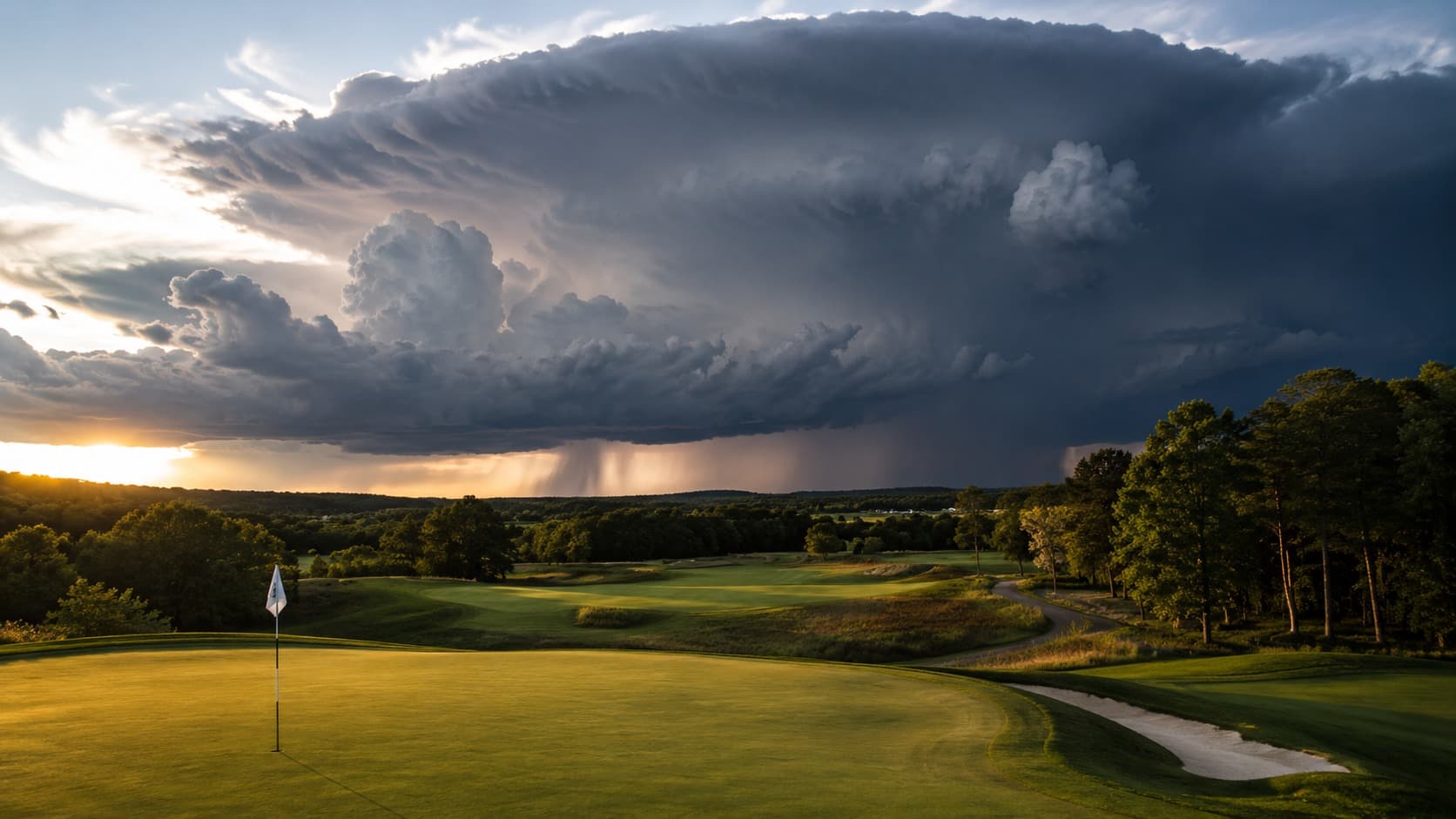
A 40% chance of afternoon thunderstorms does not mean a 40% chance of getting rained on. In the summer convective season it means the morning is nearly clear and the afternoon carries a fast-building, high-energy storm risk driven by a daily heating cycle. Here is the meteorology behind the pattern, the G-Score data on how the storm cycle punishes afternoon tee times across the Southeast, Midwest, and desert Southwest, the lightning-safety decision tree that actually matters, and the workflow that gets you off the course before the first bolt.
Read Story
How to Read a G-Score: The 0–100 Golf Playability Number, Decoded
A G-Score on this site is a single 0–100 number that tells you whether today is worth tee-up. Here is exactly what each band means, what drives the calculation, and how to use it to plan a round you will actually score on.
Read StoryMinSu Kim
Founder & Golf Data Analyst
MinSu is a data analyst and golfer with 10+ years on the course. He built Golf Weather Score to answer one question: is today a good day to play? He combines weather data, course intelligence, and the proprietary G-Score algorithm to help golfers make smarter decisions.
Every Friday Morning
When Bonifay Country Club (The Villages) plays best next weekend.
Friday 6am ET: peak G-Score windows for Bonifay Country Club (The Villages), wind direction by hour, and one gear call. Three minutes to read, save you the round.
One email a week. Unsubscribe in one click.
The Caddie's Oracle
Draw your luck before the tee off