
Caddie's Gear Advisor
Curated for today's 77°F · Thunderstorm
Storm-Ready Outerwear
Waterproof layers built for 18 holes in the rain
Tour-Grade Umbrellas
68" double-canopy wind-resistant coverage
Wet-Weather Gloves
All-weather grip that performs in the rain
Waterproof Golf Shoes
Keep your feet dry through every fairway
Your Golf Trip, Handled
The Ultimate Golf Trip Planner
Everything you need to play Brentwood Golf Course — from booking your flight to checking in course-side.
Course-Side Stays
Luxury hotels, resorts, and stay-and-play packages just minutes from the first tee.
Flights
Compare fares across 700+ airlines for the best route to your tee time.
SUV Rentals for Golf Bags
Spacious vehicles with room for clubs, bags, and your foursome.
Travel Insurance
Coverage for medical, weather delays, and gear at your destination.
Brentwood Golf Course: Course Intelligence
Signature Setup
Brentwood Golf Course is a 9-hole, ~2,731-yard public layout in Lecanto, Florida — Citrus County, about ten miles inland from the Gulf on the Nature Coast. It's the Brentwood Farms course, credited to Ken Creech, and it carries a slope of roughly 100, which tells you up front this is a walkable, forgiving everyday round rather than a championship test. I want to be straight: I haven't played this specific nine — I'm in California and I'm working from the scorecard, the slope/yardage record, and a decade of playing inland Florida golf in the same heat and sea-breeze pattern. Where I'm reasoning from the region rather than this exact property, I'll say so. What makes a short nine like this worth a careful pre-round read isn't the architecture — it's the Gulf weather that reshapes a 2,731-yard card hole by hole.
Hole-by-Hole Wind & Playing Lines
The wind that matters here is the afternoon Gulf sea breeze, which on the Nature Coast typically swings onshore from the SW–W by early afternoon in the warm season.
- The #1-handicap par-4 (~400y back tee): In a calm 8 a.m. window it's a driver and a short iron. Once the sea breeze fills after noon, the same hole plays a club-and-a-half longer into your face — plan driver→6-iron, not the stock 8-iron the card implies.
- The signature par-3 over the central pond: Short on paper, but it's the most wind-exposed shot on the property. A helping breeze can run a mid-iron over the back; into it, club up two and aim for the fat of the green, not the pin.
- A downwind par-4 on the back of the loop: With the SW breeze behind, the green gets reachable-adjacent for longer hitters — but Bermuda fairways here hold roll only when dry, so a wet morning kills the gamble.
I'm describing wind direction effects from the regional pattern; exact hole orientations on this nine I'd confirm on site.
Green & Fairway Characteristics
Expect Bermudagrass tee-to-green, the standard for this part of Florida — fairways that give you a clean lie and decent roll when firm, and greens that grain hard toward the late-day sun. Putts breaking with the grain run out; into the grain they die short, and grain near the holes is the single most underrated read on Florida Bermuda. In winter the course overseeds thin, so the surfaces play slower and patchier December–February. With slope around 100 and a sub-2,800-yard nine, the trouble isn't length — it's the pond complex and the grain, not the card.
Seasonal Weather Pattern
Lecanto's defining variable is summer convective heat, not wind. June through September, mornings open in the upper-70s°F and climb past 90°F with dew points in the low-70s — brutal, draining humidity — and afternoon thunderstorm probability runs 50–60% by 2 p.m. like clockwork as Gulf and Atlantic sea breezes collide inland. October–April is the real golf season here: drier air, mornings in the 50s–60s°F, and the occasional January cold front that drops a raw, breezy day. Unlike a coastal links, your enemy on this nine is the clock in summer — get the loop done before the cells build.
Local Play Tips
Because it's a 9-hole loop, the smart move in the warm months is a single early lap rather than going around twice: the second nine in Nature Coast summer is where heat exhaustion and the 2 p.m. storm window catch people. Carry more water than you think for a "short" round, and treat any towering cumulus to the east by late morning as your turn-in signal — inland Citrus County storms arrive fast. In winter, do the opposite and start late: let the overnight chill burn off so the overseeded greens speed up.
Pre-Round Weather Workflow
Use the 7-day G-Score and windExposure read like this for Brentwood:
- In summer, check the afternoon thunderstorm probability first, not the high temp. If storm odds clear 50% by early afternoon, book the earliest tee you can and plan to be off by 11 a.m.
- Watch the SW sea-breeze onset. When G-Score shows wind filling before noon, the #1-handicap par-4 and the pond par-3 both jump a club-plus into the breeze — club up pre-emptively.
- In Dec–Feb, check the prior-night low. Overseeded Bermuda greens are slow and soft until the chill lifts; a mid-morning tee beats a frosty early one here.
- Target the highest morning G-Score window. On the Nature Coast that's almost always the calm, pre-storm early slot — often 8–12 points better than a stormy, sticky afternoon.
Related Reading
Before you tee off at Brentwood Golf Course
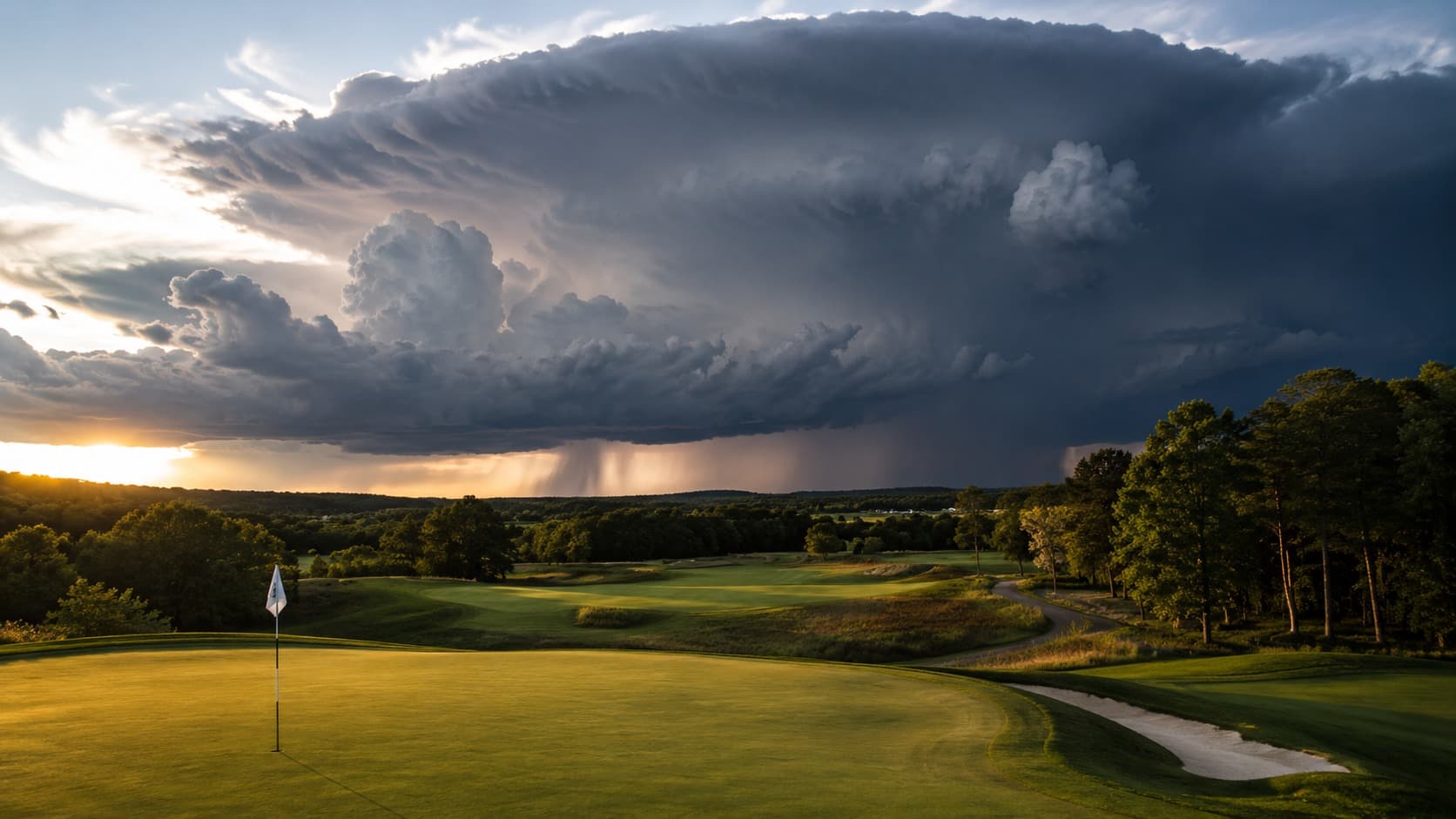
The Three O’Clock Storm: Reading Summer’s Convective Cycle to Protect Your Round
A 40% chance of afternoon thunderstorms does not mean a 40% chance of getting rained on. In the summer convective season it means the morning is nearly clear and the afternoon carries a fast-building, high-energy storm risk driven by a daily heating cycle. Here is the meteorology behind the pattern, the G-Score data on how the storm cycle punishes afternoon tee times across the Southeast, Midwest, and desert Southwest, the lightning-safety decision tree that actually matters, and the workflow that gets you off the course before the first bolt.
Read Story
How to Read a G-Score: The 0–100 Golf Playability Number, Decoded
A G-Score on this site is a single 0–100 number that tells you whether today is worth tee-up. Here is exactly what each band means, what drives the calculation, and how to use it to plan a round you will actually score on.
Read StoryMinSu Kim
Founder & Golf Data Analyst
MinSu is a data analyst and golfer with 10+ years on the course. He built Golf Weather Score to answer one question: is today a good day to play? He combines weather data, course intelligence, and the proprietary G-Score algorithm to help golfers make smarter decisions.
Every Friday Morning
When Brentwood Golf Course plays best next weekend.
Friday 6am ET: peak G-Score windows for Brentwood Golf Course, wind direction by hour, and one gear call. Three minutes to read, save you the round.
One email a week. Unsubscribe in one click.
The Caddie's Oracle
Draw your luck before the tee off