
Caddie's Gear Advisor
Curated for today's 82°F · Clear
Tour-Level Drivers
Engineered for maximum distance and forgiveness
Laser Rangefinders
Pin-seeking technology for precision approaches
Premium Golf Balls
Tour-caliber spin and distance performance
Performance Sunglasses
Polarized lenses optimized for reading greens
Your Golf Trip, Handled
The Ultimate Golf Trip Planner
Everything you need to play Bretwood Golf Course — from booking your flight to checking in course-side.
Course-Side Stays
Luxury hotels, resorts, and stay-and-play packages just minutes from the first tee.
Flights
Compare fares across 700+ airlines for the best route to your tee time.
SUV Rentals for Golf Bags
Spacious vehicles with room for clubs, bags, and your foursome.
Travel Insurance
Coverage for medical, weather delays, and gear at your destination.
Bretwood Golf Course: Course Intelligence
Signature Setup
Let me be straight before anything else: I built this read from the course's published materials, the Geoffrey Cornish design record, and decades of southwestern New Hampshire climate data — I have not personally teed it up, so the wind reads below are profile-and-pattern reasoning, not a round I'm dressing up as memory. Bretwood Golf Course sits in Keene, in the Monadnock region of southwestern New Hampshire, and it is a 36-hole facility: a North Course attributed to Geoffrey Cornish and dating to the mid-1960s, and a South Course added in 1989 from the Cornish & Silva office. Both eighteens are full-length par 72s in the high-6,000-to-7,000-yard range. The defining feature is the Branch River, which threads through the property and brings water and wetland into the routing — and in a New England river valley, the thing that actually defends the card is the combination of that water, the cool-air carry penalty, and the wind that funnels down the valley in the afternoon.
TL;DR: 36-hole Keene, NH facility — Cornish-designed North (1965) and a 1989 South from the Cornish & Silva office. Rolling Monadnock-region parkland, par-72 eighteens near 6,900–7,000y, the Branch River in play, bentgrass greens. The real defense is cool air plus the afternoon valley wind over river wetland — tee off early, club up into the breeze, and respect the water.
Hole-by-Hole Wind & Playing Lines
Bretwood doesn't publish a per-hole stroke-index card I could independently verify, so I won't invent exact hole numbers and yardages I can't stand behind — instead, here is how the prevailing river-valley wind and cool air dictate play on a New England parkland layout this exposed to the Branch:
- The long par-4 index holes into the afternoon NW–W valley wind: Once the wind funnels down the valley after midday — commonly 10–18 mph in fall — a flushed 150-yard club behaves like 165–170, and where the approach is played over Branch River wetland, that lost distance is the difference between dry and wet. Club up one and flight the ball low rather than ballooning it into the gust.
- The downwind par-5s on a morning offshore/SE drainage flow: Early, before the valley wind reverses and builds, a soft tailwind helps the run-out. Land short of water-fronted greens and let the ball release rather than flying a hot, high shot that won't hold a firm bentgrass surface.
- Any crosswind hole along the river corridor: On a routing this open to the Branch, nothing blocks the wind, so the player who can hold a shaped ball into a crosswind stays dry while the one who only hits it far feeds it toward the hazard. Length is the cheap yard here; ball flight that resists the wind is the expensive one.
The habit that travels: read the wind off the flags on the first exposed hole, decide whether the valley breeze has filled in yet, and re-club for both the water and the cold-air carry loss all the way in.
Green & Fairway Characteristics
The greens read as classic northern New England — bentgrass with poa creeping in over a long season — set on rolling, glacially-shaped Monadnock terrain, and they swing hard with the calendar. Through the dry early-fall window they firm up and quicken; in the spring melt and after summer rain they soften and hold. The fairways move over genuine elevation change rather than the flat parkland you'd find further south, so the card rewards a player who flights the ball and manages position over one who just bombs it. The catch is twofold: the Branch River brings water into the routing on both eighteens, and with the valley open to the wind, your stock yardages are only fully reliable in the calm early-day window. On a still, cool 8 a.m. tee time the course is gettable; by a breezy mid-afternoon it is a meaningfully different test.
Seasonal Weather Pattern
Keene sits in a humid continental climate with real four-season swing — the opposite of a year-round resort site. Peak season (late May–Sep): warm, with highs in the 70s to mid-80s°F, the most predictable scoring conditions, and soft enough greens to attack. Fall (late Sep–Oct): the signature New England window — crisp, often spectacular foliage along the Branch, highs dropping from the 60s into the 50s°F, firm fast greens, and a real cold-air carry penalty as morning temperatures fall; the ball simply flies shorter in dense, cool air, so the yardages that worked in July run a touch long. Shoulder/winter (Nov–Apr): cold, with frost delays giving way to snow cover that closes the course outright for the heart of winter. For the cold-edge and closure stretches I lean on NOAA Keene / Dillant-Hopkins historicals rather than anything firsthand.
Local Play Tips
Here's the one thing that decides scoring on a New England river-valley course like this and that a generic forecast won't tell you: in fall you are fighting two clocks at once. The valley wind builds through the afternoon down the Branch, and the morning air is cold enough that your carry is measurably shorter than the summer number you have memorized — both penalties stack against the same long approaches. So the same hole can be a comfortable 150-yard wedge on a calm, slightly-warmed late morning and a 170-yard, water-carry grind by mid-afternoon with the breeze up and the temperature already sliding back down. The play through the prime fall stretch is a tee time that catches the brief warm, calm midday pocket if you can — late enough that the dew and the deepest chill are off the greens, early enough to beat the afternoon valley wind. A summer instinct to "play whenever" leaves strokes on the table once the cold-air carry loss enters the math.
Pre-Round Weather Workflow
Treat golfweatherscore's 7-day G-Score and windExposure as your go/no-go and your timing tool — and read it for an open river-valley course in a cold-swing climate, not a sheltered resort:
- Three days out: scan the G-Score trend for the temperature swing as much as the rain. In fall the difference between a comfortable round and a grind is often the morning low and how much cold-air carry penalty you're carrying into every approach.
- The night before: lock in wind direction and speed down the valley. A light morning drainage flow means soft, gettable golf; a building NW–W valley breeze means water-carry approaches play a club or two longer all afternoon.
- Round morning: if windExposure flags sustained gusts over ~15 mph — routine on a fall afternoon here — accept that a cool, water-fronted card plays markedly longer into the breeze, take the calm midday or early slot when you can, and let position-golf over the Branch, not heroics, protect your number.
Related Reading
Before you tee off at Bretwood Golf Course
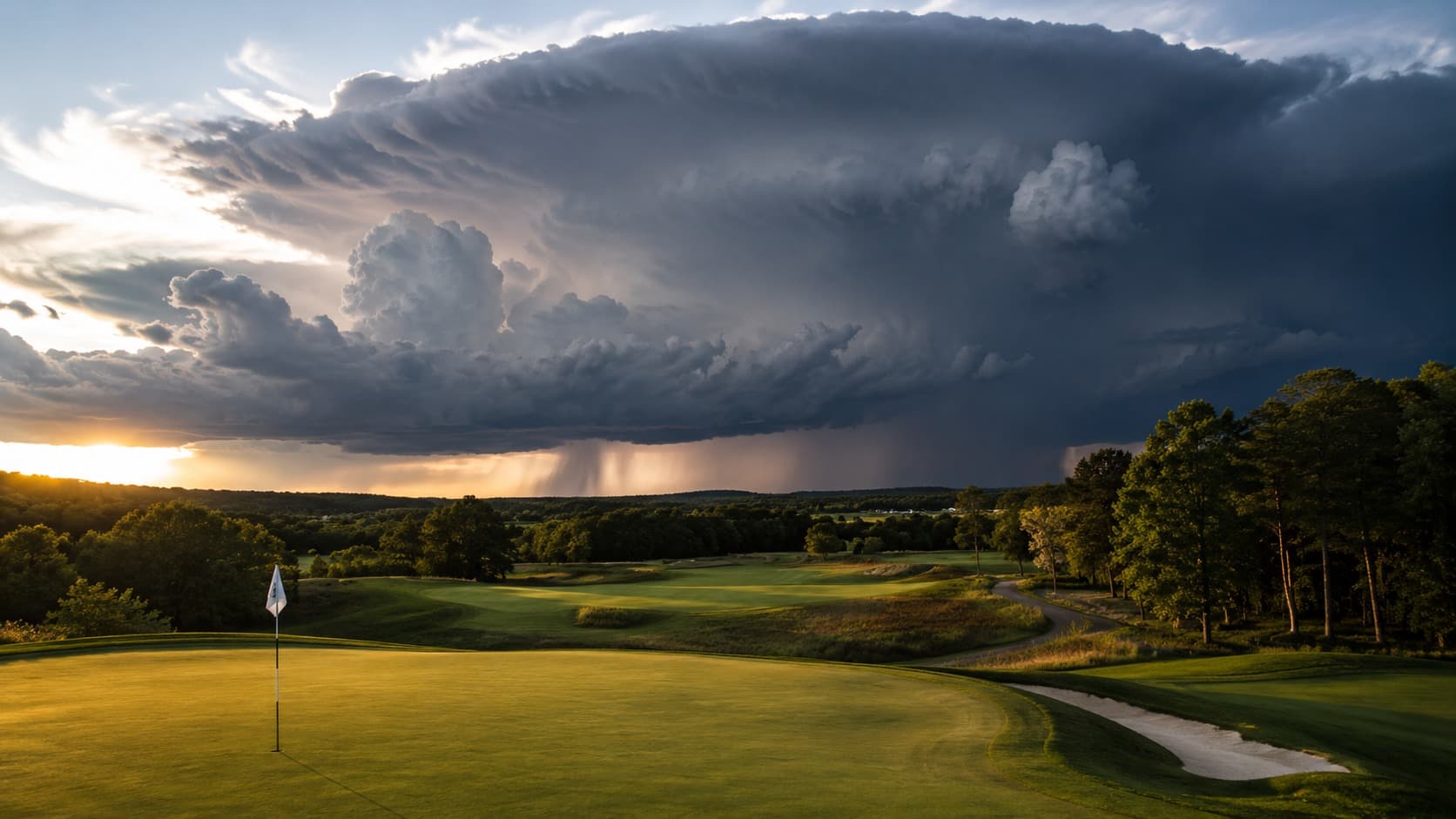
The Three O’Clock Storm: Reading Summer’s Convective Cycle to Protect Your Round
A 40% chance of afternoon thunderstorms does not mean a 40% chance of getting rained on. In the summer convective season it means the morning is nearly clear and the afternoon carries a fast-building, high-energy storm risk driven by a daily heating cycle. Here is the meteorology behind the pattern, the G-Score data on how the storm cycle punishes afternoon tee times across the Southeast, Midwest, and desert Southwest, the lightning-safety decision tree that actually matters, and the workflow that gets you off the course before the first bolt.
Read Story
How to Read a G-Score: The 0–100 Golf Playability Number, Decoded
A G-Score on this site is a single 0–100 number that tells you whether today is worth tee-up. Here is exactly what each band means, what drives the calculation, and how to use it to plan a round you will actually score on.
Read StoryMinSu Kim
Founder & Golf Data Analyst
MinSu is a data analyst and golfer with 10+ years on the course. He built Golf Weather Score to answer one question: is today a good day to play? He combines weather data, course intelligence, and the proprietary G-Score algorithm to help golfers make smarter decisions.
Every Friday Morning
When Bretwood Golf Course plays best next weekend.
Friday 6am ET: peak G-Score windows for Bretwood Golf Course, wind direction by hour, and one gear call. Three minutes to read, save you the round.
One email a week. Unsubscribe in one click.
The Caddie's Oracle
Draw your luck before the tee off