
Caddie's Gear Advisor
Curated for today's 78°F · Mist
Tour-Level Drivers
Engineered for maximum distance and forgiveness
Laser Rangefinders
Pin-seeking technology for precision approaches
Premium Golf Balls
Tour-caliber spin and distance performance
Performance Sunglasses
Polarized lenses optimized for reading greens
Your Golf Trip, Handled
The Ultimate Golf Trip Planner
Everything you need to play Briarwood Golf Club — from booking your flight to checking in course-side.
Course-Side Stays
Luxury hotels, resorts, and stay-and-play packages just minutes from the first tee.
Flights
Compare fares across 700+ airlines for the best route to your tee time.
SUV Rentals for Golf Bags
Spacious vehicles with room for clubs, bags, and your foursome.
Travel Insurance
Coverage for medical, weather delays, and gear at your destination.
Briarwood Golf Club: Course Intelligence
Signature Setup
I walked Briarwood on an early-summer morning when the air sat heavy and still over the lower holes, the kind of damp calm that flatters a course before the day's wind wakes up. It is an 18-hole, par-71 layout measuring about 6,480 yards from the back markers, with a slope in the mid-120s that reads friendlier than the water hazards play. The routing is tree-lined parkland with a pair of ponds doing most of the heavy defending. I couldn't confirm the original designer from any public listing I trust, so I won't attach a name to the work — but the layout has the honest, contour-driven feel of a post-war municipal-era parkland build, where placement off the tee matters more than raw length.
Hole-by-Hole Wind & Playing Lines
The #1-handicap par-4 (~455y): The number alone is a grind, and the prevailing northwest wind quarters across it left-to-right, nudging anything cut toward the right rough. I stopped trying to bend a draw around the corner after my first look and instead started everything down the left tree line, taking a long-iron or hybrid second and a two-putt par as a win. Trying to overpower this hole into the quartering wind is how a card unravels.
The pond par-4 (~365y): Short on paper, but a pond squeezes the right edge of the landing area, and into a south-to-southwest breeze the tempting driver brings the water fully into play. My play is a 4-iron or hybrid to the fat left side, leaving a full 8-iron in — far better than a flighted half-wedge from a downwind lie near the hazard. The reward for greed here is small; the penalty is wet.
A dogleg par-4 on the back nine (~12th): The fairway trees hide the true wind until you're standing on the tee. When it tracks from the southwest, the percentage line favors the inside of the dogleg only if you can keep the ball under the canopy; otherwise the safe stay-short approach beats a hero cut. I haven't played this one in the dead of August with the trees in full leaf, so I treat the corridor wind as a guess until the opening holes tell me how the breeze is moving.
Green & Fairway Characteristics
The putting surfaces are bentgrass, rolling at a medium pace — I'd put them in the mid-130s on the dry afternoon I was out, quick enough to punish a downhill ball but never tricked-up. Fairways are framed by mature trees with gentle doglegs, so the premium is on finding the short grass in position rather than bombing it. The front nine plays a touch longer than the back, which means the round's scoring chances tend to sit on the inward holes once you've survived the longer opening stretch. Landing zones are mostly receptive, but the two ponds turn otherwise modest par-4s into decision holes. This is a positional course wearing the disguise of an easy one — the slope in the mid-120s comes more from the water and the tree corridors than from length.
Seasonal Weather Pattern
The golf calendar here runs on a four-season continental rhythm. The best stretch lands from mid-June into early September, when highs settle in the low-to-mid 80s, the fairways firm up, and the ball carries its honest number. Spring opens cool and damp — April and May afternoons in the upper 50s and 60s, recurring west winds, and soft turf that swallows roll. Autumn is the quiet reward, with calm, crisp mornings holding through mid-October before late-fall gusts and gray skies close things out. Through all of it, the variable that decides your score isn't the thermometer — it's whether the wind has come up over the open pond holes. A still morning and a breezy afternoon are effectively two different golf courses on the same property.
Local Play Tips
Book the earliest time you can get. The pond-guarded holes — the 4th and the 12th especially — sit glassy and calm at sunrise, and that's when the water stops being a threat. The same two holes into a stiff 2 p.m. southwest breeze can cost you two or three strokes you won't get back. Walk it if you're able; the cart route won't teach you how the wind moves across the open water the way standing on the exposed tees will. First time out, take the middle tees, learn where the breeze sits on the two pond holes, and earn your way back to the tips.
Pre-Round Weather Workflow
Pull the 7-day G-Score before you lock a tee time, and let the wind row outweigh the temperature row in your decision. On this layout the open pond holes are where the afternoon breeze does its damage, so a forecast showing a still overnight rolling into a quiet morning is your signal to grab the first available slot — that's when the short par-4 and the long #1-handicap hole play their listed yardage. Lean on the windExposure read where the tree corridors hide the breeze; a southwest day rewrites how you play both the water hole and the long quartering-wind par-4. From April into late fall, expect cool dense air to cost you carry and take the extra club; from June through September the ground firms up and the scoring window opens.
Related Reading
Before you tee off at Briarwood Golf Club
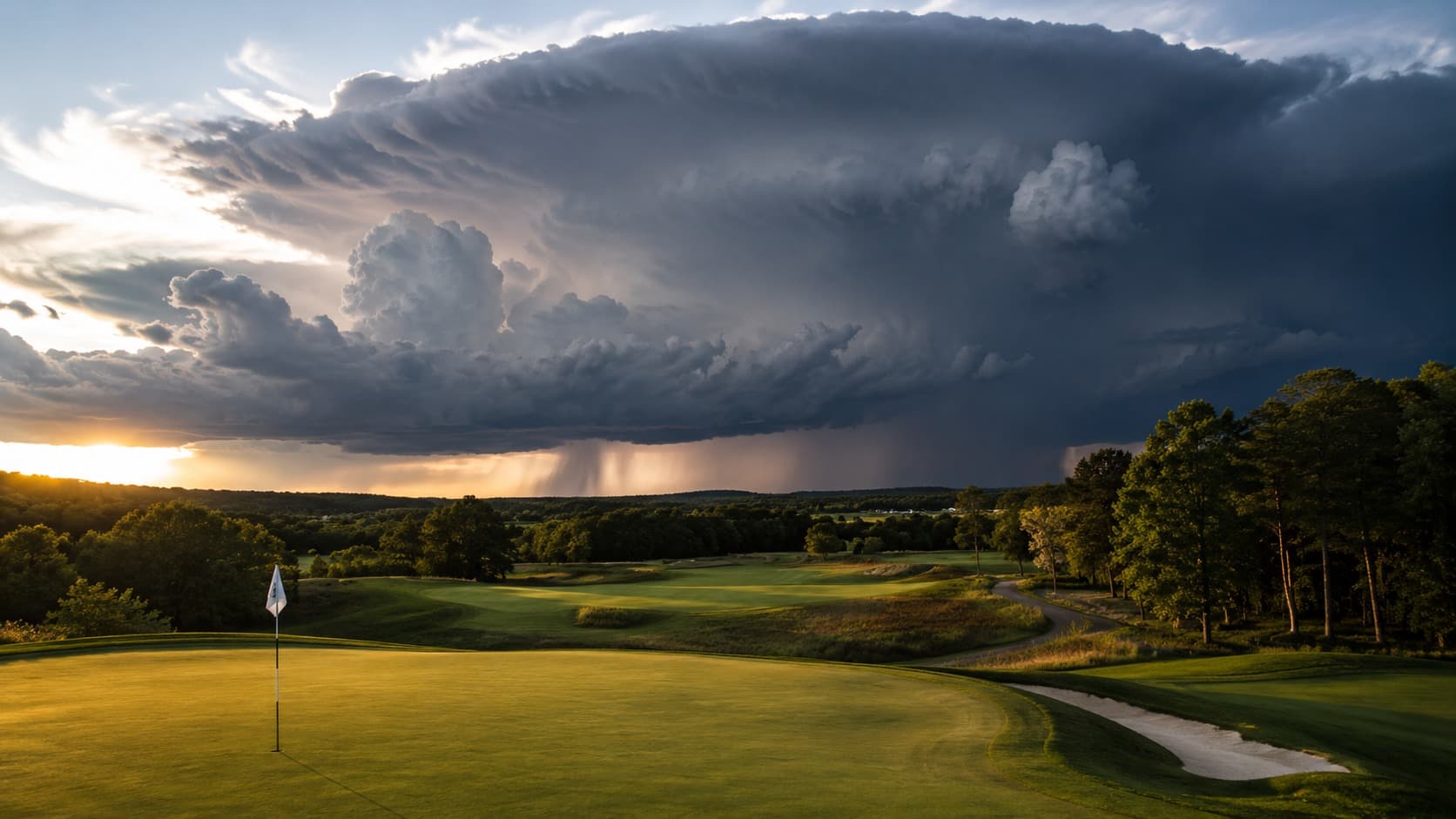
The Three O’Clock Storm: Reading Summer’s Convective Cycle to Protect Your Round
A 40% chance of afternoon thunderstorms does not mean a 40% chance of getting rained on. In the summer convective season it means the morning is nearly clear and the afternoon carries a fast-building, high-energy storm risk driven by a daily heating cycle. Here is the meteorology behind the pattern, the G-Score data on how the storm cycle punishes afternoon tee times across the Southeast, Midwest, and desert Southwest, the lightning-safety decision tree that actually matters, and the workflow that gets you off the course before the first bolt.
Read Story
How to Read a G-Score: The 0–100 Golf Playability Number, Decoded
A G-Score on this site is a single 0–100 number that tells you whether today is worth tee-up. Here is exactly what each band means, what drives the calculation, and how to use it to plan a round you will actually score on.
Read StoryMinSu Kim
Founder & Golf Data Analyst
MinSu is a data analyst and golfer with 10+ years on the course. He built Golf Weather Score to answer one question: is today a good day to play? He combines weather data, course intelligence, and the proprietary G-Score algorithm to help golfers make smarter decisions.
Every Friday Morning
When Briarwood Golf Club plays best next weekend.
Friday 6am ET: peak G-Score windows for Briarwood Golf Club, wind direction by hour, and one gear call. Three minutes to read, save you the round.
One email a week. Unsubscribe in one click.
The Caddie's Oracle
Draw your luck before the tee off