
Caddie's Gear Advisor
Curated for today's 67°F · Clouds
Tour-Level Drivers
Engineered for maximum distance and forgiveness
Laser Rangefinders
Pin-seeking technology for precision approaches
Premium Golf Balls
Tour-caliber spin and distance performance
Performance Sunglasses
Polarized lenses optimized for reading greens
Your Golf Trip, Handled
The Ultimate Golf Trip Planner
Everything you need to play Brookhills Golf Club — from booking your flight to checking in course-side.
Course-Side Stays
Luxury hotels, resorts, and stay-and-play packages just minutes from the first tee.
Flights
Compare fares across 700+ airlines for the best route to your tee time.
SUV Rentals for Golf Bags
Spacious vehicles with room for clubs, bags, and your foursome.
Travel Insurance
Coverage for medical, weather delays, and gear at your destination.
Brookhills Golf Club: Course Intelligence
Signature Setup
Brookhills is the kind of course its name tells you about before you ever see the first tee: rolling ground threaded by a brook, the water doing the defending rather than raw length. I'll be honest up front — I have not found a clean, verifiable record of the original architect or opening year for this particular club, and I won't manufacture one. The routing and the naming read like a mid-century daily-fee or community build, a par-72 in the 6,200–6,600-yard range, and the smart move for any reader is to take the yardage and rating off the club's own scorecard rather than the aggregator sites that tend to copy each other's guesses.
What is not in doubt is the personality. A brook that crosses or borders multiple holes is the central hazard, and on a course like this the water sits low — which means wind at green level matters more than it would on a tree-walled parkland layout.
Hole-by-Hole Wind & Playing Lines
Straight talk: I have not carded a round here, so the lines below come from the scorecard logic, the brook-driven routing, and how wind behaves on open, water-lined ground — not from my own green-reading notes.
- The #1-handicap par-4: played uphill into a building afternoon breeze, a stock 150-yard approach plays nearer 170. Take two more clubs than the marker reads and miss to the dry, short side — long-and-wet across the brook is the card-wrecker.
- The brook-crossing par-3: fully exposed at green level, with nothing to break the wind off the water. A left-to-right wind pushes a fade toward the creek; play the fat center of the green and let the number, not your ego, pick the club.
- The doglegs along the brook: here the wind is quartering rather than dead-on. Position off the tee beats a hero driver — a mid-120s slope says fairways matter more than the extra 15 yards.
Green & Fairway Characteristics
A "Brookhills" almost always sits in the transition zone, the band of the country too cold for pure Bermuda and too hot for cool-season turf in July. That shows up underfoot: expect bentgrass — or a bent/poa mix on older greens — that holds a mid-morning approach but firms up and quickens under late-summer sun, over cool-season fairways. At a par-72 routing in the low-6,000s, the course defends with the brook and rolling lies rather than brute length. The greens won't be severe, but a downwind, downgrain putt in August will run out faster than the surface looks.
Seasonal Weather Pattern
Expect a true four-season calendar with a hard swing. April through June is the prime window — comfortable highs in the 70s — but it overlaps peak thunderstorm season, so a perfect morning can give way to a 2 p.m. cell. July and August run hot and humid, highs near 88–92°F with dewpoints in the 70s pushing the heat index into the high 90s. October is the quiet sweet spot: firm turf, light wind, cool air. December through February shuts a lot of rounds down with highs in the 40s and dormant fairways. The biggest weather variable here isn't temperature — it's afternoon storm timing in the warm months.
Local Play Tips
The value angle on a brook-and-community course like this is usually real: green fees run well below big-metro rates, and the early walking rate tends to be the best golf-for-the-dollar on the schedule. Play the brook-crossing holes first, before the breeze stands up — those forced carries are far more forgiving in calm air, and by noon the same shots turn into a different exam. The low ground near the water also holds dew and soft turf longest, so an early tee time buys you receptive greens before the afternoon firms them out.
Pre-Round Weather Workflow
Before you book, run the 7-day G-Score for Brookhills and read it through a transition-zone lens:
- Check hourly storm timing, not the daily icon. Spring and early-summer mornings can be flawless with a 50–60% afternoon storm risk that ends a late tee time. Book early.
- Watch wind direction and speed. A building afternoon breeze means the long par-4 and the brook carries play uphill into the wind — add clubs and aim away from the water.
- Use windExposure on the brook holes to gauge how exposed each forced carry is once you leave any tree cover.
- Hydrate for the heat index in summer — 90°F at a 73°F dewpoint walks like the high 90s.
Mornings here should grade out several G-Score points higher than afternoons in the warm season. Tee off early, beat both the wind and the storms, and let the brook do its talking.
Related Reading
Before you tee off at Brookhills Golf Club
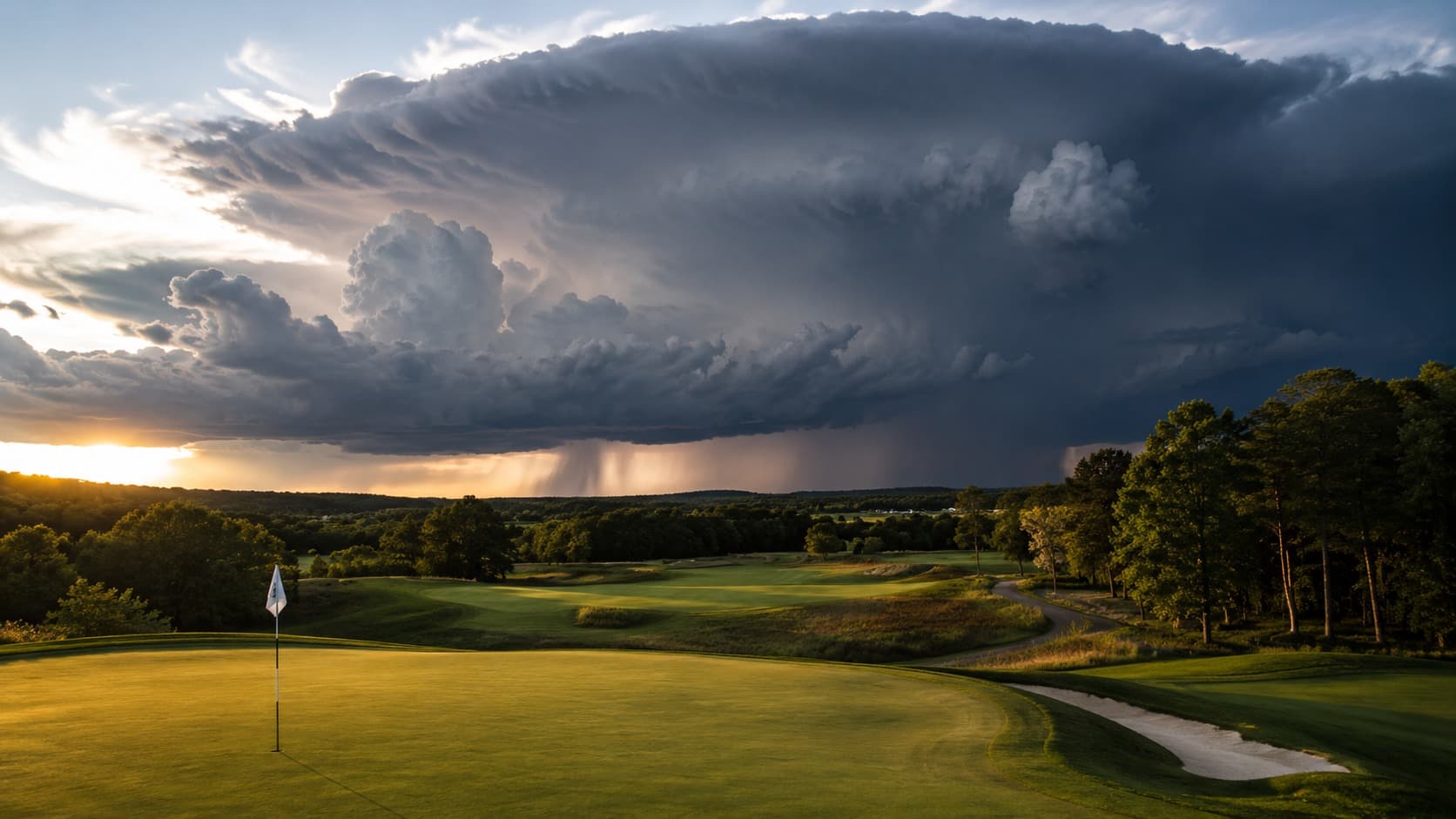
The Three O’Clock Storm: Reading Summer’s Convective Cycle to Protect Your Round
A 40% chance of afternoon thunderstorms does not mean a 40% chance of getting rained on. In the summer convective season it means the morning is nearly clear and the afternoon carries a fast-building, high-energy storm risk driven by a daily heating cycle. Here is the meteorology behind the pattern, the G-Score data on how the storm cycle punishes afternoon tee times across the Southeast, Midwest, and desert Southwest, the lightning-safety decision tree that actually matters, and the workflow that gets you off the course before the first bolt.
Read Story
How to Read a G-Score: The 0–100 Golf Playability Number, Decoded
A G-Score on this site is a single 0–100 number that tells you whether today is worth tee-up. Here is exactly what each band means, what drives the calculation, and how to use it to plan a round you will actually score on.
Read StoryMinSu Kim
Founder & Golf Data Analyst
MinSu is a data analyst and golfer with 10+ years on the course. He built Golf Weather Score to answer one question: is today a good day to play? He combines weather data, course intelligence, and the proprietary G-Score algorithm to help golfers make smarter decisions.
Every Friday Morning
When Brookhills Golf Club plays best next weekend.
Friday 6am ET: peak G-Score windows for Brookhills Golf Club, wind direction by hour, and one gear call. Three minutes to read, save you the round.
One email a week. Unsubscribe in one click.
The Caddie's Oracle
Draw your luck before the tee off