
Caddie's Gear Advisor
Curated for today's 52°F · Clouds
Cold-Weather Performance Layers
Thermal mid-layers that move with your swing
Tour Hand Warmers
Rechargeable warmers trusted by caddies
Thermal Base Layers
Lightweight compression that traps heat
Winter Golf Headwear
Beanies and ear warmers built for the links
Your Golf Trip, Handled
The Ultimate Golf Trip Planner
Everything you need to play Brookside Golf and Grill — from booking your flight to checking in course-side.
Course-Side Stays
Luxury hotels, resorts, and stay-and-play packages just minutes from the first tee.
Flights
Compare fares across 700+ airlines for the best route to your tee time.
SUV Rentals for Golf Bags
Spacious vehicles with room for clubs, bags, and your foursome.
Travel Insurance
Coverage for medical, weather delays, and gear at your destination.
Brookside Golf and Grill: Course Intelligence
Signature Setup
West Michigan golf in October has a particular feel — the air off Lake Michigan is colder than the sun suggests, and your first tee shot of the morning travels shorter than your ego expects. Brookside Golf & Grill sits in Gowen, in Montcalm County, about 40 miles inland from the lakeshore, close enough that the prevailing westerlies still reach it.
Let me be straight about what this is. Brookside is an 18-hole public course playing to par 72 and roughly 6,100 yards from the back tees, rated 68.7 with a 132 slope. I have not found a verified architect or opening year for it, so I won't invent one — this reads as a community public track, not a marquee resort design, and that's exactly who it serves. The "& Grill" in the name is honest signage: it's a play-and-eat neighborhood course. The real defense here isn't yardage — at 6,100 yards the card is short by modern standards — it's the wind and the firm-or-soft swing of west Michigan turf.
Hole-by-Hole Wind & Playing Lines
Honest note first: I don't have a verified hole-by-hole scorecard for Gowen, so I'm reasoning from the region's geography rather than naming a specific hole as the toughest. What's reliable is the wind direction. West-central lower Michigan's prevailing breeze runs west to southwest, and on open afternoons it builds to 10–18 mph.
Any hole routed into that breeze plays meaningfully longer after lunch. A 150-yard approach into a 15 mph headwind becomes roughly a 165-yard shot — that's one full club, sometimes two, and you want the ball started on the wind side so the breeze brings it back rather than throwing it offline. Downwind, a fairway that's dried out in a July dry spell will give you an extra 10–15 yards of release. The judgment all day is simple: know which way you're pointed relative to the lake breeze before you pick a club.
Green & Fairway Characteristics
At 6,100 yards / par 72, the scorecard rewards position over power, and the 68.7 rating tells you scoring is available if you keep the ball in play. The greens here roll at a moderate, holdable pace rather than glassy-fast — resist babying downhill putts, because they'll hold their line better than you fear on a tournament-fast surface. The 132 slope from the tips says the trouble is real enough off the back markers but fair from the forward sets. Plan layups around firmness: in a wet Michigan spring the fairways stay soft and the ball stops where it lands, while a dry mid-summer stretch turns the same holes into roll-out targets.
Seasonal Weather Pattern
Gowen's golf calendar is a Michigan calendar — roughly April through October, weather permitting. Summers (Jun–Aug) are pleasant: highs in the 70s and low 80s°F, the prime window, though afternoon pop-up storms off the lake are common. Spring (Apr–May) and fall (Oct) run cool — mornings in the 40s–50s°F, when the ball flies short and the greens are slow and wet. The course closes through winter under snow. The lake-effect cloud and wind are the wildcards: a forecast that looks clean inland can still mean a stiff westerly and a cold front rolling through Montcalm County by mid-afternoon.
Local Play Tips
A few things the rate sheet won't tell you. First, the afternoon breeze is a clock, not a coin flip — calm at dawn, building through the day, so the same holes play like two different courses at 8 a.m. versus 3 p.m. Take the earliest tee you can get. Second, this is a "& Grill" course for a reason: the value play is an early round followed by lunch, not a white-knuckle championship test, so set your expectations and enjoy the pace. Third, in spring carry one extra layer and an extra club — the cool, damp lake air costs you distance you won't notice until you're short of every green. I haven't played Gowen specifically, so I'm leaning on west-Michigan experience here, but the lake-breeze pattern holds across the region.
Pre-Round Weather Workflow
Use the 7-day G-Score on this page to time your round. For Brookside specifically: find the morning slot with the highest G-Score and the lowest windExposure reading — that's almost always before the west/southwest breeze fills in. In summer, target the cooler morning before afternoon storm risk climbs. In spring and fall, weight temperature: wait for the warmest dry window and add a club for the cool, heavy air. If the only tee is afternoon, plan for the westerly — club up into the wind, take the gift going the other way, and flight the ball lower when the gusts pick up off the lake.
Related Reading
Before you tee off at Brookside Golf and Grill
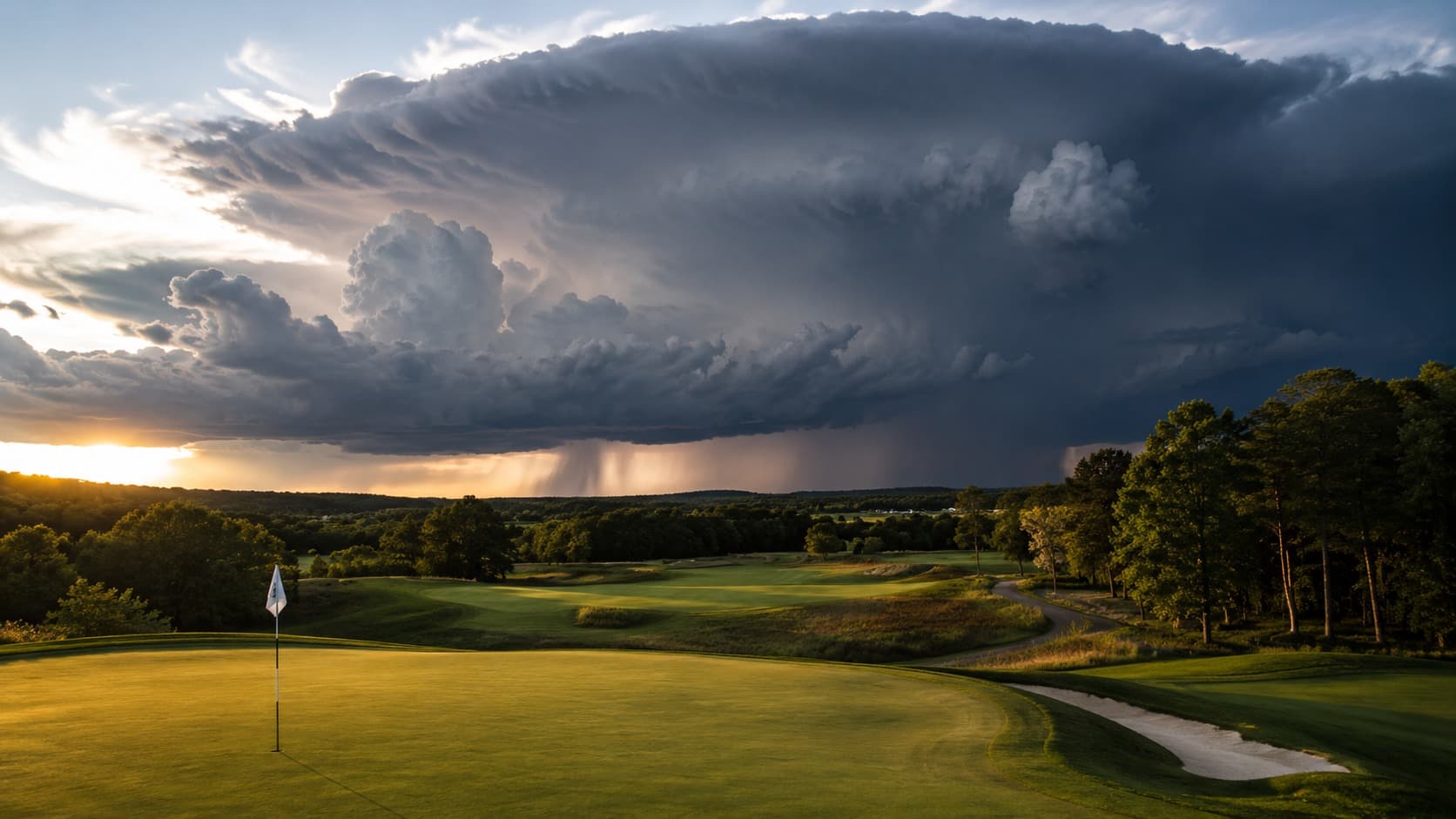
The Three O’Clock Storm: Reading Summer’s Convective Cycle to Protect Your Round
A 40% chance of afternoon thunderstorms does not mean a 40% chance of getting rained on. In the summer convective season it means the morning is nearly clear and the afternoon carries a fast-building, high-energy storm risk driven by a daily heating cycle. Here is the meteorology behind the pattern, the G-Score data on how the storm cycle punishes afternoon tee times across the Southeast, Midwest, and desert Southwest, the lightning-safety decision tree that actually matters, and the workflow that gets you off the course before the first bolt.
Read Story
How to Read a G-Score: The 0–100 Golf Playability Number, Decoded
A G-Score on this site is a single 0–100 number that tells you whether today is worth tee-up. Here is exactly what each band means, what drives the calculation, and how to use it to plan a round you will actually score on.
Read StoryMinSu Kim
Founder & Golf Data Analyst
MinSu is a data analyst and golfer with 10+ years on the course. He built Golf Weather Score to answer one question: is today a good day to play? He combines weather data, course intelligence, and the proprietary G-Score algorithm to help golfers make smarter decisions.
Every Friday Morning
When Brookside Golf and Grill plays best next weekend.
Friday 6am ET: peak G-Score windows for Brookside Golf and Grill, wind direction by hour, and one gear call. Three minutes to read, save you the round.
One email a week. Unsubscribe in one click.
The Caddie's Oracle
Draw your luck before the tee off