
Caddie's Gear Advisor
Curated for today's 80°F · Clouds
Tour-Level Drivers
Engineered for maximum distance and forgiveness
Laser Rangefinders
Pin-seeking technology for precision approaches
Premium Golf Balls
Tour-caliber spin and distance performance
Performance Sunglasses
Polarized lenses optimized for reading greens
Your Golf Trip, Handled
The Ultimate Golf Trip Planner
Everything you need to play Brookside Golf Course — from booking your flight to checking in course-side.
Course-Side Stays
Luxury hotels, resorts, and stay-and-play packages just minutes from the first tee.
Flights
Compare fares across 700+ airlines for the best route to your tee time.
SUV Rentals for Golf Bags
Spacious vehicles with room for clubs, bags, and your foursome.
Travel Insurance
Coverage for medical, weather delays, and gear at your destination.
Brookside Golf Course: Course Intelligence
Signature Setup
I have not teed it up at Brookside — it's a private Columbus club, and I'm honest about that — but I've spent enough fall mornings on Central Ohio bentgrass to know what this card is asking of you. Charlie Lorms, the first head professional at Columbus Country Club, laid Brookside out in 1927 on roughly 260 acres; it opened with nine holes that year before growing to eighteen. The course is constantly miscredited to Donald Ross, mostly because there is a separate, genuinely Ross-built Brookside Country Club two hours northeast in Canton. That's worth knowing before you repeat the clubhouse myth — Brookside G&CC is a Lorms design, later rebuilt and re-bunkered by classic-restoration architect Brian Silva, who also added a new par-3. The club hosted the 1954 Ohio Amateur. From the Championship tees it measures 7,418 yards, par 72, with a course rating of 75.8 and a slope of 145 — the second number is the one that matters: 145 is among the steepest in the Columbus District.
Hole-by-Hole Wind & Playing Lines
The back nine is the harder half — Championship back-nine slope is 149 versus 140 on the front, so the trouble compounds when you're already tired. The three hardest holes are all long par-4s. Hole 6 (452y, #1 handicap) plays to an elevated green; in summer the prevailing wind here is out of the southwest, and on those afternoons the hole effectively stretches past 480 yards — take the extra club and accept a long-iron approach. Hole 13 (433y, #2) and Hole 9 (483y, #3) follow the same math: into a 10-15 mph SW breeze, your stock 150-yard club becomes a 170-yard decision. When the wind lays down at dawn, all three are reachable in regulation; by 1 p.m. they are bogey holes for most. The 220-yard 15th is the card's longest par-3 — into wind it is a fairway wood, and bailing right leaves a small, fast green running away from you.
Green & Fairway Characteristics
This is a small-target golf course. The bentgrass greens are compact and undulating — Lorms's original character that Silva sharpened — and they get genuinely fast and firm in July and August. Several greens sit elevated with false fronts (the 2nd and 7th in particular), so an approach landing short of the surface trickles back to your feet. The 6th is multi-tiered; pick your tier. Water comes into play on the right of the 8th and short of the green at the 16th, both back-nine pressure points. The longest par-5s are the 12th (579y) and 16th (576y), while the front nine plays shorter and is where you should bank your strokes. Fairways are tree-lined and firm in dry stretches, adding roll but punishing the loose tee shot.
Seasonal Weather Pattern
Columbus sits in a humid continental zone, and the golf calendar reflects it. Summer (Jun-Aug) brings highs in the mid-80s°F with real humidity and pop-up afternoon thunderstorms — the firm greens are at their most treacherous then. September and October are prime: 60s-70s°F, lower humidity, and the bentgrass holds approaches well. Watch October and November mornings for frost delays, common this far inland once overnight lows dip near freezing. Spring (Apr-May) is the windy season — variable, gusty days that make the long par-4s a guessing game on club selection.
Local Play Tips
Access is the first hurdle — Brookside is fully private, so you'll need a member or a reciprocal arrangement; don't plan a casual walk-up. If you do get on, study the greens before you trust your eyes: small, fast, and undulating means the read matters more than the stroke. And settle the Donald Ross argument early — the Ross "resemblance" people cite is real in the bunkering, but the routing is Lorms's, and Silva's recent par-3 is the newest hole on the property. Knowing that marks you as someone who did the homework.
Pre-Round Weather Workflow
Run Brookside's 7-day G-Score before you book a time. Aim for a morning slot on a day scoring 80+ with a sub-10 mph SW windExposure reading — that combination means soft-enough greens and manageable approaches on the long 6th, 9th, and 13th. If the forecast shows a firm, hot, breezy afternoon (high G-Score but elevated windExposure), club up one across the board and play to the fat side of every small green. In October-November, check the morning low: anything near 34°F means a likely frost delay, so target a mid-morning tee instead of first light.
Related Reading
Before you tee off at Brookside Golf Course
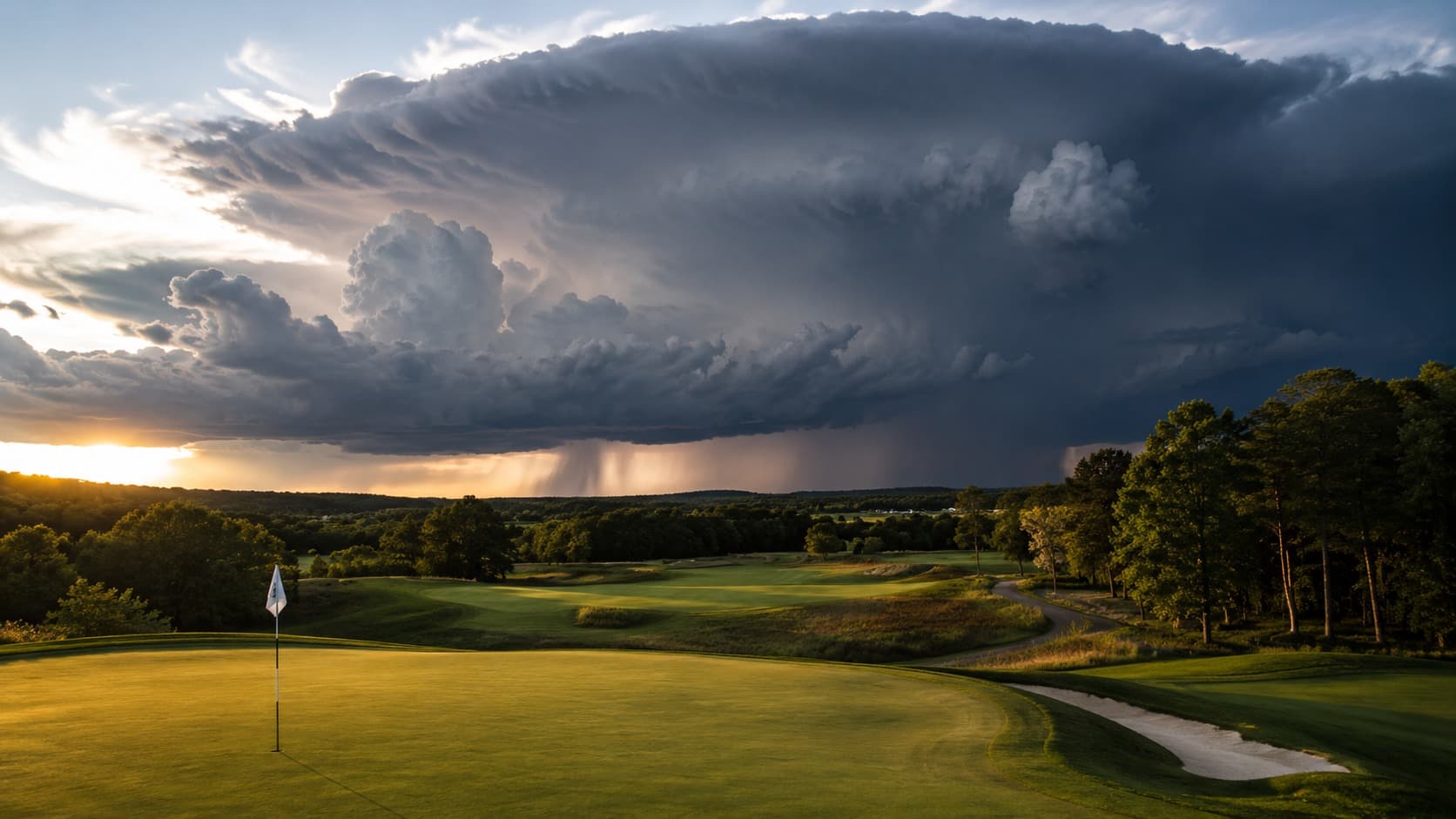
The Three O’Clock Storm: Reading Summer’s Convective Cycle to Protect Your Round
A 40% chance of afternoon thunderstorms does not mean a 40% chance of getting rained on. In the summer convective season it means the morning is nearly clear and the afternoon carries a fast-building, high-energy storm risk driven by a daily heating cycle. Here is the meteorology behind the pattern, the G-Score data on how the storm cycle punishes afternoon tee times across the Southeast, Midwest, and desert Southwest, the lightning-safety decision tree that actually matters, and the workflow that gets you off the course before the first bolt.
Read Story
How to Read a G-Score: The 0–100 Golf Playability Number, Decoded
A G-Score on this site is a single 0–100 number that tells you whether today is worth tee-up. Here is exactly what each band means, what drives the calculation, and how to use it to plan a round you will actually score on.
Read StoryMinSu Kim
Founder & Golf Data Analyst
MinSu is a data analyst and golfer with 10+ years on the course. He built Golf Weather Score to answer one question: is today a good day to play? He combines weather data, course intelligence, and the proprietary G-Score algorithm to help golfers make smarter decisions.
Every Friday Morning
When Brookside Golf Course plays best next weekend.
Friday 6am ET: peak G-Score windows for Brookside Golf Course, wind direction by hour, and one gear call. Three minutes to read, save you the round.
One email a week. Unsubscribe in one click.
The Caddie's Oracle
Draw your luck before the tee off