
Caddie's Gear Advisor
Curated for today's 80°F · Clear
Tour-Level Drivers
Engineered for maximum distance and forgiveness
Laser Rangefinders
Pin-seeking technology for precision approaches
Premium Golf Balls
Tour-caliber spin and distance performance
Performance Sunglasses
Polarized lenses optimized for reading greens
Your Golf Trip, Handled
The Ultimate Golf Trip Planner
Everything you need to play Bruce Hills Golf Course — from booking your flight to checking in course-side.
Course-Side Stays
Luxury hotels, resorts, and stay-and-play packages just minutes from the first tee.
Flights
Compare fares across 700+ airlines for the best route to your tee time.
SUV Rentals for Golf Bags
Spacious vehicles with room for clubs, bags, and your foursome.
Travel Insurance
Coverage for medical, weather delays, and gear at your destination.
Bruce Hills Golf Course: Course Intelligence
Signature Setup
Bruce Hills is a par-70, 18-hole layout at 6771 Taft Rd in Bruce Township, north of Romeo, Michigan, about 30 miles up from Detroit. From the white tees it measures 5,574 yards (course rating 67.3, slope 118); the red tees play 4,637 yards at slope 112. I haven't found a verified architect or opening year for this course in public records, so I won't put a name to it — what the scorecard shows is an honest, walkable southeast-Michigan parkland course built around short par-4s and a cluster of genuinely short par-3s. The defining number is the front nine: slope 123 versus 113 on the back, so the harder golf comes early. The 5th (376 yards, #1 handicap) is the truest test on the card and the hole I'd call the signature.
Hole-by-Hole Wind & Playing Lines
The three hardest holes by index are all par-4s: the 5th (376y, #1), the 14th (405y, #2), and the 8th (387y, #3). Southeast Michigan's prevailing warm-season wind is out of the southwest, and it matters most here because none of these holes is long enough to need driver if the wind is helping — but all three get awkward when it's against.
- 5th, 376y (#1): Into a morning SW breeze this plays closer to 400. Take the aggressive line off the tee out of play; a 3-wood or long iron to a flat number leaves a full wedge instead of a half-club between-yardages approach.
- 14th, 405y (#2): The longest par-4 on the card and the back-nine's signature difficulty. Downwind it's a tidy two-shotter; into a NW post-frontal wind in fall, it's a legitimate par-4.5 — bail toward the wide side and take your bogey without a blow-up.
- 7th, 532y par-5 (#7) and 18th, 468y par-5: Both are reachable in two only when the SW wind is at your back. Once the afternoon thermal kicks up, the 532-yard 7th eats the helping wind and you're laying up anyway.
Green & Fairway Characteristics
The greens read like typical northern-Michigan bent/poa surfaces — moderate pace, more break than speed, and they firm up by mid-summer. Fairways are parkland, tree-framed rather than links-open, which is why wind direction reads differently hole to hole as you turn through the property. The front nine carries the higher slope (123) largely because of the back-to-back 376y and 112y test at 5 and 6, then the 532-yard 7th. The back is more forgiving on paper (slope 113) but hides a sting at the 405-yard 14th. With four par-3s under 160 yards (the 6th at 112, 13th at 137, 17th at 151, 11th at 157), scoring lives and dies on wedge control into small targets, not on length.
Seasonal Weather Pattern
This is a roughly April-through-October course; Bruce Township sits in a humid-continental zone that closes for snow most of November to March. July highs run in the low 80s°F, but the round that scores well is the early one — spring and fall mornings here sit in the 45–55°F range, and cold-soaked golf balls fly noticeably shorter, so the 387-yard 8th plays its full length at 8 a.m. in May. By 1 p.m. in summer the SW breeze is up and humidity climbs. Fall brings the sharper risk: NW winds behind a cold front can drop the temperature 15°F in an afternoon and turn the 405-yard 14th into a survival hole.
Local Play Tips
Because the harder nine is the front (slope 123), don't ease into the round — your scoring buffer has to be built before the turn, not after. The smartest local read is the tee time itself: a morning slot at this course beats an afternoon one on two counts at once — the SW breeze hasn't filled in, and the small par-3 greens are still holding moisture and receptive. Save your aggression for the two short par-5s (7th, 18th) only when you can feel the wind helping.
Pre-Round Weather Workflow
Pull the 7-day G-Score for Bruce Township before you book. Target the day with the highest morning G-Score and a SW or calm windExposure reading — that's when the 532y 7th and 468y 18th become reachable and the small greens hold. If the forecast shows a fall cold front and NW windExposure, move your tee time as early as possible: the 405-yard 14th and the exposed par-4 5th punish a stiff headwind far more than the yardage suggests. Check the temperature line too — anything under 55°F means club up one across the board for cold-ball carry.
Related Reading
Before you tee off at Bruce Hills Golf Course

America's 20 Windiest Golf Courses: A G-Score Wind Analysis
We ranked America's 20 windiest golf courses using G-Score wind penalty data. See how coastal gusts and prairie gales reshape playability scores.
Read Story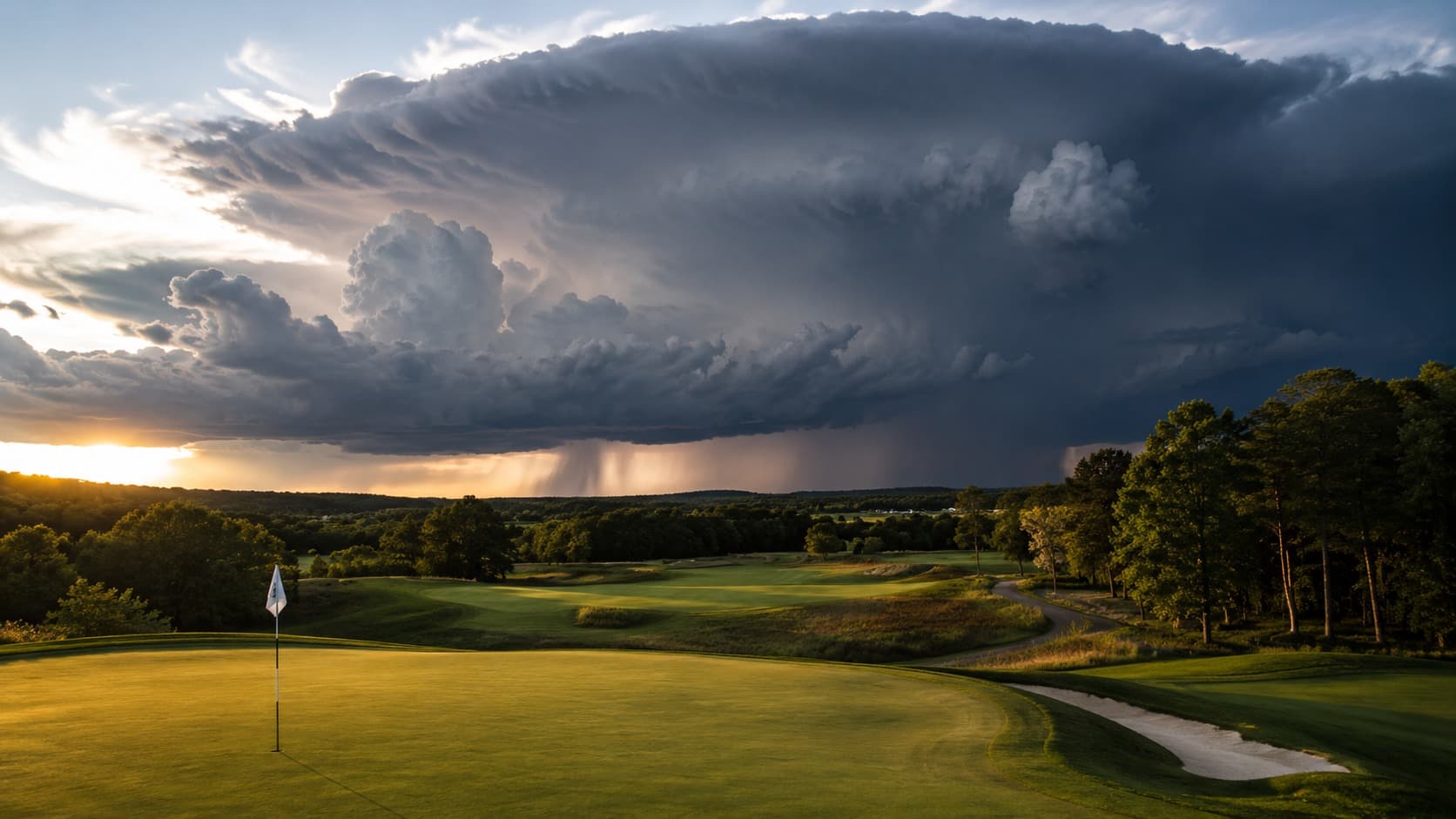
The Three O’Clock Storm: Reading Summer’s Convective Cycle to Protect Your Round
A 40% chance of afternoon thunderstorms does not mean a 40% chance of getting rained on. In the summer convective season it means the morning is nearly clear and the afternoon carries a fast-building, high-energy storm risk driven by a daily heating cycle. Here is the meteorology behind the pattern, the G-Score data on how the storm cycle punishes afternoon tee times across the Southeast, Midwest, and desert Southwest, the lightning-safety decision tree that actually matters, and the workflow that gets you off the course before the first bolt.
Read StoryMinSu Kim
Founder & Golf Data Analyst
MinSu is a data analyst and golfer with 10+ years on the course. He built Golf Weather Score to answer one question: is today a good day to play? He combines weather data, course intelligence, and the proprietary G-Score algorithm to help golfers make smarter decisions.
Every Friday Morning
When Bruce Hills Golf Course plays best next weekend.
Friday 6am ET: peak G-Score windows for Bruce Hills Golf Course, wind direction by hour, and one gear call. Three minutes to read, save you the round.
One email a week. Unsubscribe in one click.
The Caddie's Oracle
Draw your luck before the tee off