
Caddie's Gear Advisor
Curated for today's 80°F · Clear
Tour-Level Drivers
Engineered for maximum distance and forgiveness
Laser Rangefinders
Pin-seeking technology for precision approaches
Premium Golf Balls
Tour-caliber spin and distance performance
Performance Sunglasses
Polarized lenses optimized for reading greens
Your Golf Trip, Handled
The Ultimate Golf Trip Planner
Everything you need to play Bucks Run Golf Club — from booking your flight to checking in course-side.
Course-Side Stays
Luxury hotels, resorts, and stay-and-play packages just minutes from the first tee.
Flights
Compare fares across 700+ airlines for the best route to your tee time.
SUV Rentals for Golf Bags
Spacious vehicles with room for clubs, bags, and your foursome.
Travel Insurance
Coverage for medical, weather delays, and gear at your destination.
Bucks Run Golf Club: Course Intelligence
Signature Setup
I stood on a Michigan first tee one September morning with the thermometer reading 49°F and frost still silvering the rough — the kind of cold-handed start that decides whether your 7-iron carries the front bunker or comes up short. Bucks Run Golf Club sits in Mount Pleasant, Michigan, in Isabella County, and it is a Jerry Matthews design that opened in 2000. Matthews is one of Michigan's most prolific architects, and Bucks Run is one of his cleaner public statements — a parkland-meets-prairie routing that runs alongside the Chippewa River. The river and its wetland corridor, not a manufactured hazard, are the course's defining feature: water and marsh come into play along the property's river side, and the rest of the layout sits open to the central-Michigan sky. From the tips it stretches past 7,000 yards to a par 72. What sets the daily scoring ceiling here is not a single signature hazard but the wind off open farmland and the cold-air timing of a continental-climate morning.
Hole-by-Hole Wind & Playing Lines
I haven't logged every hole with a wind gauge, so I'll frame this by the prevailing-wind logic of an open central-Michigan site rather than invent yardages I can't confirm.
- The #1 stroke-index par-4: Summer flow here is predominantly southwest, sweeping unobstructed across surrounding farmland. Into a SW breeze the longest par-4 plays a full club longer than the card — a 430-yard hole eats like 460. Take the extra club off the tee and accept a mid-iron approach instead of forcing driver-wedge.
- A river-side par-3: The one-shotters that flirt with the Chippewa corridor channel a quartering crosswind down the river line. On a SW morning the wind pushes left-to-right for a right-hander, toward the water — aim at the fat, dry side of the green and let the wind feed it back, never at a river-side flag.
- A downwind par-5: When that same SW wind is behind you, a three-shot par-5 at dawn becomes reachable by mid-afternoon. It's the rare hole where a later tee time helps; everywhere else on this open ground, earlier and calmer wins.
Green & Fairway Characteristics
Expect a cool-season setup standard for mid-Michigan: bentgrass greens with bluegrass and rye fairways. The variable that moves your score is firmness, and it swings hard with the calendar. In a dry August the fairways run firm and the greens accept a confident release; after the wet central-Michigan spring, the same turf plays soft and slow, holding spin and adding real length off the tee. The river-corridor holes sit lower and hold morning moisture longer, so early approaches on that side release less than a mid-afternoon ball off baked turf elsewhere on the property. I haven't putted these greens enough to claim a break tendency, so read them fresh — but on a Matthews parkland green, expect pace to track toward the lower, river side of the complex.
Seasonal Weather Pattern
Mount Pleasant sits in a humid-continental zone (Köppen Dfb). July and August daytime highs typically reach the low-to-mid 80s °F with humidity, and afternoon SW winds build over the open ground — heat plus wind is the summer scoring tax. Spring (April–May) is the wet window: soft greens, cart-path mornings, and a course that plays longer than its yardage. Winters are genuinely cold and the course closes — expect dormant turf and no play from roughly late November through March, with frost delays bracketing the April and October shoulders. The most reliable scoring weather is a calm, cool late-September or early-October morning, after the overnight frost burns off and before any wind gets up: firm fairways, crisp air, and a river valley that's briefly dead still.
Local Play Tips
Here's something a tee-sheet won't tell you about a river-corridor course on open Michigan ground: the frost-to-wind window in autumn is narrow and decisive. The river-side low ground frosts first and clears last, so a sunrise tee time in late September often means a frost delay on exactly the holes where you most want soft, holdable greens. By early afternoon the SW wind is up across the farmland. The genuinely good scoring conditions live in the mid-morning gap between the two — frost gone, wind not yet built. Lock your tee time to that window rather than to convenience, and you'll play the river holes when they're soft and the open holes when they're calm.
Pre-Round Weather Workflow
Use the 7-day G-Score forecast on this course page before you book. For Bucks Run, the highest-leverage variable is the frost-then-wind sequence layered over the river corridor. Check the overnight low the night before — surface frost forms near or below ~36°F even when the air reads warmer — and check the windExposure rating for the afternoon. If the forecast flags a cold dawn and an above-average SW afternoon wind, target a mid-morning slot: you skip the frost delay on the low river holes and beat the wind on the open ones, and the G-Score will reflect it. In April–May, also watch the precipitation band: a wet card means soft, longer-playing fairways and minimal release, so club up off the tee and don't expect the ground to help on the approach.
Related Reading
Before you tee off at Bucks Run Golf Club
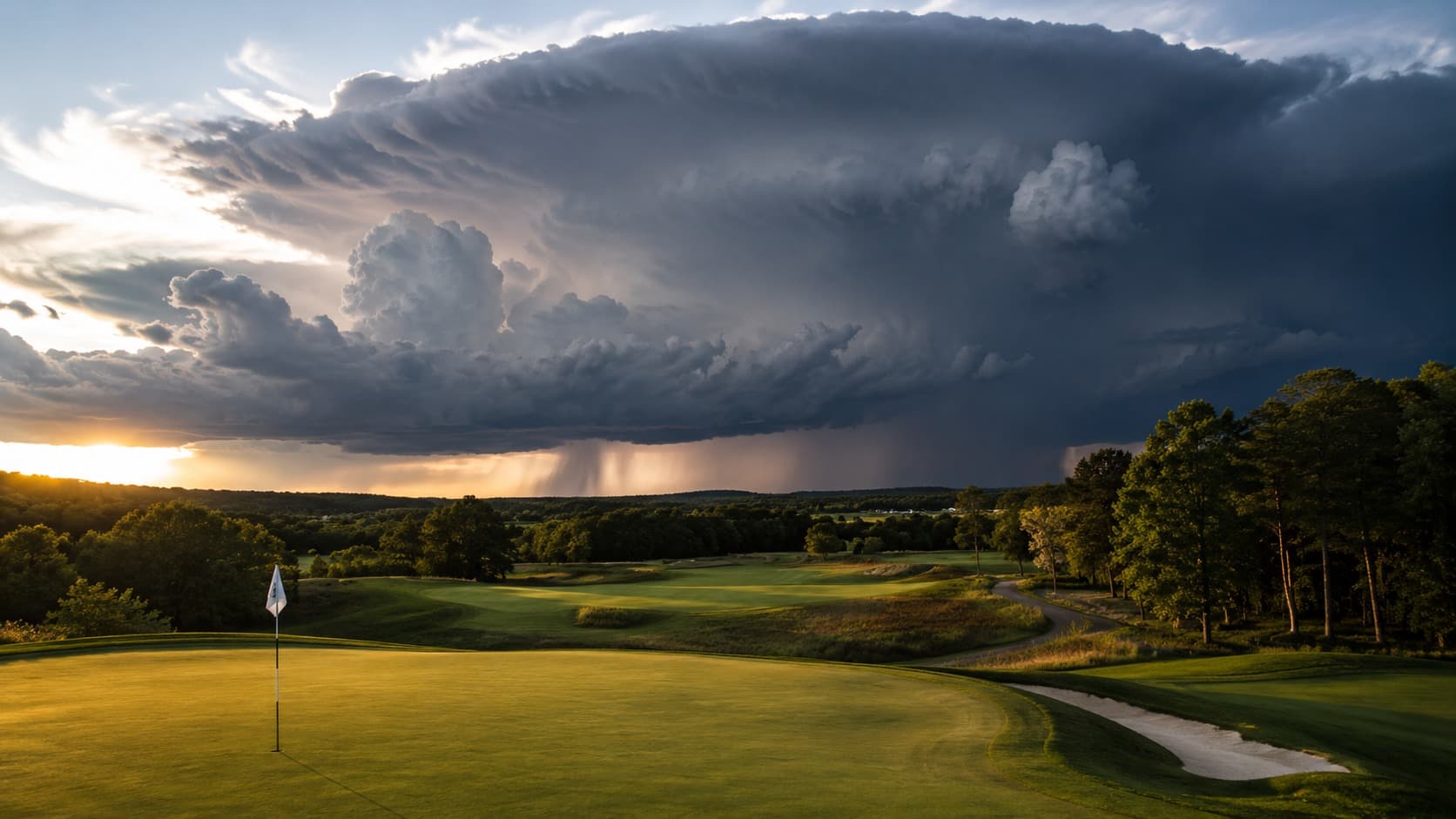
The Three O’Clock Storm: Reading Summer’s Convective Cycle to Protect Your Round
A 40% chance of afternoon thunderstorms does not mean a 40% chance of getting rained on. In the summer convective season it means the morning is nearly clear and the afternoon carries a fast-building, high-energy storm risk driven by a daily heating cycle. Here is the meteorology behind the pattern, the G-Score data on how the storm cycle punishes afternoon tee times across the Southeast, Midwest, and desert Southwest, the lightning-safety decision tree that actually matters, and the workflow that gets you off the course before the first bolt.
Read Story
How to Read a G-Score: The 0–100 Golf Playability Number, Decoded
A G-Score on this site is a single 0–100 number that tells you whether today is worth tee-up. Here is exactly what each band means, what drives the calculation, and how to use it to plan a round you will actually score on.
Read StoryMinSu Kim
Founder & Golf Data Analyst
MinSu is a data analyst and golfer with 10+ years on the course. He built Golf Weather Score to answer one question: is today a good day to play? He combines weather data, course intelligence, and the proprietary G-Score algorithm to help golfers make smarter decisions.
Every Friday Morning
When Bucks Run Golf Club plays best next weekend.
Friday 6am ET: peak G-Score windows for Bucks Run Golf Club, wind direction by hour, and one gear call. Three minutes to read, save you the round.
One email a week. Unsubscribe in one click.
The Caddie's Oracle
Draw your luck before the tee off