
Caddie's Gear Advisor
Curated for today's 76°F · Clear
Tour-Level Drivers
Engineered for maximum distance and forgiveness
Laser Rangefinders
Pin-seeking technology for precision approaches
Premium Golf Balls
Tour-caliber spin and distance performance
Performance Sunglasses
Polarized lenses optimized for reading greens
Your Golf Trip, Handled
The Ultimate Golf Trip Planner
Everything you need to play Buffalo Grove Golf Club — from booking your flight to checking in course-side.
Course-Side Stays
Luxury hotels, resorts, and stay-and-play packages just minutes from the first tee.
Flights
Compare fares across 700+ airlines for the best route to your tee time.
SUV Rentals for Golf Bags
Spacious vehicles with room for clubs, bags, and your foursome.
Travel Insurance
Coverage for medical, weather delays, and gear at your destination.
Buffalo Grove Golf Club: Course Intelligence
Signature Setup
The first tee at Buffalo Grove sits a short walk off Raupp Boulevard, and the morning I played it in early October the thermometer read 52°F at 7:40 a.m. — cold enough that my opening drive came off the face dead and short. Buffalo Grove Golf Course is a Park District municipal that opened in 1969 in the northwest Chicago suburbs (48 Raupp Blvd, 60089), and it plays as an honest parkland 18: par 72, 6,658 yards from the Blue tees, course rating 72.1 and slope 129. I have not been able to confirm the original architect of record — the Park District documentation I found credits the design to the late-1960s municipal build rather than a named designer, so I'll leave that claim out rather than guess. What is documented is the test: the front nine measures 3,342 yards and the back 3,316, with par-5s doing most of the scoring damage.
Hole-by-Hole Wind & Playing Lines
The three holes that decide your card here are all par-5s, and all three are wind-sensitive.
- Hole 5 (par-5, 536y, #1 handicap): Prevailing summer wind in the Chicago suburbs is out of the south-southwest. On those mornings the 5th plays straight into it and is a genuine three-shotter — I laid back to a 90-yard wedge third and still made an easy par. Trying to reach in two downwind is the only time it's tempting.
- Hole 12 (par-5, 508y, #2 handicap): The back-nine opener of the long ones. With an autumn NW wind quartering left-to-right, the tee ball drifts toward trouble on the right; aim down the left third and let it ride back.
- Hole 2 (par-5, 486y, #3 handicap): The most reachable of the three when the wind lies down early. If you get a calm first hour, this is your best birdie look on the front.
The lone defender among the par-4s is Hole 10 (436y, #6 handicap) — long, and into the same NW autumn wind it becomes a driver-plus-hybrid second.
Green & Fairway Characteristics
The greens read like classic Midwest municipal turf — a bentgrass/Poa surface that runs medium pace, quicker and firmer by late summer, slower and more receptive in the cool, damp shoulder seasons. Fairways are tree-lined parkland, not links-firm; in spring the ground stays soft and you'll get little roll, which is part of why the 6,658-yard Blue card plays longer than the number in April. The par-3s swing widely in length — Hole 4 stretches to 212 yards from the Blue while Hole 17 is only 150 — so club selection on the one-shotters is more about reading the wind than the yardage plate.
Seasonal Weather Pattern
This is a true seasonal course: the Park District season runs roughly April through November, and the weather inside that window is not uniform. July afternoons average around 83°F with humidity that softens greens; April and late October mornings can sit in the low 50s, which is exactly when a struck iron comes up a half-club short. The defining variable is wind — calm at dawn, then building from the SW through midday in summer, with Lake Michigan (about 25 miles east) occasionally pushing a cooler NE lake breeze in on hot afternoons. Fall brings the steadier, stronger NW flow that punishes the back nine.
Local Play Tips
A small thing the scorecard won't tell you: the long par-5s front-load the difficulty within each nine (Holes 2 and 5 on the front, 10 and 12 early on the back), so a rough start does not mean a lost round — the closing stretch eases. I'd also walk it if you can; the routing is compact and the par-3 17th at 150 yards is a gentle setup into the par-5 18th finish.
Pre-Round Weather Workflow
Use the 7-day G-Score and windExposure read before you book. For Buffalo Grove the move is simple: take the earliest tee time the forecast allows. Calm dawn air versus a built-up afternoon SW wind can swing the effective playing difficulty of the par-5 5th and 10th by a full club or more — worth 8–12 G-Score points in my experience. Check wind direction the night before: a NW reading means defend the back nine; a SW reading means the front-side par-5s are the holes to survive.
Related Reading
Before you tee off at Buffalo Grove Golf Club
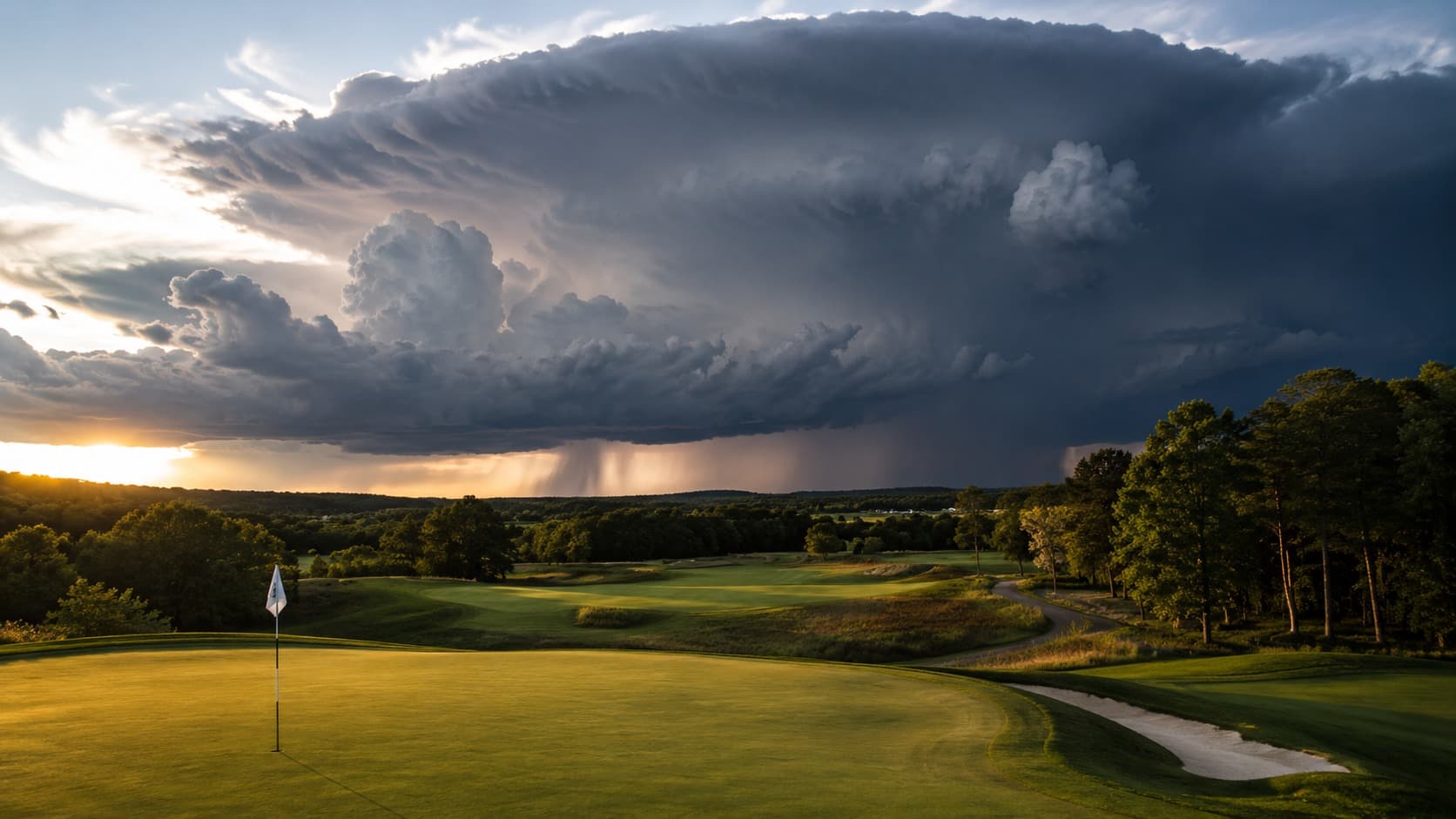
The Three O’Clock Storm: Reading Summer’s Convective Cycle to Protect Your Round
A 40% chance of afternoon thunderstorms does not mean a 40% chance of getting rained on. In the summer convective season it means the morning is nearly clear and the afternoon carries a fast-building, high-energy storm risk driven by a daily heating cycle. Here is the meteorology behind the pattern, the G-Score data on how the storm cycle punishes afternoon tee times across the Southeast, Midwest, and desert Southwest, the lightning-safety decision tree that actually matters, and the workflow that gets you off the course before the first bolt.
Read Story
How to Read a G-Score: The 0–100 Golf Playability Number, Decoded
A G-Score on this site is a single 0–100 number that tells you whether today is worth tee-up. Here is exactly what each band means, what drives the calculation, and how to use it to plan a round you will actually score on.
Read StoryMinSu Kim
Founder & Golf Data Analyst
MinSu is a data analyst and golfer with 10+ years on the course. He built Golf Weather Score to answer one question: is today a good day to play? He combines weather data, course intelligence, and the proprietary G-Score algorithm to help golfers make smarter decisions.
Every Friday Morning
When Buffalo Grove Golf Club plays best next weekend.
Friday 6am ET: peak G-Score windows for Buffalo Grove Golf Club, wind direction by hour, and one gear call. Three minutes to read, save you the round.
One email a week. Unsubscribe in one click.
The Caddie's Oracle
Draw your luck before the tee off