
Caddie's Gear Advisor
Curated for today's 79°F · Thunderstorm
Storm-Ready Outerwear
Waterproof layers built for 18 holes in the rain
Tour-Grade Umbrellas
68" double-canopy wind-resistant coverage
Wet-Weather Gloves
All-weather grip that performs in the rain
Waterproof Golf Shoes
Keep your feet dry through every fairway
Your Golf Trip, Handled
The Ultimate Golf Trip Planner
Everything you need to play Burke Golf Course — from booking your flight to checking in course-side.
Course-Side Stays
Luxury hotels, resorts, and stay-and-play packages just minutes from the first tee.
Flights
Compare fares across 700+ airlines for the best route to your tee time.
SUV Rentals for Golf Bags
Spacious vehicles with room for clubs, bags, and your foursome.
Travel Insurance
Coverage for medical, weather delays, and gear at your destination.
Burke Golf Course: Course Intelligence
Signature Setup
The first thing you notice walking up to Burke is how old the trees are. This is the William J. Burke Memorial Golf Course on the University of Notre Dame campus in South Bend, Indiana — a William Langford design that opened in 1929, decades before the school built the newer Warren Course in 2000. I have not played a full 18 here in peak summer; my time on it has been shoulder-season, so where I give summer numbers below they come from South Bend climate records, not my own card.
Burke is a tree-lined, par-70 campus course of roughly 6,000 yards from the back markers — short on paper, but the corridors are tight and the greens are small. It has served generations of Notre Dame students and faculty, which gives it a worn-in, walkable, distinctly Midwestern-muni character rather than a resort polish. The design is classic Langford: modest length, defended by trees and green size rather than water and length.
Hole-by-Hole Wind & Playing Lines
The defining weather variable here is wind off Lake Michigan, about 25 miles to the northwest. South Bend's prevailing autumn and winter flow is NW to NNW, and the back nine sits more exposed than the tree-sheltered front.
- The long par-4 (#1 handicap, ~430 yards): Into a 12–15 mph NW wind — common Oct–Nov mornings — a 150-yard second shot plays closer to 175. Club up one to two and favor the right side; the left tree line gobbles a wind-pushed pull.
- The exposed par-3 (~165 yards): On calm front-nine air it is a clean mid-iron, but when the NW wind clears the trees it knocks the ball down hard. I have hit a club-and-a-half more here than the yardage said.
- The tight dogleg par-4: Trees pinch the landing zone. With a left-to-right wind, a fade rides into the timber — take less club off the tee and keep it under the branches rather than chasing distance.
Green & Fairway Characteristics
The greens are small, bentgrass/poa surfaces typical of a 1920s Langford build — they reward an accurate approach far more than a long drive. Expect stimp in the mid-9s on a normal day, quicker and firmer through August when South Bend dries out. Fairways run firm by late summer and softer in the cool, damp spring.
Because the corridors are narrow, the front nine plays as a placement test and the more open back nine as a wind test. Total yardage near 6,000 means few forced long carries, but the tree framing makes errant tee shots costly. Putts tend to drift toward the lower campus drainage — read break with the terrain's gentle fall, not just the visible slope.
Seasonal Weather Pattern
South Bend has a humid continental climate, strongly shaped by lake-effect weather. The playable season runs roughly April through October. Summer highs sit in the low-to-mid 80s°F with high humidity; July and August afternoons can build thunderstorms quickly off the lake. September and October bring the best golf — dry, 60s–70s°F days — but mornings turn cold fast, often 45–50°F at an 8 a.m. tee time by mid-October. Late autumn adds steady NW wind and the first lake-effect cloud. Winter shuts the course down under snow.
Local Play Tips
Burke is a campus course, so its rhythm follows the university, not a resort. Early weekday mornings before classes are the quietest and cheapest window; weekends in football season can fill with visitors. Walk it — the routing is compact and walkable, the way Langford intended, and you will read the greens better on foot. Bring more short irons than you think; this is a wedge-and-putter course, not a driver course.
Pre-Round Weather Workflow
Use the 7-day G-Score and windExposure panel above before you book. For Burke specifically:
- Check wind direction, not just speed. A 12 mph NW wind matters far more here than a 12 mph S wind — the back nine is exposed to the lake flow.
- Target the morning G-Score window in fall. Calm, cool, dry mornings score highest; afternoon thunderstorm risk spikes in July–August.
- Layer for the front-to-back swing. The sheltered front warms before the open back nine; a packable windbreaker earns its place from October on.
- Watch overnight lows in spring and late fall — frost delays are common in South Bend and will push your tee time.
Related Reading
Before you tee off at Burke Golf Course
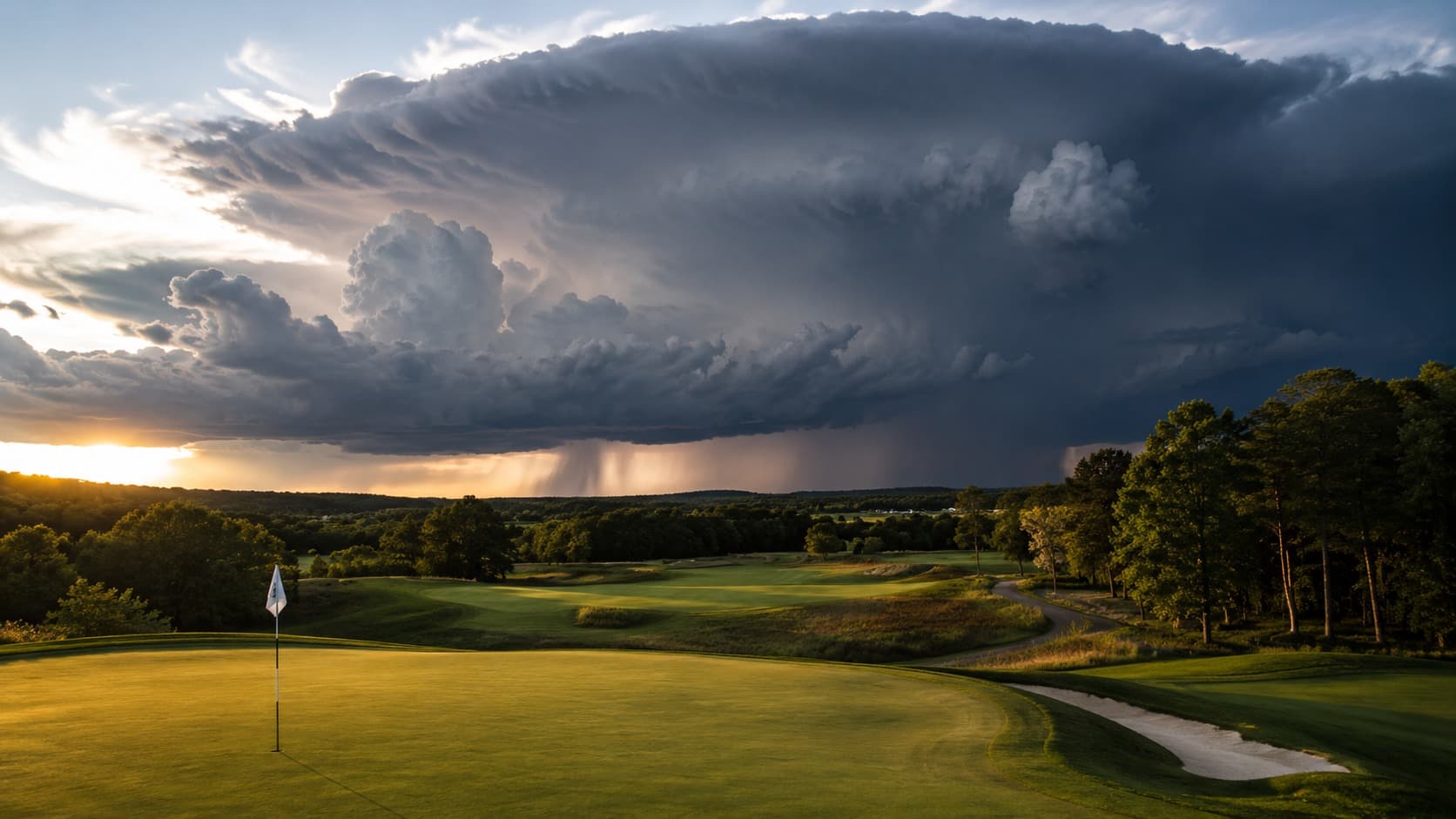
The Three O’Clock Storm: Reading Summer’s Convective Cycle to Protect Your Round
A 40% chance of afternoon thunderstorms does not mean a 40% chance of getting rained on. In the summer convective season it means the morning is nearly clear and the afternoon carries a fast-building, high-energy storm risk driven by a daily heating cycle. Here is the meteorology behind the pattern, the G-Score data on how the storm cycle punishes afternoon tee times across the Southeast, Midwest, and desert Southwest, the lightning-safety decision tree that actually matters, and the workflow that gets you off the course before the first bolt.
Read Story
How to Read a G-Score: The 0–100 Golf Playability Number, Decoded
A G-Score on this site is a single 0–100 number that tells you whether today is worth tee-up. Here is exactly what each band means, what drives the calculation, and how to use it to plan a round you will actually score on.
Read StoryMinSu Kim
Founder & Golf Data Analyst
MinSu is a data analyst and golfer with 10+ years on the course. He built Golf Weather Score to answer one question: is today a good day to play? He combines weather data, course intelligence, and the proprietary G-Score algorithm to help golfers make smarter decisions.
Every Friday Morning
When Burke Golf Course plays best next weekend.
Friday 6am ET: peak G-Score windows for Burke Golf Course, wind direction by hour, and one gear call. Three minutes to read, save you the round.
One email a week. Unsubscribe in one click.
The Caddie's Oracle
Draw your luck before the tee off