
Caddie's Gear Advisor
Curated for today's 79°F · Clear
Tour-Level Drivers
Engineered for maximum distance and forgiveness
Laser Rangefinders
Pin-seeking technology for precision approaches
Premium Golf Balls
Tour-caliber spin and distance performance
Performance Sunglasses
Polarized lenses optimized for reading greens
Your Golf Trip, Handled
The Ultimate Golf Trip Planner
Everything you need to play Butterfield Country Club — from booking your flight to checking in course-side.
Course-Side Stays
Luxury hotels, resorts, and stay-and-play packages just minutes from the first tee.
Flights
Compare fares across 700+ airlines for the best route to your tee time.
SUV Rentals for Golf Bags
Spacious vehicles with room for clubs, bags, and your foursome.
Travel Insurance
Coverage for medical, weather delays, and gear at your destination.
Butterfield Country Club: Course Intelligence
Signature Setup
I'll be honest up front: I don't carry a member's card at Butterfield Country Club, and it's a private Chicago-suburb club, not a tee-time you book online. What I can speak to is the type of golf — I've played enough Chicago-area parkland in October, hands tightening at 46°F on an 8 a.m. first tee, to know exactly how this kind of flat-then-pushed-up prairie course defends itself.
Butterfield is one of the older clubs in the western suburbs, laid out by William B. Langford and Theodore Moreau and opened in 1921, in Oak Brook, Illinois. Langford is a Chicago-school architect known for bold, geometric green pads raised above their surrounds — the so-called "volcano" complexes — and steep-faced bunkering. The course grew to 27 holes, so the routing a member plays depends on which two nines are in rotation that day. The defense here isn't tricked-up length; it's elevated greens, deep bunkers, and a wide-open sky that lets the wind work.
Hole-by-Hole Wind & Playing Lines
The signature short par-3 (roughly 160y over a low hollow). This is a true Langford green pad — raised, crowned, and ringed by deep bunkers, so anything not pin-high is rejected. On a helping WSW wind the ball flies the surface and trundles down the back bank; into the wind, players under-club and find the front bunker. Take the club that lands it flag-high in calm air, then trust the read and aim center-back.
The #1 stroke-index par-4. A genuine long two-shotter that turns brutal in the afternoon. On the prevailing WSW breeze — the dominant wind across this open Oak Brook ground — the effective yardage pushes past 440y. Don't be a hero off the tee; lay to a flat lie, club up on the approach, and play to the front-center of the raised green so a slightly short shot still climbs the pad instead of spinning back down the slope.
A mid-length par-4 that turns with the wind. When the breeze is up and behind, the smart miss is short of the green, not long — over the back of a Langford pad leaves a downhill chip off tight cool-season turf back toward a surface running away from you. Take one less club than ego wants and leave yourself the uphill putt.
Green & Fairway Characteristics
The greens are classic Langford: pushed-up pads sitting above the fairway grade, firm, and tilted, with steep run-offs that punish the short-sided miss far more than a long lag. They're cool-season surfaces — bent with poa intrusion typical of century-old Chicago courses — so in spring and late fall they hold a touch more and roll a touch slower than peak-summer firmness. The fairways themselves are mostly gentle prairie grade, which lulls you into thinking the course is flat; the elevation that matters is all at the greens, where a ball landing on the front pad behaves completely differently from one landing two paces short of it. Front and back nines play to similar parkland yardages, with the teeth in the green complexes rather than the tee shots.
Seasonal Weather Pattern
Oak Brook sits in the humid continental belt of northern Illinois, and the playing calendar is shaped hard by it. The honest season runs roughly April through October; midwinter is dormant and frozen. April mornings commonly open in the low 40s°F and climb into the 60s, with cold fronts swinging the wind 180 degrees inside a single afternoon. July and August routinely push past 88°F with thick humidity that softens the greens and lets the ball stop on the pads. The constant across all of it is wind: the WSW prevailing flow across open prairie ground regularly runs 10–18 mph by midafternoon, and a still dawn can become a two-club crosswind by 1 p.m. That daily build, not the season, is the single biggest scoring variable.
Local Play Tips
Here's the read worth knowing on this kind of open Oak Brook layout: the wind is a clock, not a constant. Mornings near sunrise are often genuinely calm, and the elevated Langford greens are receptive while the air is still. By late morning the WSW breeze fills in and keeps building into the afternoon, and that's when the raised pads start rejecting anything not flighted correctly. If you have any choice of tee time, take the early one — the same approach that holds a green at 8 a.m. balloons and gets shoved off-line at 2 p.m. Plan your aggressive pins for the front of the round and play to fat green centers once the flag starts snapping.
Pre-Round Weather Workflow
Use the 7-day G-Score on this course page the way I'd prep for a Chicago-area parkland round. Three days out, watch for a passing cold front — a sharp temperature or pressure drop is your signal that the wind will rotate off its usual WSW line and play tricks on the elevated greens. The morning of, open the windExposure panel: any reading above roughly 12 mph means treat every Langford pad as a front-to-center target, not a flag-hunt, and accept the long uphill putt over the short-sided miss. If the dawn temperature reads below 50°F, expect one less club of carry into the raised approaches and book the earliest tee time you can — the calm window before the prairie wind builds is where your best scoring holes live.
Related Reading
Before you tee off at Butterfield Country Club
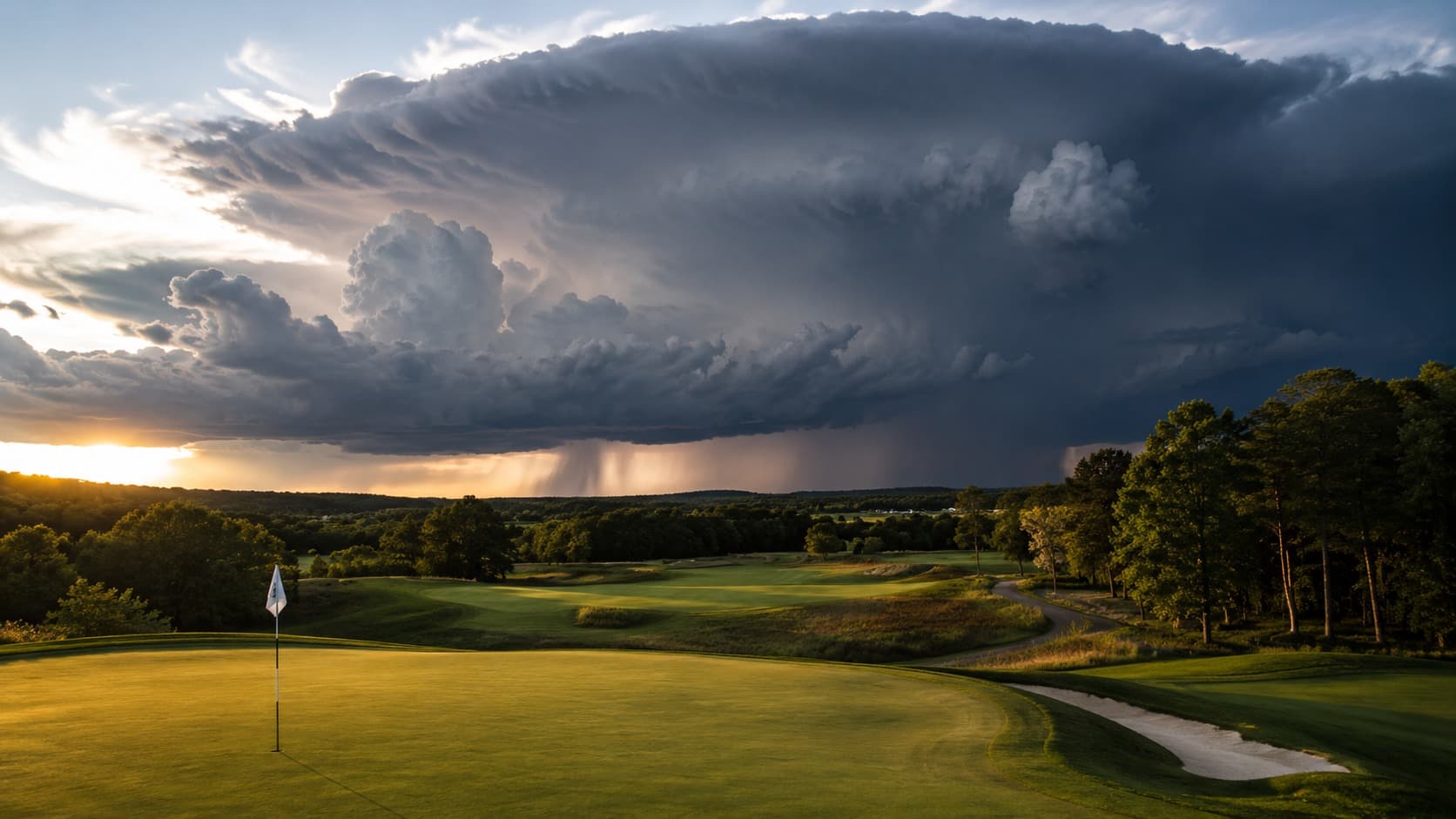
The Three O’Clock Storm: Reading Summer’s Convective Cycle to Protect Your Round
A 40% chance of afternoon thunderstorms does not mean a 40% chance of getting rained on. In the summer convective season it means the morning is nearly clear and the afternoon carries a fast-building, high-energy storm risk driven by a daily heating cycle. Here is the meteorology behind the pattern, the G-Score data on how the storm cycle punishes afternoon tee times across the Southeast, Midwest, and desert Southwest, the lightning-safety decision tree that actually matters, and the workflow that gets you off the course before the first bolt.
Read Story
How to Read a G-Score: The 0–100 Golf Playability Number, Decoded
A G-Score on this site is a single 0–100 number that tells you whether today is worth tee-up. Here is exactly what each band means, what drives the calculation, and how to use it to plan a round you will actually score on.
Read StoryMinSu Kim
Founder & Golf Data Analyst
MinSu is a data analyst and golfer with 10+ years on the course. He built Golf Weather Score to answer one question: is today a good day to play? He combines weather data, course intelligence, and the proprietary G-Score algorithm to help golfers make smarter decisions.
Every Friday Morning
When Butterfield Country Club plays best next weekend.
Friday 6am ET: peak G-Score windows for Butterfield Country Club, wind direction by hour, and one gear call. Three minutes to read, save you the round.
One email a week. Unsubscribe in one click.
The Caddie's Oracle
Draw your luck before the tee off