
Caddie's Gear Advisor
Curated for today's 68°F · Clouds
Tour-Level Drivers
Engineered for maximum distance and forgiveness
Laser Rangefinders
Pin-seeking technology for precision approaches
Premium Golf Balls
Tour-caliber spin and distance performance
Performance Sunglasses
Polarized lenses optimized for reading greens
Your Golf Trip, Handled
The Ultimate Golf Trip Planner
Everything you need to play Callahan Golf Links — from booking your flight to checking in course-side.
Course-Side Stays
Luxury hotels, resorts, and stay-and-play packages just minutes from the first tee.
Flights
Compare fares across 700+ airlines for the best route to your tee time.
SUV Rentals for Golf Bags
Spacious vehicles with room for clubs, bags, and your foursome.
Travel Insurance
Coverage for medical, weather delays, and gear at your destination.
Callahan Golf Links: Course Intelligence
TL;DR — Callahan Golf Links in Waleska, Georgia is a true links-style layout (D.J. DeVictor, 2007) built on a 150-year-old family farm: pot bunkers, thick rough, large undulating greens, almost no water, and very little tree cover. Par 72, 6,839 yards / 72.8 rating / 134 slope from the black tees, down to 4,669 from the reds. Because the routing is open, wind and afternoon storms matter more here than water hazards. I should be upfront: I have not played Callahan myself — what follows leans on the scorecard, the routing, and north Georgia weather records, plus my own rounds on comparable open foothills tracks.
Signature Setup
Callahan sits in the north Georgia foothills near Reinhardt University, roughly an hour north of Atlanta. D.J. DeVictor routed it in 2007 across a 150-year-old family farm, and the design reads as a genuine links interpretation rather than a parkland course with a few bunkers added: carefully placed pot bunkers, thick cuts of rough, and large rolling greens, with water "barely present," per the course's own description. From the black tees it measures 6,839 yards to a par of 72 (72.8 rating, 134 slope); the blue tees play 6,382 (130 slope), and the reds drop to 4,669. The opener is the course's calling card — a 495-yard par-5 dogleg left that bends around a pond with the approach carried over a creek.
Hole-by-Hole Wind & Playing Lines
The hardest hole is the 5th — the #1 handicap, a 429-yard par-4 dogleg right lined with trees, demanding both accuracy and length. North Georgia's prevailing cool-season wind runs out of the W-NW; on those mornings the 5th plays into and across the turn, so the safe miss is left-center off the tee, leaving a mid-iron rather than flirting with the right tree line. The 1st (par-5, 495y) is reachable downwind but the creek-fronted green punishes a thin layup in a headwind — favor a full wedge third over a half-pitch. On the open holes with no tree shelter, a steady 12–15 mph breeze can add a club and a half to exposed mid-irons; club up before the green firms in the afternoon sun.
Green & Fairway Characteristics
Expect Bermuda fairways typical of Georgia — lush and grippy in summer, dormant or overseeded and faster-running from late November into March. The greens are the defining feature: large and undulating, which means above-the-hole leaves you defending fast downhill putts, especially when summer heat firms the surfaces. With the front nine working out toward the property's far edge and the back returning, you feel the elevation roll more than the yardage suggests; the 6,382-yard blue set is plenty of golf for a single-digit player who wants to keep mid-irons in hand.
Seasonal Weather Pattern
At roughly 1,150 feet, Waleska runs a touch cooler than metro Atlanta but holds the same humid-subtropical rhythm. June–August: morning starts in the upper 60s°F climbing into the upper 80s–low 90s, with convective thunderstorms building most afternoons by 2–3 p.m. April–May and September–October are the prime windows — dry mornings in the 50s–70s°F, lighter wind, firm-but-fair greens. December–February brings dormant Bermuda, occasional frost delays, and the strongest W-NW gusts of the year across the treeless holes.
Local Play Tips
This is a links routing with no tree canopy, so it bakes in the afternoon and offers no shade or wind block — a detail that doesn't show on the scorecard. In summer, the first two tee groups (typically before 8 a.m.) finish ahead of both the heat and the storm cells. The course is also known regionally as an excellent value and runs busy on weekend mornings; midweek mornings give you the open, fast greens largely to yourself.
Pre-Round Weather Workflow
Check the 7-day G-Score for Callahan before you book. Target the highest morning G-Score day — for an open foothills links that means low wind and low afternoon storm probability. Use the windExposure reading: on W-NW days, expect the 5th and the back-side open holes to play a club longer, and tee off as early as the sheet allows so you clear the green before afternoon convection and surface firm-up. In winter, scan for frost-delay risk on sub-35°F mornings before committing to a dawn time.
Related Reading
Before you tee off at Callahan Golf Links
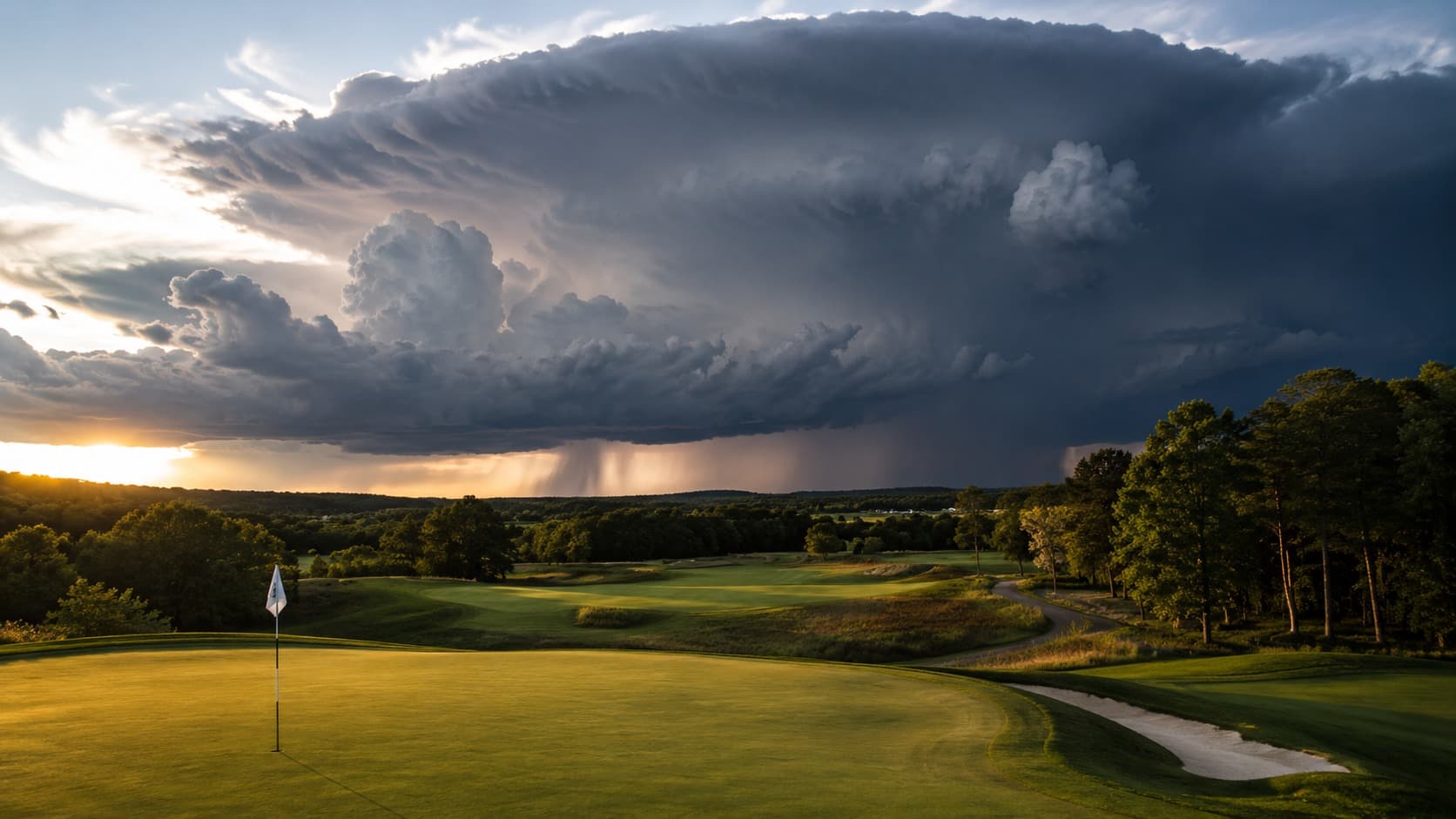
The Three O’Clock Storm: Reading Summer’s Convective Cycle to Protect Your Round
A 40% chance of afternoon thunderstorms does not mean a 40% chance of getting rained on. In the summer convective season it means the morning is nearly clear and the afternoon carries a fast-building, high-energy storm risk driven by a daily heating cycle. Here is the meteorology behind the pattern, the G-Score data on how the storm cycle punishes afternoon tee times across the Southeast, Midwest, and desert Southwest, the lightning-safety decision tree that actually matters, and the workflow that gets you off the course before the first bolt.
Read Story
The May 2026 G-Score Heatmap: Where American Golf Peaks This Spring
May is the most underrated month on the American golf calendar. Five regions hit their annual peak this spring, three turn quietly hostile, and the data tells a clearer story than the brochures. Here is where to play, where to avoid, and how to time your booking window.
Read StoryMinSu Kim
Founder & Golf Data Analyst
MinSu is a data analyst and golfer with 10+ years on the course. He built Golf Weather Score to answer one question: is today a good day to play? He combines weather data, course intelligence, and the proprietary G-Score algorithm to help golfers make smarter decisions.
Every Friday Morning
When Callahan Golf Links plays best next weekend.
Friday 6am ET: peak G-Score windows for Callahan Golf Links, wind direction by hour, and one gear call. Three minutes to read, save you the round.
One email a week. Unsubscribe in one click.
The Caddie's Oracle
Draw your luck before the tee off