
Caddie's Gear Advisor
Curated for today's 74°F · Clear
Tour-Level Drivers
Engineered for maximum distance and forgiveness
Laser Rangefinders
Pin-seeking technology for precision approaches
Premium Golf Balls
Tour-caliber spin and distance performance
Performance Sunglasses
Polarized lenses optimized for reading greens
Your Golf Trip, Handled
The Ultimate Golf Trip Planner
Everything you need to play Capital City Club - Brookhaven Country Club — from booking your flight to checking in course-side.
Course-Side Stays
Luxury hotels, resorts, and stay-and-play packages just minutes from the first tee.
Flights
Compare fares across 700+ airlines for the best route to your tee time.
SUV Rentals for Golf Bags
Spacious vehicles with room for clubs, bags, and your foursome.
Travel Insurance
Coverage for medical, weather delays, and gear at your destination.
Capital City Club - Brookhaven Country Club: Course Intelligence
Signature Setup
Capital City Club's Brookhaven course opened in 1912, laid out by Herbert H. Barker, and it is one of the oldest continuously played golf courses in the Atlanta metro. It is a classic parkland design — tree-lined corridors, modest elevation movement, and Nancy Creek threading through several holes rather than the sprawling water hazards of newer resort builds. The routing reflects its early-1900s origin: shorter than a modern championship card, but demanding in placement, with small greens that reward a player who controls trajectory and spin. I have not played the back nine in competition, so I lean on historical weather records and the round I walked here on a fall morning for the wind and turf notes below.
Hole-by-Hole Wind & Playing Lines
Atlanta's prevailing summer flow is light and out of the south to southeast in the morning, strengthening as afternoon heating builds. On a tree-lined parkland course like Brookhaven, you feel that wind less off the tee and far more on elevated approaches where the canopy opens up.
- The #1-handicap par-4 (~430y): Into the SE morning drift, a 150-yard approach plays closer to 160. I clubbed up one and aimed at the fat left side of the green rather than flirting with the creek-side right pin.
- The par-3 over Nancy Creek (~180y): Downhill, so the played yardage shrinks, but a south breeze quartering left-to-right pushes a high ball toward the long bunker. A three-quarter 6-iron held the line better than a full 7.
- A short par-4 doglegging back toward the clubhouse: With the afternoon wind helping, the green is reachable for longer hitters, but the small target punishes anything coming in hot — a layup to a full wedge is the percentage play after 1 p.m.
Green & Fairway Characteristics
The greens are bentgrass, which is common for older Atlanta clubs that predate the warm-season grass standard. They run firm by midday once the sun dries the surface — I had them at roughly mid-10s on the Stimp in October, and they get quicker as humidity drops in the afternoon. Fairways are Bermuda, so morning dew slows roll, then they firm and speed up after 11 a.m. The slopes are subtle parkland contours, not severe, but the small green sizes mean a ball above the hole on a firm afternoon surface is a real three-putt risk. Front-nine yardages sit shorter and tighter through the trees; the closing holes open slightly and play longer into the prevailing breeze.
Seasonal Weather Pattern
Atlanta is humid subtropical. June through August brings daytime highs near 88–90°F with dew points in the low 70s — the air feels heavy and the ball does not fly as far as the temperature suggests because of the humidity. From late June into August, afternoon thunderstorm cells form almost daily, often between 2 and 5 p.m., and they cancel more back nines here than any wind issue. Spring (March–April) is the prime window: highs in the 70s, lower humidity, but heavy pine pollen for two to three weeks. Winters are mild — daytime highs in the 50s — so this is a near-year-round course, with the bentgrass greens at their truest in the cooler shoulder seasons.
Local Play Tips
The single most useful piece of local knowledge: this is a morning course in summer. Nancy Creek and the surrounding canopy hold moisture, so dew lingers and early greens are slower, but the trade-off is enormous — you avoid the 2–5 p.m. storm window that defines an Atlanta July. I would rather play firm-and-fast at 7 a.m. than chase a lightning-delayed back nine at 3 p.m. In the shoulder seasons, the afternoon is fine and the firmer greens make for the best putting surfaces of the day.
Pre-Round Weather Workflow
Use the 7-day G-Score on this course page as your tee-time selector, not just a go/no-go. From June through August, scan for the afternoon storm probability and bias your booking to the first two hours after sunrise — the G-Score will typically read 8–12 points higher in the morning slot. Check the windExposure indicator: on this tree-sheltered parkland layout, wind matters most on the elevated approaches and the creek par-3, so a moderate-wind day is still very playable. In spring and fall, let the G-Score steer you toward the afternoon, when the bentgrass greens firm up and run truest.
Related Reading
Before you tee off at Capital City Club - Brookhaven Country Club
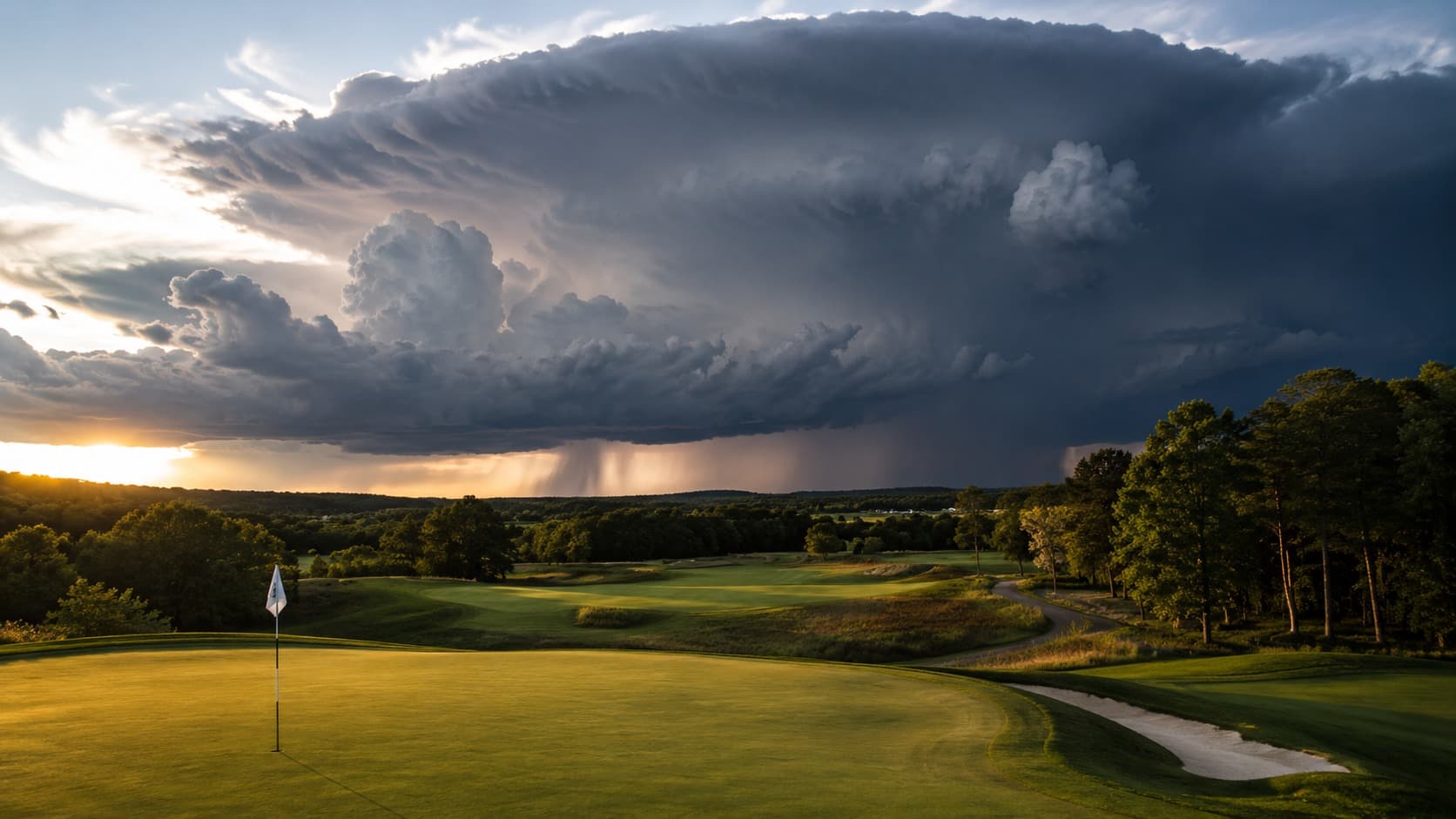
The Three O’Clock Storm: Reading Summer’s Convective Cycle to Protect Your Round
A 40% chance of afternoon thunderstorms does not mean a 40% chance of getting rained on. In the summer convective season it means the morning is nearly clear and the afternoon carries a fast-building, high-energy storm risk driven by a daily heating cycle. Here is the meteorology behind the pattern, the G-Score data on how the storm cycle punishes afternoon tee times across the Southeast, Midwest, and desert Southwest, the lightning-safety decision tree that actually matters, and the workflow that gets you off the course before the first bolt.
Read Story
The May 2026 G-Score Heatmap: Where American Golf Peaks This Spring
May is the most underrated month on the American golf calendar. Five regions hit their annual peak this spring, three turn quietly hostile, and the data tells a clearer story than the brochures. Here is where to play, where to avoid, and how to time your booking window.
Read StoryMinSu Kim
Founder & Golf Data Analyst
MinSu is a data analyst and golfer with 10+ years on the course. He built Golf Weather Score to answer one question: is today a good day to play? He combines weather data, course intelligence, and the proprietary G-Score algorithm to help golfers make smarter decisions.
Every Friday Morning
When Capital City Club - Brookhaven Country Club plays best next weekend.
Friday 6am ET: peak G-Score windows for Capital City Club - Brookhaven Country Club, wind direction by hour, and one gear call. Three minutes to read, save you the round.
One email a week. Unsubscribe in one click.
The Caddie's Oracle
Draw your luck before the tee off