
Caddie's Gear Advisor
Curated for today's 96°F · Thunderstorm
Storm-Ready Outerwear
Waterproof layers built for 18 holes in the rain
Tour-Grade Umbrellas
68" double-canopy wind-resistant coverage
Wet-Weather Gloves
All-weather grip that performs in the rain
Waterproof Golf Shoes
Keep your feet dry through every fairway
Your Golf Trip, Handled
The Ultimate Golf Trip Planner
Everything you need to play Capital City Country Club — from booking your flight to checking in course-side.
Course-Side Stays
Luxury hotels, resorts, and stay-and-play packages just minutes from the first tee.
Flights
Compare fares across 700+ airlines for the best route to your tee time.
SUV Rentals for Golf Bags
Spacious vehicles with room for clubs, bags, and your foursome.
Travel Insurance
Coverage for medical, weather delays, and gear at your destination.
Capital City Country Club: Course Intelligence
Signature Setup
Capital City Country Club sits in the Myers Park neighborhood just south of downtown Tallahassee, and the thing that surprises people is that it is *hilly* — genuinely rolling ground, which you almost never get in Florida. The club dates to 1923, and the course has been reworked and re-grassed many times since, so there is no single architect of record I can point to honestly; what survives is the routing across the old terrain. I'll be straight here: Capital City is a private club, and I haven't walked it myself, so the reads below lean on the routing and Tallahassee's weather record rather than my own scorecard.
The course is short by modern championship standards — this is a classic in-town members' club, not a 7,200-yard resort layout — and its identity comes from the land it sits on. Part of the property includes a Native American temple mound, a genuine pre-Columbian earthwork, which is both a historical landmark and the source of the unusual elevation. Under a heavy live-oak canopy, the holes weave between mature trees rather than across open links ground.
Hole-by-Hole Wind & Playing Lines
Tallahassee sits about 25 miles inland from the Gulf, so the dominant warm-season flow is a south-to-southwest breeze that builds through the day. Three pressure points stand out on a tree-lined, rolling layout like this:
- The uphill par-4 climbing back toward the clubhouse (the #1-handicap test): Into a 10 mph S/SSW Gulf breeze this plays a club-and-a-half longer than the number. Club up, commit, and favor the back of the green — short shots into an uphill, canopy-shaded green get stuck on the front and leave a nervy uphill putt.
- The mound-side hole with the most elevation: The temple-mound terrain gives you the course's biggest grade change. On a post-front NW flow the crosswind funnels through the oaks unpredictably; play the center of the fairway and take the tree-gap that the wind isn't fighting, not the aggressive line.
- A short, tree-pinched par-4: Length isn't the defense here — the canopy is. A low S breeze under the oaks pushes a high approach long. Take the spin off it, land it short, and let it release.
Green & Fairway Characteristics
Fairways are Bermuda, standard for north Florida, and they run firm once the summer heat sets in — but the heavy live-oak canopy means many fairways hold morning dampness longer and stay soft and shaded well past sunrise. The greens are an ultradwarf surface that handles Tallahassee's brutal summers far better than bentgrass ever could; expect noticeable grain that follows the afternoon sun and a moderate, fair speed rather than a glassy one. Because the routing rides real grade and tucks between trees, very few approaches are dead flat or fully open — read the slope and the shade line before you read the yardage.
Seasonal Weather Pattern
Tallahassee's golf calendar is governed by humidity and lightning, not cold. July and August highs run 90–92°F with dew points in the low-to-mid 70s, and the air goes thick and still by early afternoon. Critically, Tallahassee is one of the most lightning-prone cities in the United States — afternoon convective storms June through August are a near-daily planning factor, not a rare event. Spring (late March–May) is the sweet spot: highs in the 70s to low 80s, firmer turf, calmer mornings. Winters are mild — January highs around 64°F — but a passing front can drop a 30s°F frost morning on you in December and January, which firms the greens and shortens carry until the surface thaws.
Local Play Tips
A detail you won't get off the scorecard: the live-oak canopy is the real course architect here. Shaded, tree-lined fairways hold dew and stay soft and slow for the first couple of hours, then the firm-up is uneven — open holes bake out while canopy holes stay receptive. On a humid, tree-canopy course like this, my own approach in the panhandle has always been to take the earliest tee I can get: I've stood on north-Florida first tees enough summer mornings to know the difference between an 8 a.m. round and a 1 p.m. one is measured in lightning holds, not just comfort. Plan your second shots around shade and slope, not the card number, and on the mound-side elevation give yourself an extra half-club uphill.
Pre-Round Weather Workflow
Use the 7-day G-Score and windExposure read to time this course, because Tallahassee's afternoon storm risk swings conditions hard:
1. Book the earliest tee you can. In summer the morning window scores meaningfully higher than the afternoon, when humidity peaks and storm probability climbs. Finishing before the convection builds is the single biggest scoring lever here. 2. Read wind direction, not just speed. A building S/SSW Gulf flow loads the uphill approaches; a post-front NW flow turns the canopy holes into a crosswind guessing game. Let the windExposure flag drive club selection. 3. Watch the afternoon storm line June–August. This is lightning country — if the 7-day shows building afternoon convection, target an 18 finished before 1 p.m. rather than risk a mid-round hold. 4. In winter, check the overnight low. A frost morning in the 30s°F firms the greens and shortens carry; add a half-club until the surface softens.
Related Reading
Before you tee off at Capital City Country Club
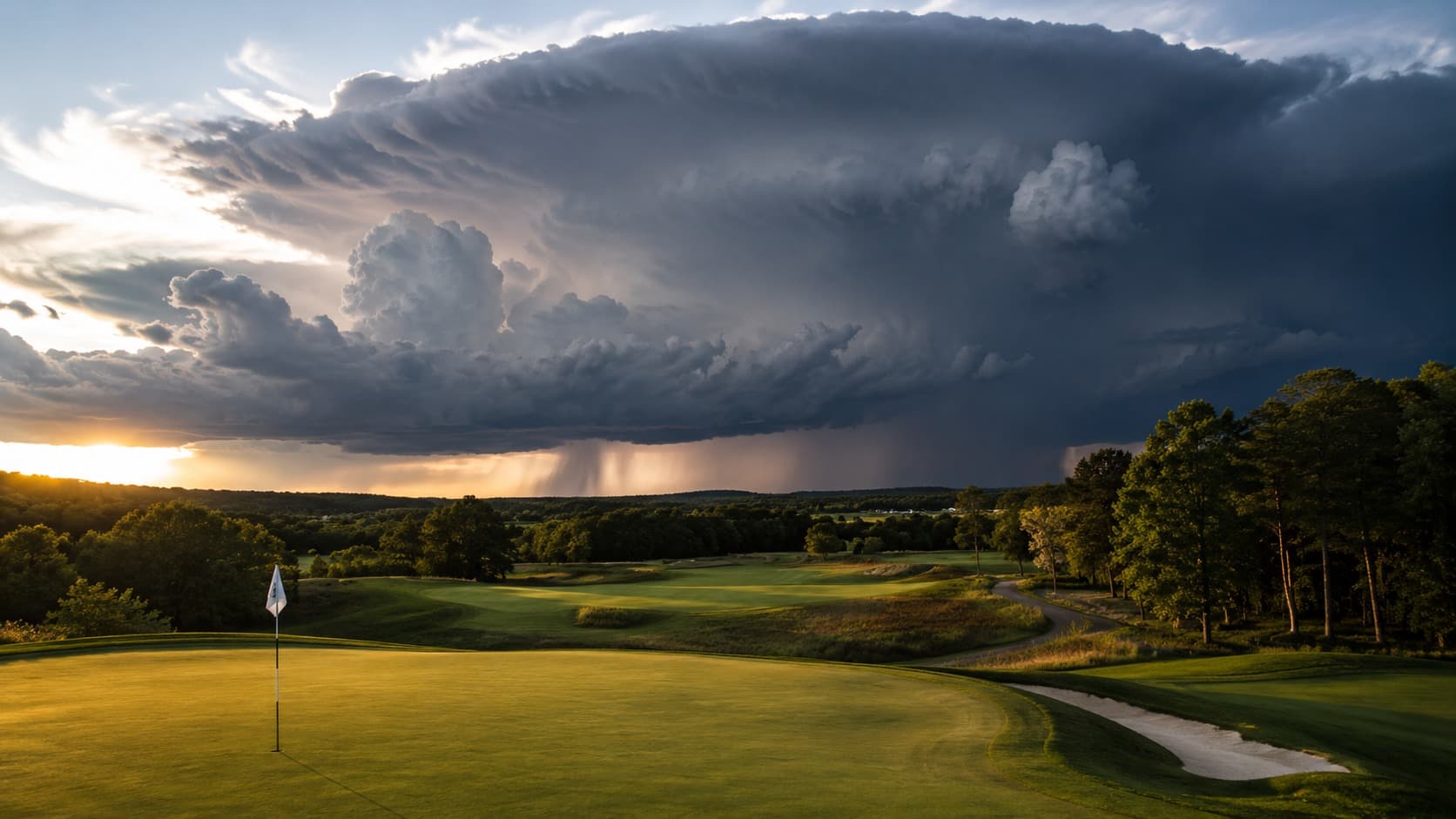
The Three O’Clock Storm: Reading Summer’s Convective Cycle to Protect Your Round
A 40% chance of afternoon thunderstorms does not mean a 40% chance of getting rained on. In the summer convective season it means the morning is nearly clear and the afternoon carries a fast-building, high-energy storm risk driven by a daily heating cycle. Here is the meteorology behind the pattern, the G-Score data on how the storm cycle punishes afternoon tee times across the Southeast, Midwest, and desert Southwest, the lightning-safety decision tree that actually matters, and the workflow that gets you off the course before the first bolt.
Read Story
The May 2026 G-Score Heatmap: Where American Golf Peaks This Spring
May is the most underrated month on the American golf calendar. Five regions hit their annual peak this spring, three turn quietly hostile, and the data tells a clearer story than the brochures. Here is where to play, where to avoid, and how to time your booking window.
Read StoryMinSu Kim
Founder & Golf Data Analyst
MinSu is a data analyst and golfer with 10+ years on the course. He built Golf Weather Score to answer one question: is today a good day to play? He combines weather data, course intelligence, and the proprietary G-Score algorithm to help golfers make smarter decisions.
Every Friday Morning
When Capital City Country Club plays best next weekend.
Friday 6am ET: peak G-Score windows for Capital City Country Club, wind direction by hour, and one gear call. Three minutes to read, save you the round.
One email a week. Unsubscribe in one click.
The Caddie's Oracle
Draw your luck before the tee off