
Caddie's Gear Advisor
Curated for today's 83°F · Clear
Tour-Level Drivers
Engineered for maximum distance and forgiveness
Laser Rangefinders
Pin-seeking technology for precision approaches
Premium Golf Balls
Tour-caliber spin and distance performance
Performance Sunglasses
Polarized lenses optimized for reading greens
Your Golf Trip, Handled
The Ultimate Golf Trip Planner
Everything you need to play Carmi Country Club — from booking your flight to checking in course-side.
Course-Side Stays
Luxury hotels, resorts, and stay-and-play packages just minutes from the first tee.
Flights
Compare fares across 700+ airlines for the best route to your tee time.
SUV Rentals for Golf Bags
Spacious vehicles with room for clubs, bags, and your foursome.
Travel Insurance
Coverage for medical, weather delays, and gear at your destination.
Carmi Country Club: Course Intelligence
Signature Setup
Carmi Country Club sits in White County, in the southeastern corner of Illinois, where the land flattens out toward the Little Wabash River bottoms. This is small-town Illinois golf — a 9-hole club that, like a lot of farm-belt courses from the early-to-mid 1900s, has no celebrity architect attached to its name. I'll be honest up front: I have not teed it myself, and I won't pretend otherwise. The original designer is unrecorded, which is the norm for member-built clubs of this size and era, not a knock on the place.
What I can tell you with confidence is the *type* of golf this is and how the local weather shapes it, because southern Illinois plays a very specific way and I've spent mornings on courses just like it across the lower Midwest. Expect a walkable, tree-lined par-35/36 nine, river-bottom flat with a few gentle moves, the kind of layout you play twice from different tees to make an eighteen. The signature on a course like this is almost always the water hole — here, the par-3 over the pond — which reads as a soft mid-iron on paper and turns into something else entirely when the wind gets into it.
Hole-by-Hole Wind & Playing Lines
On a flat, tree-framed river-bottom nine, the wind doesn't roar — it leaks through the gaps between tree lines, and that's what fools you. The three holes I'd watch:
- The pond par-3 (signature): A short par-3 on the card. But the prevailing southern Illinois spring flow is out of the south-southwest, and an open water hole has no trees to block it. A 150-yard shot into a 12–15 mph SSW breeze plays closer to 170, and the pond punishes the short miss. Club up, take the long side of the green, and never bail toward the water.
- The #1-handicap par-4: The toughest hole on the card. Into that same SSW spring wind it stretches well past its yardage. Drive to the side away from the tree line to keep your approach angle open, then take one more club than the number tells you — the bottomland air is heavy with humidity here and the ball does not fly as far as the scorecard wants you to believe.
- A tree-lined dogleg: On river-bottom courses the tightest hole is usually a dogleg pinched by mature trees. With a crossing wind off a post-front NW shift, resist cutting the corner — the wind that helps your line also pushes a pull into the trees. Play the stock shot to the fat of the fairway.
Green & Fairway Characteristics
Southern Illinois sits in the cool-season turf belt, so expect bluegrass/ryegrass-type fairways and bentgrass greens rather than the Bermuda you'd find three states south. In spring and fall those surfaces are soft and receptive — approach shots hold, and a small-club green-speed setup will run in the 8–9 Stimp range, fair rather than fast. The flip side: in a wet spell the Little Wabash bottomland holds water, and the fairways can play heavy and plug, killing your rollout. After a dry July week they'll firm up and give you 15–20 yards of chase, which changes your club off the tee.
Greens on a 9-hole club like this are typically modest in size and contour — the defense is the surround and the wind, not severe internal slope. Read for grain less and for the soft-vs-firm condition more; whether it rained in the last 48 hours tells you more here than any green book would.
Seasonal Weather Pattern
White County has a humid continental climate, and the golf calendar runs by it. Summer (July–August) brings daytime highs around 88–92°F with dew points in the low-to-mid 70s — genuinely muggy, the kind of air that sits still over the river bottom and makes an afternoon nine feel longer than it is. Spring (April–May) is the sweet window: highs in the 60s and 70s, firmer footing, but also the windiest stretch, with that persistent south-southwest flow and a real risk of afternoon thunderstorms rolling up from the Ohio Valley. Fall is arguably the best golf — September and October highs in the 70s, lower humidity, calmer mornings. Winters are cold enough to shut casual play down: January highs sit in the upper 30s to low 40s°F, and the course goes dormant. The defining local factor isn't temperature, though — it's the bottomland morning fog and moisture off the Little Wabash, which lingers later here than on higher ground.
Local Play Tips
The one thing I'd flag that you won't get off a scorecard: river-bottom courses like Carmi hold morning fog and dew well past sunrise, later than nearby upland courses, because the cool, moist air pools in the low ground overnight. That means the early-early tee time can actually play *slower and softer* than you'd want for distance — but it's also the calmest, before the south wind builds. The trade is real: tee off too early and you fight wet turf and limited sightlines through fog; wait until mid-morning and the surface dries but the SSW wind starts loading the open holes. On a course shaped by a river like this, I'd target the window right after the fog lifts and before the wind gets organized — usually a stretch around mid-morning. And if it's rained that week, walk it expecting heavy bottomland fairways and pack accordingly.
Pre-Round Weather Workflow
Use the 7-day G-Score and windExposure read to time a round here, because a flat river-bottom nine swings more on moisture and wind than on temperature:
1. Check the fog-and-dew window before sunrise tee times. The Little Wabash bottoms hold morning moisture longer than higher ground. The G-Score will favor mid-morning over first light in spring — let the fog lift before you commit to an early slot. 2. Read wind direction, not just speed. The signature pond par-3 and the #1-handicap par-4 are the holes a SSW spring wind attacks. When windExposure flags a south flow, club up on both and never short-side yourself toward the water. 3. Watch the afternoon storm line April–August. Ohio Valley convection builds in the afternoon; if the 7-day shows building storms, finish your nine (or eighteen) before early afternoon rather than risk a lightning hold. 4. Factor the last 48 hours of rain. On bottomland turf, recent rain means heavy, plugging fairways and no rollout — give yourself an extra club off the tee and don't expect the ball to chase.
Related Reading
Before you tee off at Carmi Country Club
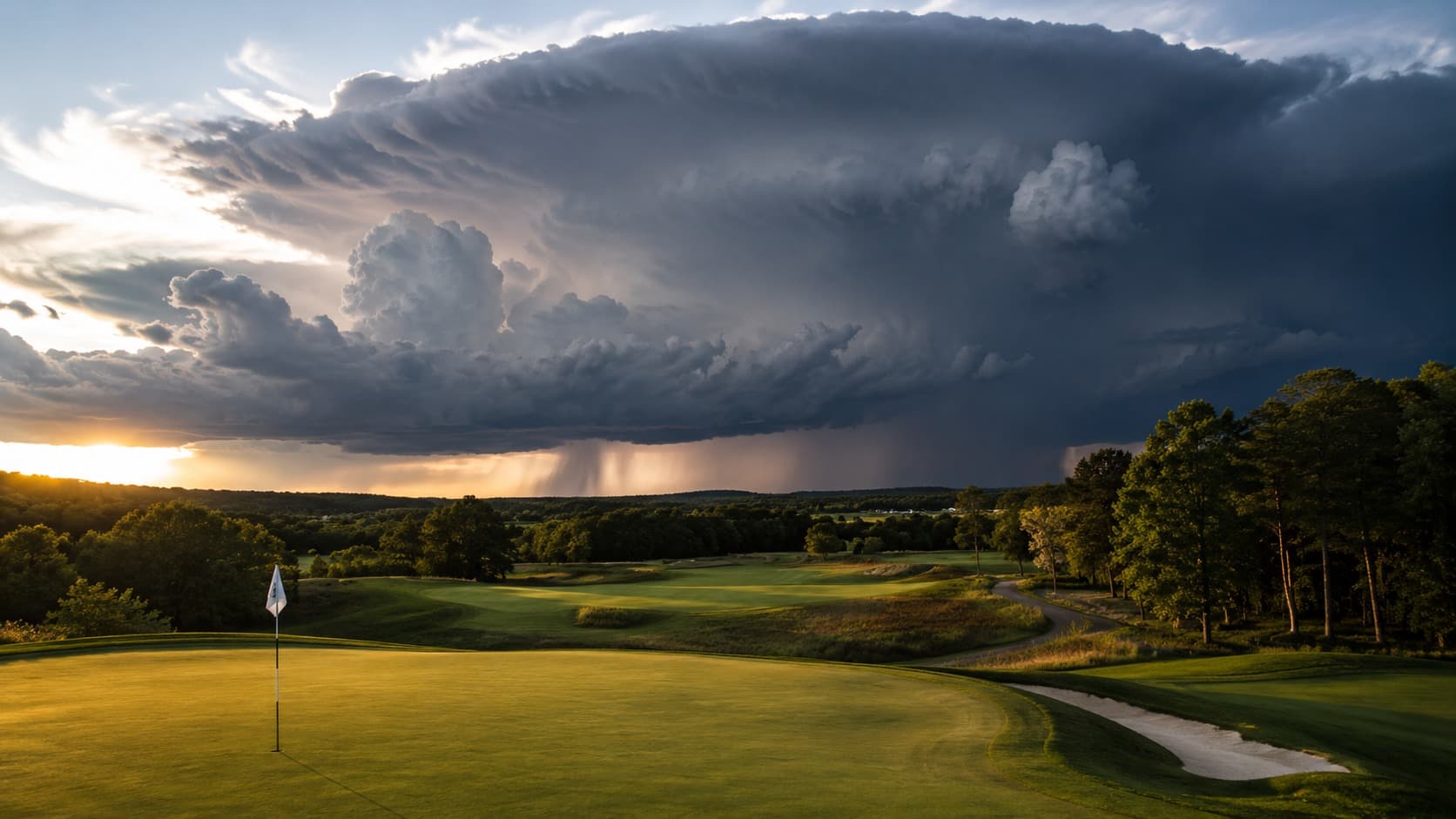
The Three O’Clock Storm: Reading Summer’s Convective Cycle to Protect Your Round
A 40% chance of afternoon thunderstorms does not mean a 40% chance of getting rained on. In the summer convective season it means the morning is nearly clear and the afternoon carries a fast-building, high-energy storm risk driven by a daily heating cycle. Here is the meteorology behind the pattern, the G-Score data on how the storm cycle punishes afternoon tee times across the Southeast, Midwest, and desert Southwest, the lightning-safety decision tree that actually matters, and the workflow that gets you off the course before the first bolt.
Read Story
How to Read a G-Score: The 0–100 Golf Playability Number, Decoded
A G-Score on this site is a single 0–100 number that tells you whether today is worth tee-up. Here is exactly what each band means, what drives the calculation, and how to use it to plan a round you will actually score on.
Read StoryMinSu Kim
Founder & Golf Data Analyst
MinSu is a data analyst and golfer with 10+ years on the course. He built Golf Weather Score to answer one question: is today a good day to play? He combines weather data, course intelligence, and the proprietary G-Score algorithm to help golfers make smarter decisions.
Every Friday Morning
When Carmi Country Club plays best next weekend.
Friday 6am ET: peak G-Score windows for Carmi Country Club, wind direction by hour, and one gear call. Three minutes to read, save you the round.
One email a week. Unsubscribe in one click.
The Caddie's Oracle
Draw your luck before the tee off