
Caddie's Gear Advisor
Curated for today's 65°F · Mist
Tour-Level Drivers
Engineered for maximum distance and forgiveness
Laser Rangefinders
Pin-seeking technology for precision approaches
Premium Golf Balls
Tour-caliber spin and distance performance
Performance Sunglasses
Polarized lenses optimized for reading greens
Your Golf Trip, Handled
The Ultimate Golf Trip Planner
Everything you need to play Carthage Golf Course — from booking your flight to checking in course-side.
Course-Side Stays
Luxury hotels, resorts, and stay-and-play packages just minutes from the first tee.
Flights
Compare fares across 700+ airlines for the best route to your tee time.
SUV Rentals for Golf Bags
Spacious vehicles with room for clubs, bags, and your foursome.
Travel Insurance
Coverage for medical, weather delays, and gear at your destination.
Carthage Golf Course: Course Intelligence
Signature Setup
Carthage Golf Course sits in Carthage, in the southwestern corner of Missouri near the Kansas line and the edge of the Ozark plateau. I want to be straight about the record: this is a municipal-era course from the mid-1900s, and I could not verify a named architect or a firm opening year, so I won't pin a famous designer on it. The card I've seen runs to about par 72 and roughly 6,200 yards from the back markers — modest length by destination standards, which means the defense here is shaping, wind, and green firmness rather than raw distance. I haven't played Carthage in person, so everything below about playing lines leans on the scorecard and on what open southwest-Missouri golf reliably does to a round, not on invented memories of a tee shot I never hit.
Hole-by-Hole Wind & Playing Lines
On a course this length the wind is the whole story, and in southwest Missouri the prevailing summer flow is south to south-southwest. The signature short par-3 — about 150 yards, downhill, sitting open — plays a half-club shorter downwind in the morning calm but turns into a knockdown by mid-afternoon when the SSW breeze quarters across it; bail to the safe side of the green rather than holding a high ball against a crossing wind. The number-one-handicap par-4, listed near 420 yards, is the hole that decides your card. Into a stiffened afternoon SSW wind it eats up well past 440 effective yards, so I'd take the hero second off the table entirely: drive to the wide side, then a controlled mid-iron to the fat front-right, not at a tucked flag. On the doglegs, match your shot shape to the wind direction — a hole that bends with a left-to-right breeze plays a full club longer than the yardage suggests, and the cheap bogeys here come from over-cutting into the wind.
Green & Fairway Characteristics
Greens at a course like this read modestly — gentle slope, the kind where grain and firmness matter more than severe contour. Expect cool-season putting surfaces that hold approaches softly in the wet shoulder months and firm up hard through July and August, so in summer plan to land the ball short and let it release rather than flying it at the pin. Fairways carry bermuda character in the heat, which means tight, fast lies and plenty of roll once the turf bakes — good for distance off the tee, less forgiving on a thin strike. At about 6,200 yards over par 72, scoring is a wedge-and-putter exercise: the par-5s are reachable in the morning calm, and the difference between 75 and 82 is usually how cleanly you manage the firm summer greens.
Seasonal Weather Pattern
Southwest Missouri is humid continental shading toward humid subtropical, and the golf calendar follows it. Spring (April–May) brings the year's strongest wind — gusty south-southwest flow over open ground and cold starts in the low 40s that quietly shave 5–8 yards off carry until the air warms past mid-morning. Summer (June–August) is hot and sticky: afternoon highs commonly near 90°F, heavy humidity, and a real risk of pop-up thunderstorm cells after midday, so the early tee time is both a heat and a safety decision. Fall (September–October) is the window I'd circle — settled air, lighter breeze, cooler greens that take a softer approach. Winter largely closes meaningful seasonal play this far north of the true Sun Belt.
Local Play Tips
Here's the thing the booking apps won't flag: on an open southwest-Missouri muni, your tee time is mostly a wind-and-heat decision, not just a daylight one. The south breeze that barely moves a flag at 7 a.m. is often a steady two-club factor on the long par-4 by early afternoon, and the same sun that's pleasant at dawn is punishing by 1 p.m. in July. When I scout a course like this, I budget my round around the one or two holes that face the wind dead-on rather than the total yardage. And because the design history isn't well documented, I'd walk the signature par-3 and the #1-handicap par-4 on arrival if there's time — those two holes will set the tone of the whole card before you ever reach the turn.
Pre-Round Weather Workflow
Use the 7-day G-Score on this course page to pick the slot, and run two quick checks. First, wind: a south or SSW reading above roughly 12 mph means the long par-4 and the doglegs all play a club or more longer — club up and favor the wide, safe side. Second, the summer morning-versus-afternoon split: dew-soft greens hold approaches far better before the surfaces bake, and afternoon storm probability climbs after midday June–August, so take the earliest available time when convective risk is up. The windExposure flag here trends high because there's little tree cover to break the prairie-edge breeze, which is why a dawn G-Score will usually run several points stronger than the same afternoon number. Bottom line at Carthage: the right early tee time, ahead of both the south wind and the heat, is worth more strokes than any swing change you could make on the range.
Related Reading
Before you tee off at Carthage Golf Course
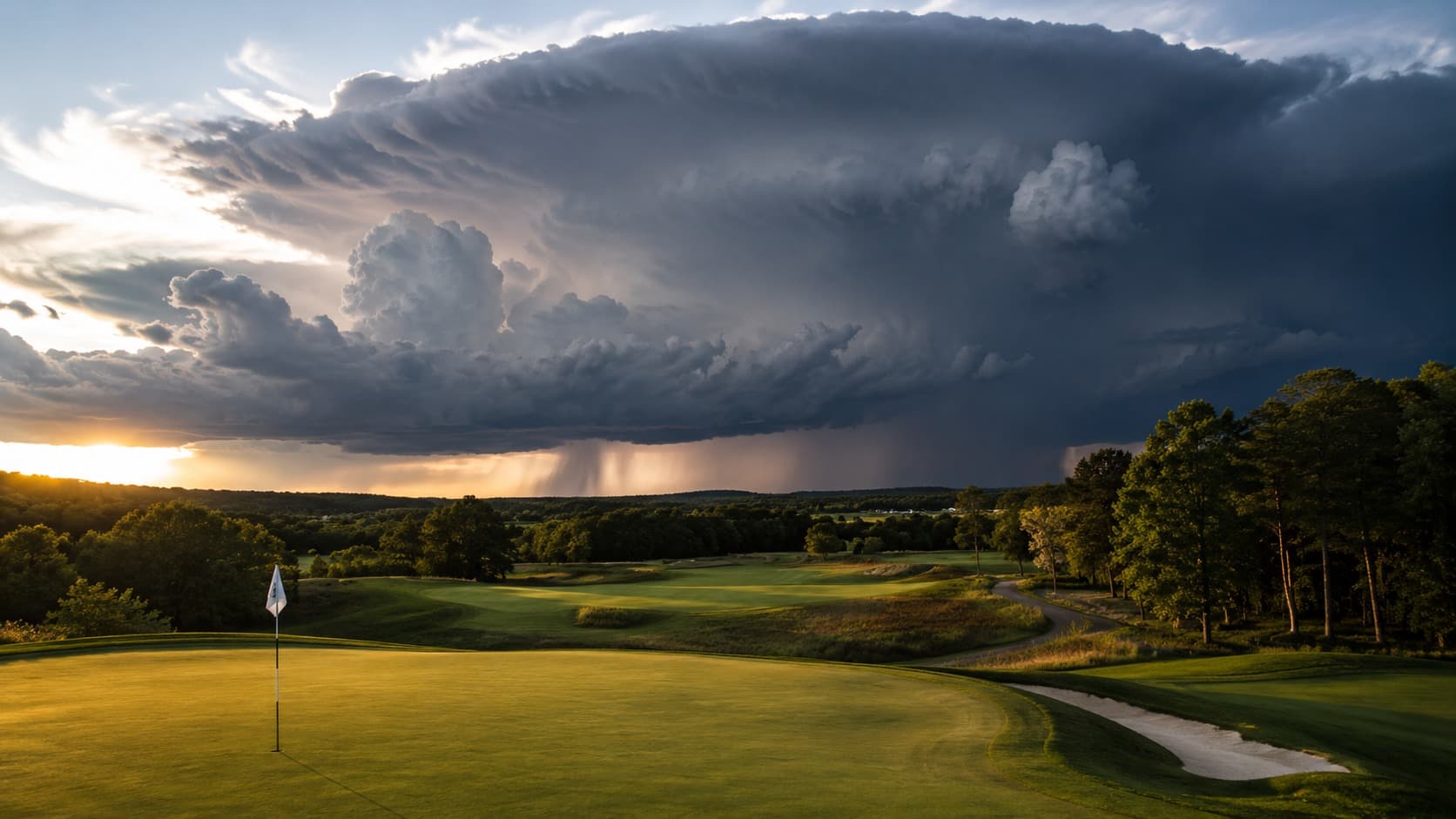
The Three O’Clock Storm: Reading Summer’s Convective Cycle to Protect Your Round
A 40% chance of afternoon thunderstorms does not mean a 40% chance of getting rained on. In the summer convective season it means the morning is nearly clear and the afternoon carries a fast-building, high-energy storm risk driven by a daily heating cycle. Here is the meteorology behind the pattern, the G-Score data on how the storm cycle punishes afternoon tee times across the Southeast, Midwest, and desert Southwest, the lightning-safety decision tree that actually matters, and the workflow that gets you off the course before the first bolt.
Read Story
How to Read a G-Score: The 0–100 Golf Playability Number, Decoded
A G-Score on this site is a single 0–100 number that tells you whether today is worth tee-up. Here is exactly what each band means, what drives the calculation, and how to use it to plan a round you will actually score on.
Read StoryMinSu Kim
Founder & Golf Data Analyst
MinSu is a data analyst and golfer with 10+ years on the course. He built Golf Weather Score to answer one question: is today a good day to play? He combines weather data, course intelligence, and the proprietary G-Score algorithm to help golfers make smarter decisions.
Every Friday Morning
When Carthage Golf Course plays best next weekend.
Friday 6am ET: peak G-Score windows for Carthage Golf Course, wind direction by hour, and one gear call. Three minutes to read, save you the round.
One email a week. Unsubscribe in one click.
The Caddie's Oracle
Draw your luck before the tee off