
Caddie's Gear Advisor
Curated for today's 80°F · Rain
Storm-Ready Outerwear
Waterproof layers built for 18 holes in the rain
Tour-Grade Umbrellas
68" double-canopy wind-resistant coverage
Wet-Weather Gloves
All-weather grip that performs in the rain
Waterproof Golf Shoes
Keep your feet dry through every fairway
Your Golf Trip, Handled
The Ultimate Golf Trip Planner
Everything you need to play Cattails Golf Club — from booking your flight to checking in course-side.
Course-Side Stays
Luxury hotels, resorts, and stay-and-play packages just minutes from the first tee.
Flights
Compare fares across 700+ airlines for the best route to your tee time.
SUV Rentals for Golf Bags
Spacious vehicles with room for clubs, bags, and your foursome.
Travel Insurance
Coverage for medical, weather delays, and gear at your destination.
Cattails Golf Club: Course Intelligence
Signature Setup
The cattails are not a marketing name here — they are the hazard. Cattails Golf Club sits in South Lyon, Michigan, about 30 miles northwest of downtown Detroit, and PGA professional John R. Williams routed it through and around a large tract of marshland when it opened in 1991. From the back tees it measures 6,433 yards, par 72, with a course rating of 72.0 and a slope of 133 — a number that tells you the trouble is constant rather than occasional. The front nine travels through and around creeks and wetlands; the back nine is cut through hardwood forest with a few wetland pockets to navigate. Just two holes, both on a small ridge, are free of the cattail-infested water.
I should be straight with you: I've played southeast Michigan public golf, but my notes on this specific routing lean on the scorecard, the regional climate, and the course's own description rather than a dozen rounds on the property. So I'll write what the numbers and the conditions actually tell you, and where I'm reading from regional norms I'll say so. On a course where hazards sit on almost every hole and you are repeatedly hitting over wetland, club selection — and therefore wind and air density — is the whole game.
Hole-by-Hole Wind & Playing Lines
The two nines play like two different golf courses, and the wind is the reason:
- The open front nine (creeks and wetlands): These holes are exposed. Southeast Michigan's prevailing summer wind is out of the southwest, and on a marsh-edge hole a 10–15 mph SW breeze into your face turns a stock 150-yard 8-iron into a 165-yard 6-iron — and the extra carry is over cattails, not short grass. Into the wind, take the extra club and aim at the fat side of the green; the penalty for coming up short here is a lost ball, not a chip.
- The tree-lined back nine (hardwood forest): The hardwoods knock the wind down at ground level, so your yardages behave more honestly. The catch is swirl — wind over a treeline doesn't quit, it eddies. Trust the number more than the flag-feel, and favor the side of the green away from the wetland pockets.
- The cattail par-3s: The course's standout holes are its par-3s over water. On these, the difference between a calm 8 a.m. tee shot and a breezy noon one is a full club. When the SW wind is up, I'd club up and swing easy rather than club down and force it — a hard, low miss into a headwind balloons and falls into the marsh.
Green & Fairway Characteristics
The course is bentgrass throughout — tees, fairways, and greens — which on a Michigan layout means surfaces that hold a well-struck approach in spring and fall and firm up through a dry July. Reviewers consistently describe the greens as undulating and "angulating," with tricky shots around the cattails; that combination rewards a committed approach and punishes a tentative one, because three-putting an undulating surface from the wrong tier costs you as surely as a wet ball. The slope of 133 from 6,433 yards confirms the layout's teeth come from the hazards and the green complexes, not raw length. I don't have a measured Stimp reading for these greens, so I won't invent one — but bentgrass kept healthy in this climate typically runs medium-fast, quicker on a dry, sunny afternoon than after morning dew.
Seasonal Weather Pattern
South Lyon sits in a humid continental climate, and the marsh setting amplifies it. Peak season is May through September: summer highs run 80–85°F in July and August, with humidity that keeps the wetlands generating low-lying morning fog and heavy dew. Afternoon pop-up thunderstorms are a real planning factor June–August — watch the radar after 2 p.m. Spring (April–May) and fall (September–October) are the sweet spots: 55–70°F, firmer footing once the wetlands drain, and the southeast-Michigan fall color through that hardwood back nine is worth the round on its own. The course closes for winter; by late November the marsh holes are cold, wet, and often frosted, and the season effectively ends with the first hard freeze.
Local Play Tips
A detail the scorecard won't give you: on a marshland course, dew and fog are a scoring factor, not just scenery. The open, low-lying front nine holds moisture well past sunrise — wet fairways kill rollout, so your driver number on Hole 1 at 7:30 a.m. is shorter than the same swing at 11 a.m. on dry turf, and a wet ball coming off the cattails grabs less spin on the greens. My own approach on a course like this would be to avoid the very first tee times in summer, take a mid-morning slot instead, and let the sun burn the marsh dry — you trade a little of the calm-air advantage for dry footing and truer rollout, which on a hazard-heavy layout is the better deal. The flip side: if you *do* go early to beat the afternoon storms, plan for soft, slow conditions and club accordingly.
Pre-Round Weather Workflow
Use the 7-day G-Score and windExposure read to time this course — on a marsh layout, the two nines respond to weather differently:
1. Time the front nine for dry, calm conditions. The open wetland holes are most exposed to the SW wind and slowest to dry. A mid-morning G-Score window typically beats both the dewy first hour and the breezy, storm-prone afternoon. 2. Read windExposure by nine. Expect the front to play to the full wind and the tree-lined back to play closer to your stock numbers with some swirl. Adjust club selection nine-by-nine rather than treating the round as one wind profile. 3. Watch the afternoon storm line June–August. If the 7-day shows building afternoon convection, get out early and accept softer, wetter conditions — lightning over open marshland is not a risk to push. 4. In shoulder season, check the overnight low. A frosty Michigan morning over the wetlands means a frost delay and firmer, faster greens once it lifts; give yourself an extra half-club until the surfaces soften under the sun.
Related Reading
Before you tee off at Cattails Golf Club
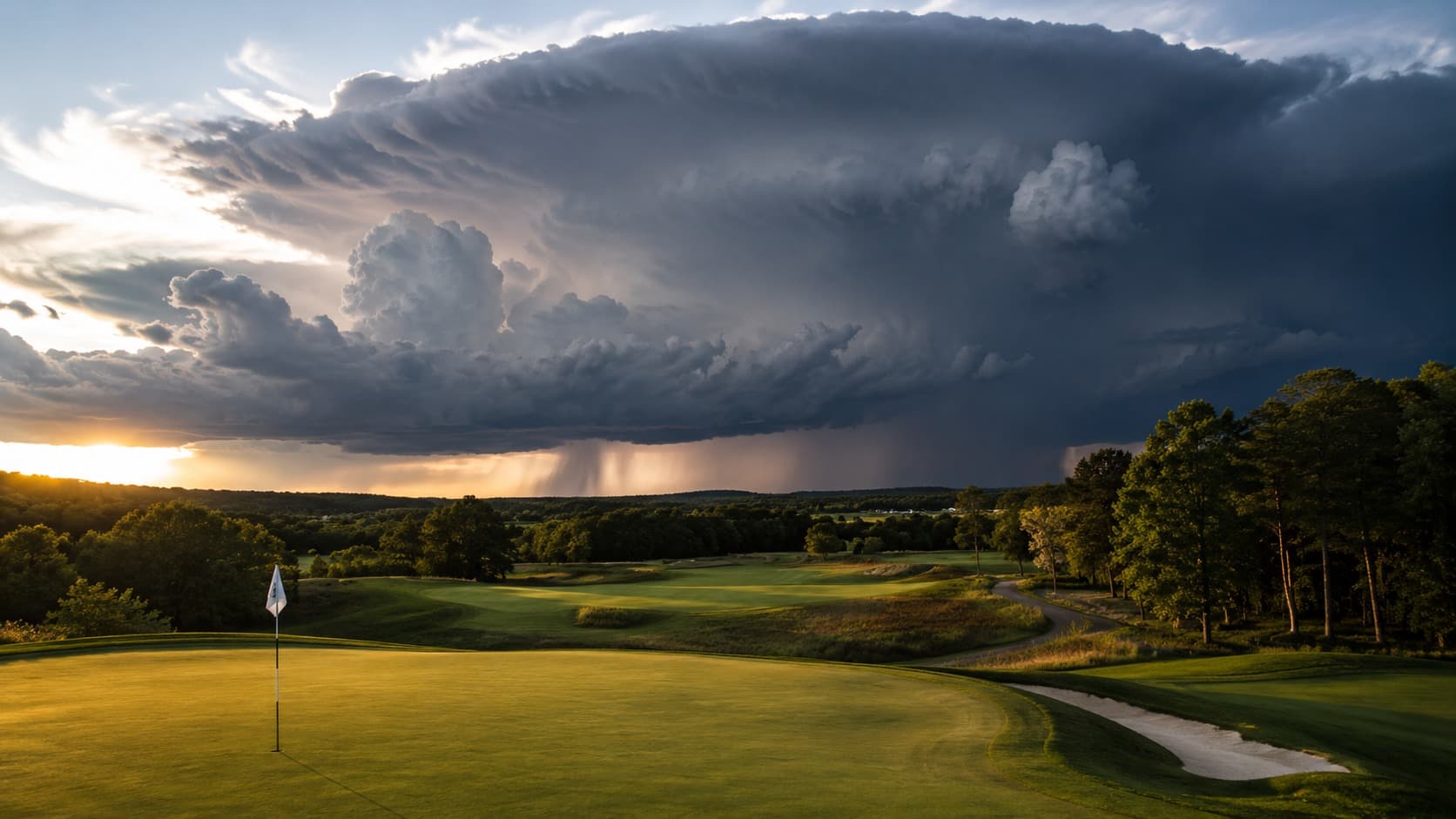
The Three O’Clock Storm: Reading Summer’s Convective Cycle to Protect Your Round
A 40% chance of afternoon thunderstorms does not mean a 40% chance of getting rained on. In the summer convective season it means the morning is nearly clear and the afternoon carries a fast-building, high-energy storm risk driven by a daily heating cycle. Here is the meteorology behind the pattern, the G-Score data on how the storm cycle punishes afternoon tee times across the Southeast, Midwest, and desert Southwest, the lightning-safety decision tree that actually matters, and the workflow that gets you off the course before the first bolt.
Read Story
How to Read a G-Score: The 0–100 Golf Playability Number, Decoded
A G-Score on this site is a single 0–100 number that tells you whether today is worth tee-up. Here is exactly what each band means, what drives the calculation, and how to use it to plan a round you will actually score on.
Read StoryMinSu Kim
Founder & Golf Data Analyst
MinSu is a data analyst and golfer with 10+ years on the course. He built Golf Weather Score to answer one question: is today a good day to play? He combines weather data, course intelligence, and the proprietary G-Score algorithm to help golfers make smarter decisions.
Every Friday Morning
When Cattails Golf Club plays best next weekend.
Friday 6am ET: peak G-Score windows for Cattails Golf Club, wind direction by hour, and one gear call. Three minutes to read, save you the round.
One email a week. Unsubscribe in one click.
The Caddie's Oracle
Draw your luck before the tee off