
Caddie's Gear Advisor
Curated for today's 52°F · Clouds
Cold-Weather Performance Layers
Thermal mid-layers that move with your swing
Tour Hand Warmers
Rechargeable warmers trusted by caddies
Thermal Base Layers
Lightweight compression that traps heat
Winter Golf Headwear
Beanies and ear warmers built for the links
Your Golf Trip, Handled
The Ultimate Golf Trip Planner
Everything you need to play Cedar Chase Golf Club — from booking your flight to checking in course-side.
Course-Side Stays
Luxury hotels, resorts, and stay-and-play packages just minutes from the first tee.
Flights
Compare fares across 700+ airlines for the best route to your tee time.
SUV Rentals for Golf Bags
Spacious vehicles with room for clubs, bags, and your foursome.
Travel Insurance
Coverage for medical, weather delays, and gear at your destination.
Cedar Chase Golf Club: Course Intelligence
Signature Setup
Cedar Chase sits in Cedar Springs, about 20 miles north of Grand Rapids in Kent County, West Michigan. I haven't walked this one myself, so I won't fake a scorecard I don't carry — what I can tell you is what the terrain and the West Michigan air dictate, and on a wooded course like this that's most of the round. It's a public, daily-fee layout threaded through rolling, tree-lined ground rather than open prairie. The defining feature isn't a single famous flourish — it's the timber. Tight corridors mean the round is decided less by raw length than by keeping the ball in the short grass, where an offline drive doesn't just cost distance, it disappears into the trees.
Hole-by-Hole Wind & Playing Lines
I don't have a verified hole-by-hole card for Cedar Chase, so I'll write what the geography forces rather than invent yardages. West Michigan's prevailing flow runs from the southwest and west — off Lake Michigan, 40 miles to the west — and it stiffens through the afternoon and through the fall. On the holes that open to the west, into a 12–15 mph breeze a 150-yard approach climbs to a 170-yard club, a full two sticks longer. The play is to club up before you think you need to and bias the approach to the open side of the green, away from the tree line. On wooded doglegs the trees themselves shelter you at ground level but swirl the wind above the canopy, so trust the club selection, not the feel of a calm tee box. Downwind on a steady southerly summer afternoon, the same holes give the yardage back and a wedge will spin off a firm front edge.
Green & Fairway Characteristics
This is cool-season country. West Michigan daily-fee courses run bentgrass greens with bluegrass-and-rye fairways — surfaces that sit soft and receptive in spring and early summer, then firm and quicken through the dry weeks of late summer. The rolling, tree-framed ground gives you sidehill and downhill lies you won't find on a flat layout, so the stance matters as much as the number. Read the greens for less grain than southern Bermuda but real break off the higher mounding; plan for more roll in August firmness and almost none after a wet spring, when the fairways hold moisture under the tree cover that keeps them shaded.
Seasonal Weather Pattern
Cedar Springs has a hard continental climate softened slightly by Lake Michigan, and the golf calendar is short. Useful play runs roughly mid-April through October. Last spring frost typically lands in early-to-mid May, the first fall frost in early October, leaving a growing season near 150 days — which is why both the turf and the tee sheet compress at the shoulders. July highs sit in the low-to-mid 80s°F with humid afternoons that build thunderstorms off the lake; January highs hover in the low 30s°F and the course closes hard for winter. The best windows are late May through June and again in September, when mornings are cool, the wind is steadier, and the lake-effect machine hasn't yet flipped into its raw fall pattern.
Local Play Tips
The edge here is timing the lake breeze, not the temperature. West Michigan mornings are often calm at sunrise; the Lake Michigan sea-breeze gradient and the daytime mixing build the wind through late morning and peak it in mid-afternoon. Book the earliest tee time you can and get the exposed, west-facing holes played before the breeze turns the open corridors gusty. One practical note for a tree-lined course this far north: in October, leaf fall makes finding a ball in the rough genuinely harder, and shaded low spots hold frost and dew well past sunrise — give the turf an extra hour in the shoulder months rather than chasing the very first slot.
Pre-Round Weather Workflow
Use the 7-day G-Score the evening before, then re-check the morning of — West Michigan conditions shift fast when the lake is involved. For Cedar Chase, the two numbers that matter are wind direction and wind speed. If the windExposure read shows a southwest-to-west flow over 12 mph, that's your cue to club up on every exposed approach and aim for the open side of each green, away from the trees. If the G-Score is high at 7–9 a.m. and falls off by early afternoon, take the early slot — that's the classic signature of a course downwind of a big lake that's calm at dawn and breezy by mid-day. And in the shoulder months, let the frost line in the forecast set your start time, not your watch.
Related Reading
Before you tee off at Cedar Chase Golf Club
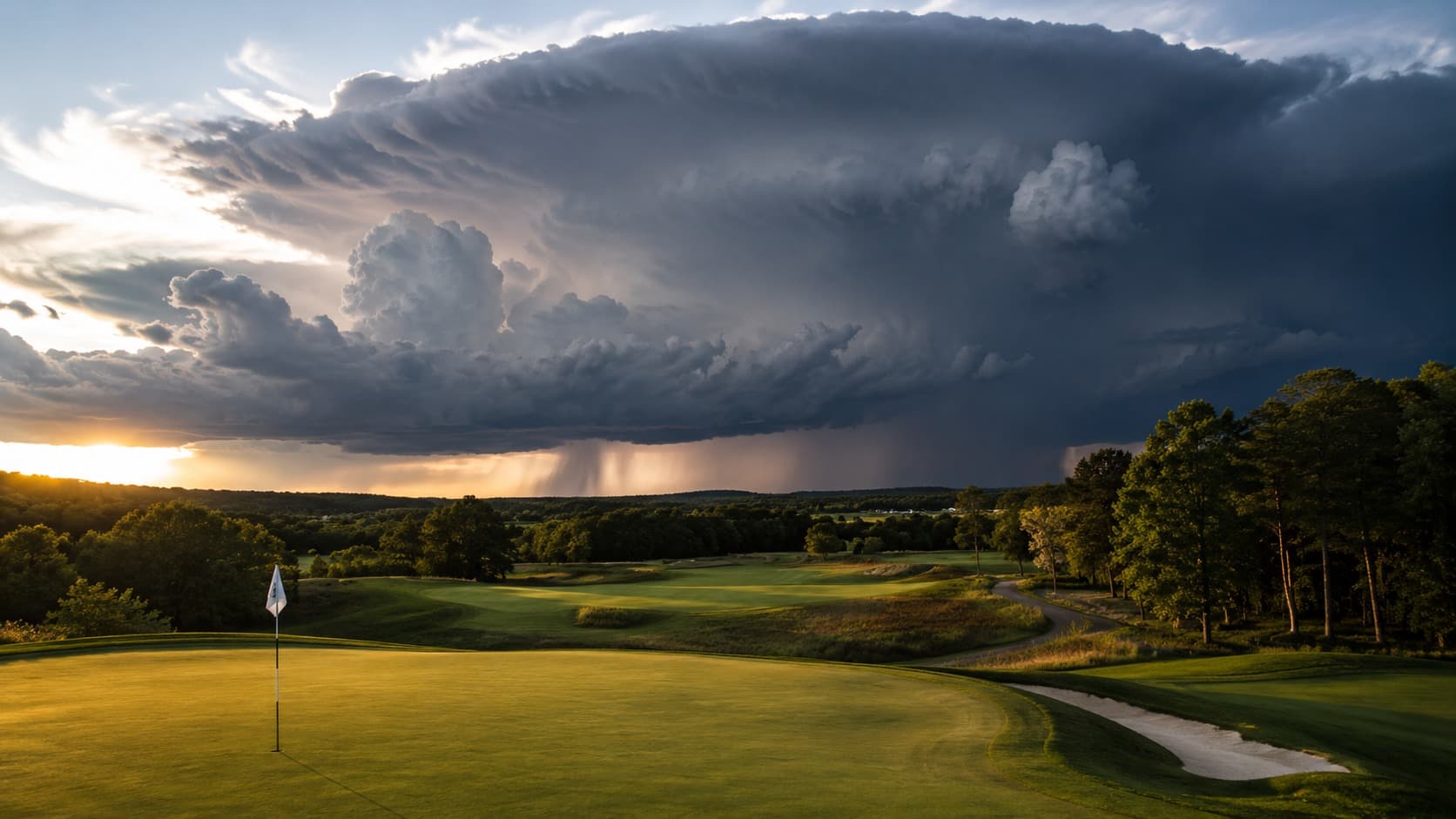
The Three O’Clock Storm: Reading Summer’s Convective Cycle to Protect Your Round
A 40% chance of afternoon thunderstorms does not mean a 40% chance of getting rained on. In the summer convective season it means the morning is nearly clear and the afternoon carries a fast-building, high-energy storm risk driven by a daily heating cycle. Here is the meteorology behind the pattern, the G-Score data on how the storm cycle punishes afternoon tee times across the Southeast, Midwest, and desert Southwest, the lightning-safety decision tree that actually matters, and the workflow that gets you off the course before the first bolt.
Read Story
How to Read a G-Score: The 0–100 Golf Playability Number, Decoded
A G-Score on this site is a single 0–100 number that tells you whether today is worth tee-up. Here is exactly what each band means, what drives the calculation, and how to use it to plan a round you will actually score on.
Read StoryMinSu Kim
Founder & Golf Data Analyst
MinSu is a data analyst and golfer with 10+ years on the course. He built Golf Weather Score to answer one question: is today a good day to play? He combines weather data, course intelligence, and the proprietary G-Score algorithm to help golfers make smarter decisions.
Every Friday Morning
When Cedar Chase Golf Club plays best next weekend.
Friday 6am ET: peak G-Score windows for Cedar Chase Golf Club, wind direction by hour, and one gear call. Three minutes to read, save you the round.
One email a week. Unsubscribe in one click.
The Caddie's Oracle
Draw your luck before the tee off