
Caddie's Gear Advisor
Curated for today's 73°F · Clear
Tour-Level Drivers
Engineered for maximum distance and forgiveness
Laser Rangefinders
Pin-seeking technology for precision approaches
Premium Golf Balls
Tour-caliber spin and distance performance
Performance Sunglasses
Polarized lenses optimized for reading greens
Your Golf Trip, Handled
The Ultimate Golf Trip Planner
Everything you need to play Cedarwood Country Club — from booking your flight to checking in course-side.
Course-Side Stays
Luxury hotels, resorts, and stay-and-play packages just minutes from the first tee.
Flights
Compare fares across 700+ airlines for the best route to your tee time.
SUV Rentals for Golf Bags
Spacious vehicles with room for clubs, bags, and your foursome.
Travel Insurance
Coverage for medical, weather delays, and gear at your destination.
Cedarwood Country Club: Course Intelligence
Signature Setup
Charlotte golf lives and dies by the humidity, and the par-4s here are where you feel it first. I haven't played Cedarwood Country Club myself, so I'll keep the playing notes honest from the opening line — what follows leans on the Carolina Piedmont's terrain and Charlotte's long weather record, not a card I signed. What I can map for you is the setting. Cedarwood is a mid-century parkland club on the eastern side of Charlotte, set in the rolling clay-soil Piedmont where the land moves in gentle swells and mature hardwood and pine frame nearly every corridor. On a course like this the defense isn't ocean wind or links contour — it's tree-lined doglegs, a thick summer air that kills carry, and greens that change personality between the wet winter and the baked-firm July. Reading that seasonal swing is where the strokes hide.
Hole-by-Hole Wind & Playing Lines
I'd rather give you terrain logic than invent yardages I can't stand behind.
The #1-handicap par-4 (~440y): Picture a long two pointed into Charlotte's prevailing summer south-to-southwest drift coming up off the Catawba River basin. The heavy, humid air already shaves a few yards off your carry, and into the breeze this hole plays every inch of its length. Skip the hero line over the dogleg trees; a ball in the wide part of the fairway leaving a full 6- or 7-iron beats a wedge punched out from under the pines.
The elevated signature par-4: As the hole bends back to a raised green, the crosswind swirls where the corridor opens above the treeline. On a gusty pre-storm afternoon, club up and aim into the wind's edge instead of floating a high approach that the gust drags off the firm Bermuda surface.
The short scoring par-3: Parkland clubs of this vintage almost always hide one tempting one-shotter. On a dead-calm, soaked spring morning the ball won't release on slow greens, so trust the number and fire at the fat of the green rather than flirting with a tucked pin you can't hold.
Green & Fairway Characteristics
This is Bermuda country, and the fairways tell the season. Through the Carolina summer the turf bakes firm and tight, handing back real rollout on the downhill lines — what you carry is not all you get from June into September. The greens, overseeded for cool-season speed, quicken into the upper-120s where the slope tips, and anything above the cup runs away on a dry, fast afternoon. The bigger swing is the winter shoulder: from December into February the grain goes dormant, the surfaces turn slow and patchy, and the clay soil holds water after rain so the fairways give back nothing. Plan for two different golf courses depending on the month.
Seasonal Weather Pattern
Charlotte sits in a humid-subtropical band, which means year-round play but sharply different conditions. Mid-summer (Jul–Aug) climbs near 90°F under heavy humidity, with afternoon thunderstorm cells firing as the heat peaks — so the firm, scorable air is the still early morning before the build-up. Autumn (Sep–Oct) is the local prime: mornings around 60°F, firm ground, and the steadiest, driest air of the calendar. Winter (Dec–Feb) rarely freezes the course out, but daytime highs in the low 50s, dormant Bermuda, and frequent rain leave the turf soft and slow. Spring (Mar–Apr) thaws back open damp, with a chilled ball flight on cool mornings that quietly costs you a club.
Local Play Tips
The real edge on a Piedmont parkland course is timing the humidity and the storm clock, not the thermometer. From July through August the move is the first tee time of the day — the air is calmer, the greens hold their overnight speed, and you finish before the afternoon convection rolls in. When I want firm and true, the play on a layout like this is a mid-morning October slot after a dry autumn week has set the Bermuda. And in winter, call ahead: after a soaking Carolina rain the clay fairways stay cart-path-only for days, and dormant greens putt nothing like the summer surface you remember.
Pre-Round Weather Workflow
Before you book, read the 7-day G-Score, and on this course weight two inputs over temperature: afternoon storm probability (book a morning slot and stay ahead of the summer convection) and recent rainfall (soaked clay means no roll — club up on every uphill approach). Lean on the windExposure read for the two holes the weather rewrites — the elevated signature par-4 and the long uphill #1-handicap — because a gusty pre-storm afternoon turns a routine approach into a one-club-more call on both. In the wet winter and early-spring windows, plan for slow greens and zero fairway roll; from June through October, expect the firmest turf and the truest speed of the year.
Related Reading
Before you tee off at Cedarwood Country Club

The May 2026 G-Score Heatmap: Where American Golf Peaks This Spring
May is the most underrated month on the American golf calendar. Five regions hit their annual peak this spring, three turn quietly hostile, and the data tells a clearer story than the brochures. Here is where to play, where to avoid, and how to time your booking window.
Read Story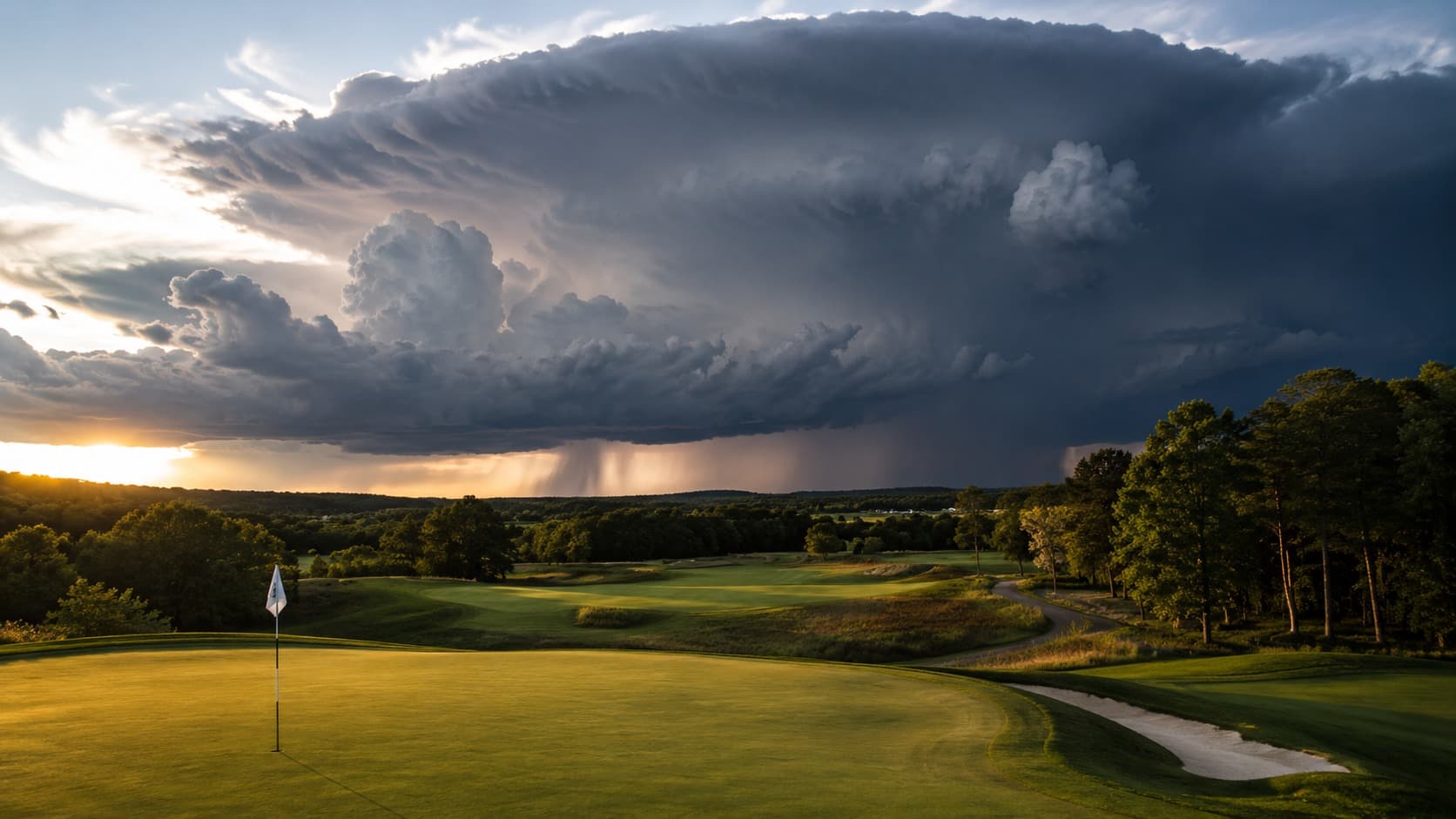
The Three O’Clock Storm: Reading Summer’s Convective Cycle to Protect Your Round
A 40% chance of afternoon thunderstorms does not mean a 40% chance of getting rained on. In the summer convective season it means the morning is nearly clear and the afternoon carries a fast-building, high-energy storm risk driven by a daily heating cycle. Here is the meteorology behind the pattern, the G-Score data on how the storm cycle punishes afternoon tee times across the Southeast, Midwest, and desert Southwest, the lightning-safety decision tree that actually matters, and the workflow that gets you off the course before the first bolt.
Read StoryMinSu Kim
Founder & Golf Data Analyst
MinSu is a data analyst and golfer with 10+ years on the course. He built Golf Weather Score to answer one question: is today a good day to play? He combines weather data, course intelligence, and the proprietary G-Score algorithm to help golfers make smarter decisions.
Every Friday Morning
When Cedarwood Country Club plays best next weekend.
Friday 6am ET: peak G-Score windows for Cedarwood Country Club, wind direction by hour, and one gear call. Three minutes to read, save you the round.
One email a week. Unsubscribe in one click.
The Caddie's Oracle
Draw your luck before the tee off