
Caddie's Gear Advisor
Curated for today's 77°F · Clouds
Tour-Level Drivers
Engineered for maximum distance and forgiveness
Laser Rangefinders
Pin-seeking technology for precision approaches
Premium Golf Balls
Tour-caliber spin and distance performance
Performance Sunglasses
Polarized lenses optimized for reading greens
Your Golf Trip, Handled
The Ultimate Golf Trip Planner
Everything you need to play Celebration Golf Club — from booking your flight to checking in course-side.
Course-Side Stays
Luxury hotels, resorts, and stay-and-play packages just minutes from the first tee.
Flights
Compare fares across 700+ airlines for the best route to your tee time.
SUV Rentals for Golf Bags
Spacious vehicles with room for clubs, bags, and your foursome.
Travel Insurance
Coverage for medical, weather delays, and gear at your destination.
Celebration Golf Club: Course Intelligence
Signature Setup
Celebration Golf Club opened in 1996 inside the Disney-developed town of Celebration, just south of Walt Disney World in Osceola County, Florida. It is one of the rare father-and-son collaborations in American golf: Robert Trent Jones Sr. routed it alongside his son Robert Trent Jones Jr., and the result is a par-72 layout of roughly 6,786 yards from the tips that leans on Florida's native materials — wetland, cypress, oak hammock, and standing water — rather than on raw length. Multiple tee sets bring it down under 5,000 yards. I haven't played Celebration in the dead of a Florida summer myself, so the playing notes below lean on published scorecard data and on what central-Florida golf consistently does to a round once the afternoon convection builds.
Hole-by-Hole Wind & Playing Lines
Central Florida sits on a low peninsula between the Gulf and the Atlantic, and through the warm months the daytime flow comes up out of the southeast as both sea breezes collide inland. That matters most on the longer two-shotters and the water-carry par-3s. On an SE afternoon, the longest par-4s play into it: a 150-yard approach becomes a 160–165-yard club, so take one extra and aim for the fat, dry side rather than flirting with the wetland edge where short-siding means a drop. The forced carries over wetland and cypress are the teeth here — into a breeze off the water, a calm-morning 7-iron is suddenly a knock-down 6, and the ball that balloons comes up wet, not short of the green. On those carries I trust the back number over my eyes and take the club that covers the hazard with room to spare. On a rare still dawn the same holes give a stroke back. On crosswinds, bail to the wide side, never the water side.
Green & Fairway Characteristics
The greens and fairways are bermuda, which in central Florida means grain — and lots of it. Bermuda putts break toward the setting sun and toward the lowest water on the property as much as they break with the contour, so read the grain first and the slope second; a downgrain four-footer can run out twice as far as you expect. By midday the surfaces firm and speed up, so a morning round holds approaches far better than a 2 p.m. one, when the ball releases hard off the front. The fairways are generous off the tee but the trouble is lateral: wetland, water, and bunkering pinch the landing zones, so the premium here is position and angle into the green, not length. Expect the back nine to demand the more precise approaches.
Seasonal Weather Pattern
This is a winter-peak Florida course. December–February delivers the postcard days: highs in the low-to-mid 70s, dawn starts in the low 50s, so the ball flies a touch shorter off cold-morning contact until it warms — expect 5–8 fewer yards early. March–April is the dry, breezy stretch, comfortable and stable. June through September is the hard season: humid mornings near 90°F, then central Florida's signature afternoon thunderstorm cells, which build almost daily after about 1–2 p.m. — this stretch of I-4 corridor is among the most lightning-prone in the United States, and a course horn here is not a suggestion. October–November is the underrated window: warm, drier, and far calmer than the summer.
Local Play Tips
Two things the tee-time sites won't tell you. First, the summer storm clock is genuinely strict — courses along the Orlando corridor clear the property fast when lightning detection trips, so a 2 p.m. June slot can become a half-round refund rather than 18 holes; book the earliest tee you can get from June through September. Second, because the greens are grainy bermuda sitting low against standing water, late-summer aerification and overseed timing shift the surfaces noticeably — call the pro shop before you drive out in early fall to confirm greens condition rather than assuming the conditioning you'd find in winter. Reading these greens, I never trust the slope alone; I plan for downgrain release toward the water and land approaches short of any back pin.
Pre-Round Weather Workflow
Use the 7-day G-Score on this course page to lock your tee time. Two checks: (1) wind direction and speed — an SE reading above ~12 mph means add a club on every approach and plan bail-outs to the dry side, away from the wetland carries; (2) the afternoon convective risk in the warm season — if storm probability climbs after 1 p.m., take the earliest slot available, because a delay here often ends the round entirely. The windExposure flag trends higher on summer afternoons; a dawn G-Score will typically run well ahead of the same day's 2 p.m. number. Bottom line: at Celebration, the right tee time saves you more strokes — and more whole holes — than the right club.
Related Reading
Before you tee off at Celebration Golf Club
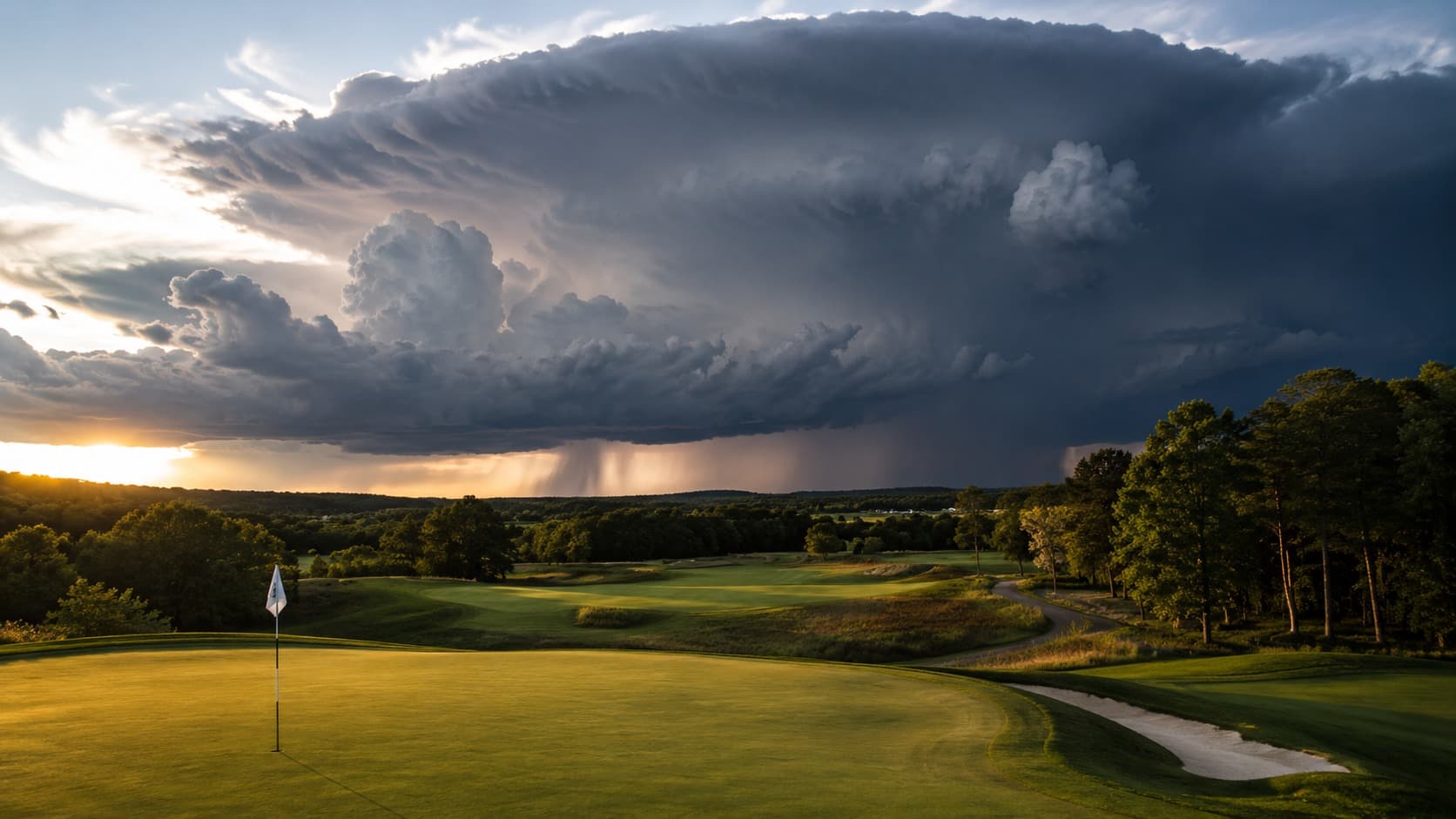
The Three O’Clock Storm: Reading Summer’s Convective Cycle to Protect Your Round
A 40% chance of afternoon thunderstorms does not mean a 40% chance of getting rained on. In the summer convective season it means the morning is nearly clear and the afternoon carries a fast-building, high-energy storm risk driven by a daily heating cycle. Here is the meteorology behind the pattern, the G-Score data on how the storm cycle punishes afternoon tee times across the Southeast, Midwest, and desert Southwest, the lightning-safety decision tree that actually matters, and the workflow that gets you off the course before the first bolt.
Read Story
How to Read a G-Score: The 0–100 Golf Playability Number, Decoded
A G-Score on this site is a single 0–100 number that tells you whether today is worth tee-up. Here is exactly what each band means, what drives the calculation, and how to use it to plan a round you will actually score on.
Read StoryMinSu Kim
Founder & Golf Data Analyst
MinSu is a data analyst and golfer with 10+ years on the course. He built Golf Weather Score to answer one question: is today a good day to play? He combines weather data, course intelligence, and the proprietary G-Score algorithm to help golfers make smarter decisions.
Every Friday Morning
When Celebration Golf Club plays best next weekend.
Friday 6am ET: peak G-Score windows for Celebration Golf Club, wind direction by hour, and one gear call. Three minutes to read, save you the round.
One email a week. Unsubscribe in one click.
The Caddie's Oracle
Draw your luck before the tee off